This article was automatically translated from the original Turkish version.
+2 More
Original Name(s) | The Love Potion | ||||||||
|---|---|---|---|---|---|---|---|---|---|
Location | De Morgan Foundation Collection | ||||||||
Signature | EDeM 1903 | ||||||||
Movement | Symbolism | ||||||||
Technique | Oil on canvas | ||||||||
Year of Production | 1903 | ||||||||
Artist | Evelyn De Morgan | ||||||||
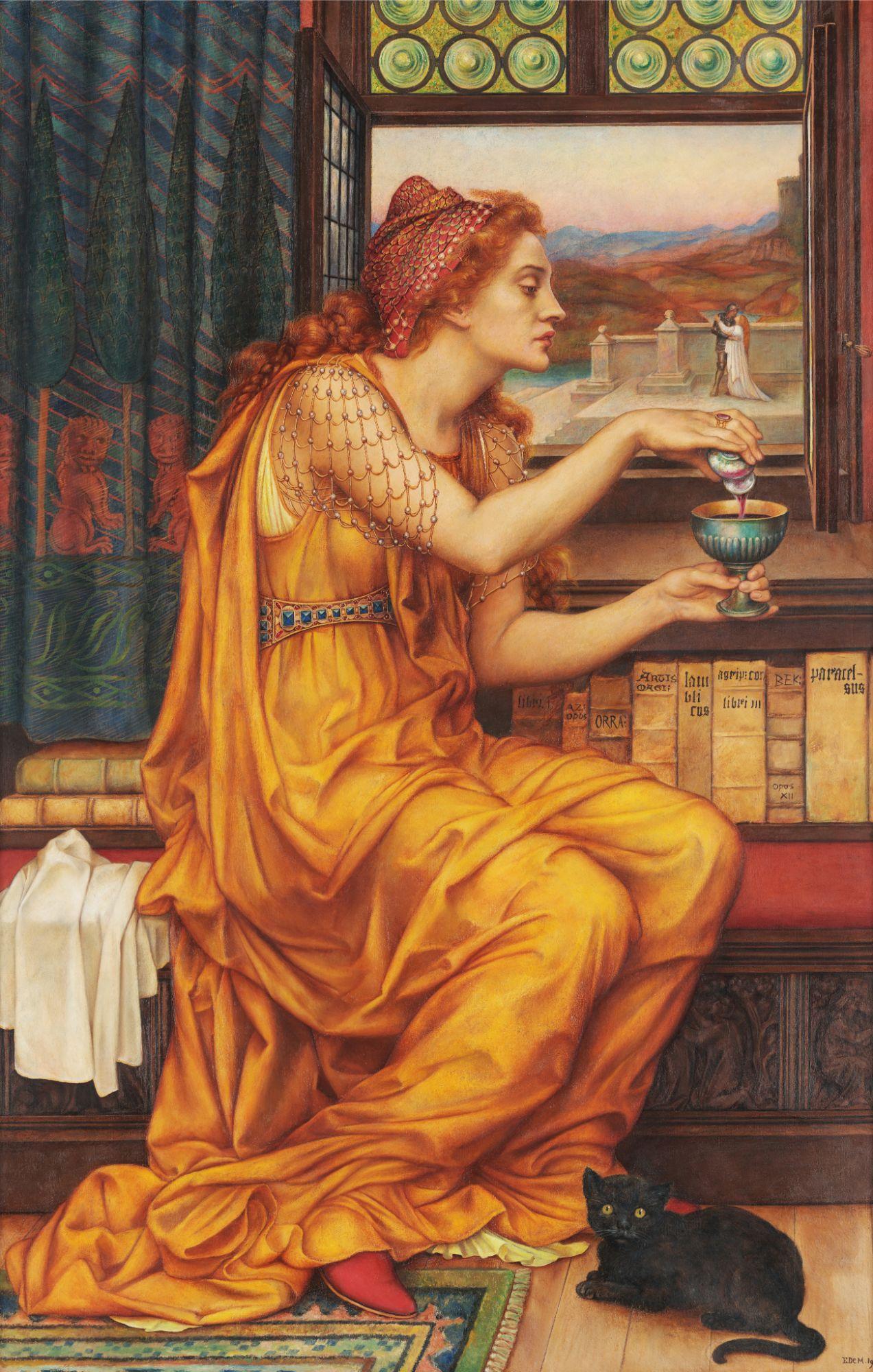
The Love Potion, an oil painting completed in 1903 by the British artist Evelyn De Morgan, is one of her later works that brings together themes of alchemy, the female figure, and the production of knowledge. The painting is currently part of the collection of the De Morgan Foundation.
The work is dated to Evelyn De Morgan’s mature period and was created during a phase in which her symbolic artistic language became more pronounced. Spiritualism, alchemy, and esoteric currents that gained popularity in England at the end of the 19th century and the beginning of the 20th century shaped the intellectual context in which the painting emerged. The Love Potion is regarded among De Morgan’s works that portray the female figure not as a passive subject but as an active, knowledgeable, and creative agent.【1】
The artist positioned the female figure in her works as strong, intellectual, and creative, challenging the limitations faced by Victorian women artists. Evelyn and her husband William De Morgan participated in social movements supporting women’s suffrage and signed the 1889 Declaration for Women’s Suffrage.
The painting was executed in oil on canvas. The color palette consists predominantly of dark and saturated tones, reinforcing the enclosed and intense atmosphere of the interior scene. The table in front of the figure, along with glass vessels and metal objects, is rendered in meticulous detail, with careful attention paid to the depiction of material textures. The use of light focuses on the figure’s face and hands, directing the viewer’s attention toward the action taking place.
The colors used in the painting are based on Paracelsus’s alchemical color system. In this system, black represents material death and sin, white signifies the beginning of purification, red stands for the process of transition, and yellow symbolizes spiritual enlightenment and salvation, represented by gold. The figure’s golden-yellow garment symbolizes the final stage of the alchemical process, namely spiritual wholeness.
The painting depicts a solitary female figure within an interior setting, preparing a potion among various bottles and vessels. The figure does not make direct eye contact with the viewer; her attention is entirely focused on the task she is performing. The composition is balanced around the relationship between the figure and the table. The minimal background places the action itself at the center of the narrative.
The pair of figures visible through the window in the background function as a symbolic element within the work. This scene alludes to the alchemical theme of the “union of opposites” (coniunctio oppositorum). A symbolic connection is established between the woman’s individual inner journey and this scene of union.
The Love Potion draws attention for addressing the alchemical themes of transformation and the pursuit of knowledge through the depiction of a female figure. In academic interpretations, the figure is viewed not as a “witch” or “sorceress” stereotype but as an intellectual and experimental subject.【2】 This approach offers an alternative representation of how women were associated with knowledge and scientific practices after the Victorian era. In this regard, the painting is understood as part of Evelyn De Morgan’s effort to redefine female identity within a symbolist framework.
The bound books on the shelves are attributed to thinkers such as Paracelsus, Agrippa von Nettesheim, and Iamblichus, who shaped Renaissance alchemical and esoteric thought. These figures were frequently referenced within the spiritualist movement. Additionally, one of the books, titled “A–Z Opus,” represents the universal spirit (Azoth), indicating that the figure’s transformation is not merely chemical but also metaphysical.【3】
The woman’s solitude, intense concentration, and the scholarly atmosphere surrounding her distance her from the traditional image of the female sorceress. Evelyn De Morgan positions this figure as a “Chymical Scholar,” transforming the woman into a subject who produces knowledge.
De Morgan Foundation. "The Love Potion." demorgan.org. Accessed January 16, 2026. https://www.demorgan.org.uk/collection/the-love-potion/
Gannon, Corinna. “Evelyn De Morgan’s Female Alchemist in *The Love Potion*: A Figurehead for the Female Artist.” *University of Toronto Art Journal* 6, (2018): 56-79. Accessed January 16, 2026. https://jps.library.utoronto.ca/index.php/UTAJ/article/view/28313
Google Arts & Culture. "The Love Potion." Google Arts and Culture. Accessed January 16, 2026. https://artsandculture.google.com/story/IwVxWppU2AchKg
[1]
Google Arts & Culture, “Evelyn De Morgan The Love Potion,” Google Arts and Culture, Erişim: 16 Ocak 2026, https://artsandculture.google.com/story/IwVxWppU2AchKg
[2]
De Morgan Foundation, “The Love Potion,” demorgan.org, erişim: 16 Ocak 2026, https://www.demorgan.org.uk/collection/the-love-potion/
[3]
Corinna Gannon, “Evelyn De Morgan’s Female Alchemist in The Love Potion: A Figurehead for the Female Artist,” University of Toronto Art Journal 6 (2018): syf 61, https://jps.library.utoronto.ca/index.php/UTAJ/article/view/28313


Original Name(s) | The Love Potion | ||||||||
|---|---|---|---|---|---|---|---|---|---|
Location | De Morgan Foundation Collection | ||||||||
Signature | EDeM 1903 | ||||||||
Movement | Symbolism | ||||||||
Technique | Oil on canvas | ||||||||
Year of Production | 1903 | ||||||||
Artist | Evelyn De Morgan | ||||||||
No Discussion Added Yet
Start discussion for "Elixir of Love (Painting)" article
History
Technical Features
Subject and Composition
Iconography and Cultural Impact