


This article was automatically translated from the original Turkish version.
+2 More
Electrostatic Discharge (ESD – Electrostatic Discharge) is the sudden and uncontrolled transfer of electric charge between two objects with different electrical potentials. This phenomenon typically occurs as a result of physical processes such as triboelectric charging (charging by friction), induction (charge separation due to a nearby electric field), and corona discharge (ionization of insulating materials like air due to high electric field intensity).
When charged objects rapidly approach or come into contact, the potential difference discharges rapidly in the form of an arc (spark).
For example, a person walking on a carpet under conditions of 10% relative humidity can generate potentials up to 35,000 volts. Voltages above 3,500 V can cause a painful sensation, while those exceeding 8,000 V can produce visible arcs.
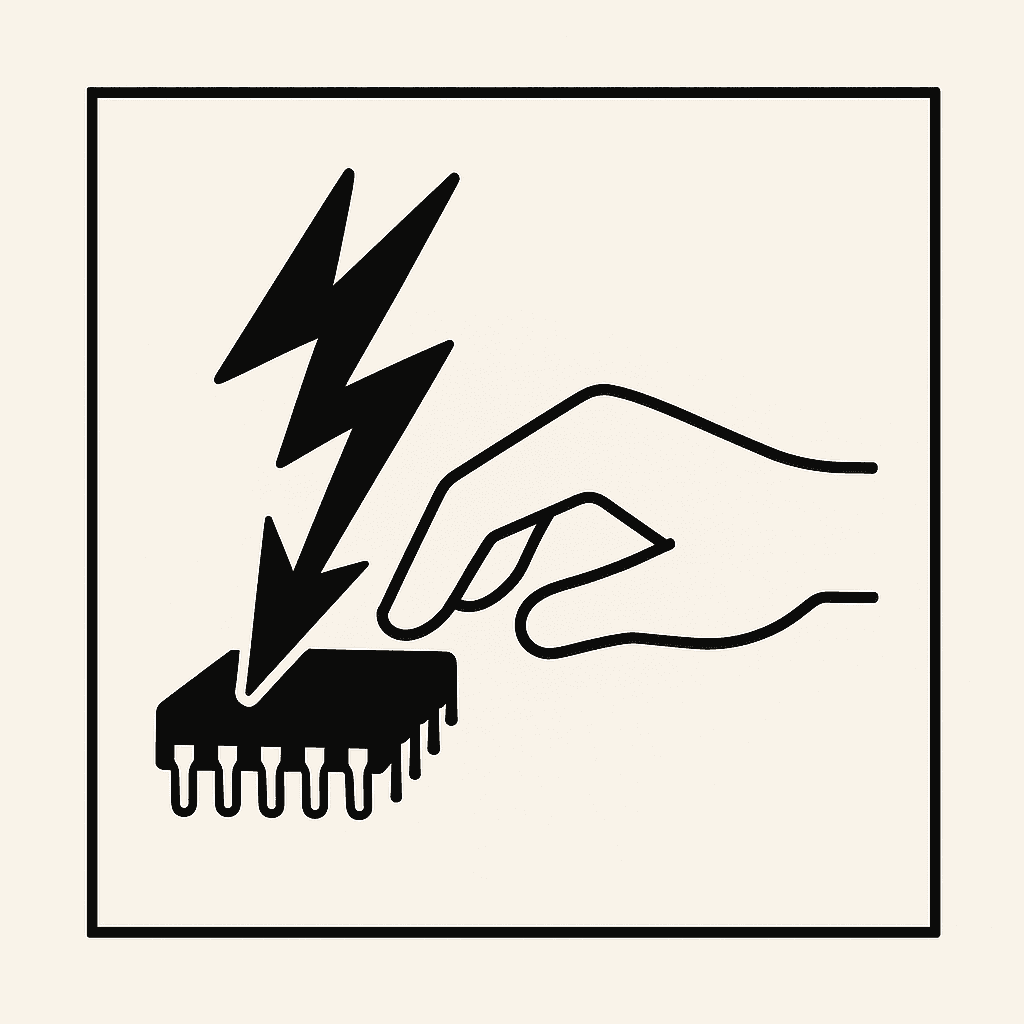
ESD Oluşumunu Temsil Eden Bir Görsel (Yapay Zeka İle Oluşturulmuştur.)
The formation of static electricity is classified into two main types:
The primary causes of charging are:
This charging generates a voltage (V) depending on the material’s capacitance (C) and the amount of accumulated charge (Q).
ESD causes serious damage especially in microelectronic circuits. For instance, CMOS integrated circuits can be damaged by exposure to as little as 250 V of ESD. In manufacturing environments, 30–50% of product failures are attributed to ESD. ESD events in the 5 V–100 V range can also cause permanent damage to microchips.
In the electronics manufacturing industry, annual losses due to defective product returns amount to approximately $4.5 billion USD.
A single damaged chip may result in a $5 loss; if mounted on a circuit board, the loss rises to $50; at the system level, it can reach $500; and if the faulty product reaches the field, repair costs can escalate to $5,000.
ESD occurs more readily in cold and low-humidity regions. For example, personnel in areas such as Alaska and Alberta wearing thermal protective clothing accumulate higher electrostatic charges. A person walking on polyethylene flooring in low humidity can become charged up to 12,000 V, while walking on handmade carpets can generate up to 35,000 V.
Measures taken against ESD include:
Aircraft in flight become subject to triboelectric charging through contact with ice crystals, rain, sand, and exhaust gases. External atmospheric fields also contribute to charge accumulation. These charges discharge via:
High-voltage charges can cause electromagnetic interference in radio and navigation systems. To mitigate this, static discharge wicks installed on aircraft allow controlled dissipation of charges into the atmosphere. In modern aircraft, where composite fuselage materials with low conductivity are increasingly used, conductive mesh structures are incorporated to safely distribute lightning current through the structure.
Akbulut, Furkan. "Uçaklar İçin Statik Elektrik Yükü Çökelme Durumunun İncelenmesi ve Yıldırım Çarpma Durumu Analizleri." Master's thesis, İstanbul Teknik Üniversitesi, 2023.
Başarır İnce, Filiz. "Statik Elektriğe Karşı Önlemler." Elektrik Mühendisliği Dergisi, no. 447 (Mayıs 2013): 42–45.
Burunkaya, Mustafa. "Statik Elektriğe Karşı Koruma için Güvenli Bir Topraklama Sistemi ve Antistatik Çalışma İstasyonunun Kurulması." Politeknik Dergisi 11, no. 2 (2008): 93–98.
Can, Sultan, and Asım Egemen Yılmaz. "Elektrostatik Boşalım İçin Etkin Bir Yaklaşım: ESD Koruyucu Giysi ve Önerilen Giysi Topolojisinin Performans Analizi." Gazi Üniversitesi Mühendislik-Mimarlık Fakültesi Dergisi 30, no. 2 (2015): 163–171.
Can, Sultan, and Asım Egemen Yılmaz. "Elektrostatik Yük Boşalımı: Elektronik Üretim Sektöründeki Etkileri ve Alınan Koruyucu Önlemler Üzerine Bir İnceleme." Gazi Üniversitesi Fen Bilimleri Dergisi Part C: Tasarım ve Teknoloji 3, no. 2 (2015): 443–455.

No Discussion Added Yet
Start discussion for "Electrostatic Discharge (ESD)" article
Sources of Static Electricity and Charging Mechanisms
Hazards and Effects of ESD
Environments Where ESD Accidents Occur
Protective Measures and ESD Control
Static Electricity and Lightning Risk in Aviation