


This article was automatically translated from the original Turkish version.
Electrocardiography (ECG) is a medical test that records the electrical activity of the heart. ECG measures and graphically records the electrical impulses generated with each heartbeat. This test is widely used to diagnose heart diseases, monitor rhythm abnormalities, and assess cardiac health.
The foundations of ECG date back to the late 19th century. In 1872, German physiologist Willem Einthoven developed the first device capable of measuring the heart’s electrical activity. Einthoven used this device to record the electrical signals of heartbeats and invented the ECG in 1903, for which he was awarded the Nobel Prize. The medical use of ECG began to spread widely in the early 20th century.
ECG records the heart’s electrical signals through electrodes placed on the skin. The heart muscle receives an electrical impulse before each contraction. These electrical signals are detected by the ECG machine and displayed as waves changing over time on a graph.
The ECG device detects electrical currents from the heart using electrodes. These electrodes are typically placed on different areas of the body (chest arms and legs). Different types of ECG exist depending on the number of electrodes; the most common is the 12-lead ECG, which provides a view of the heart’s electrical activity from multiple angles.
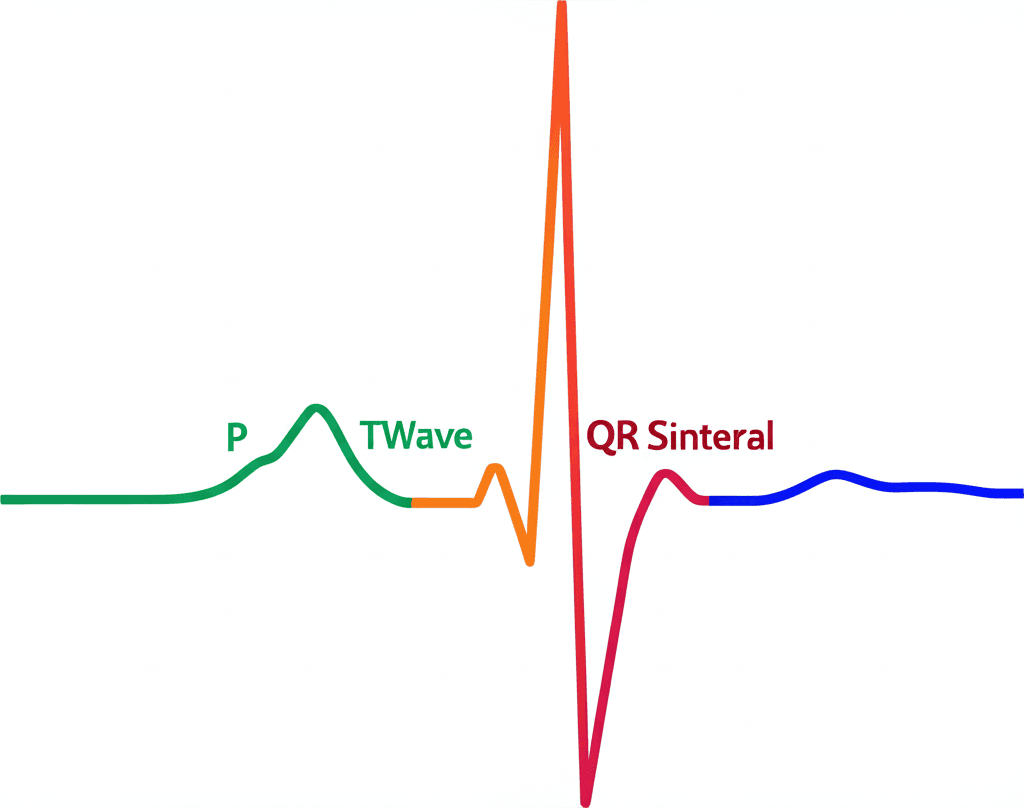
ECG Waves (Generated by Artificial Intelligence.)
The ECG tracing consists of four main waves:
Each of these waves corresponds to a specific phase of the heart’s electrical activity.
ECG is typically performed while the patient is in a resting position with electrodes placed on the body. During the test the patient must remain still and breathe normally. The ECG procedure is generally painless although mild discomfort may be felt at the sites where the electrodes are attached.
ECG is a vital tool in the diagnosis and monitoring of heart diseases. Some common applications include:
ECG results are typically interpreted by a cardiologist. A normal ECG shows waves occurring in a specific pattern and interval. However various abnormalities such as changes in wave morphology or altered intervals may indicate heart disease. Interpretation of ECG must be done in conjunction with the patient’s symptoms clinical condition and other test results.
American Heart Association, "What is an Electrocardiogram (ECG or EKG)?" Accessed June 14, 2025. https://www.heart.org/en/health-topics/heart-attack/diagnosing-a-heart-attack/electrocardiogram-ecg-or-ekg.
National Heart, Lung, and Blood Institute, "Heart Tests," Accessed June 14, 2025. https://www.nhlbi.nih.gov/health/heart-tests.

No Discussion Added Yet
Start discussion for "Electrocardiography (ECG)" article
History
Principle of Operation
ECG Waveform
ECG Recording
Applications
Interpretation
Important ECG Abnormalities
Advantages and Limitations