This article was automatically translated from the original Turkish version.
+1 More
Harput Kürsübaşı Culture and Music;Harput has held an important position throughout history as an economic, administrative and cultural center. The local population has sustained this cultural identity through various traditional gatherings and has produced and performed music in unique forms. In this context, especially during the winter months, the kürsübaşı assemblies held in homes and village rooms are one of the most significant elements of Harput culture.
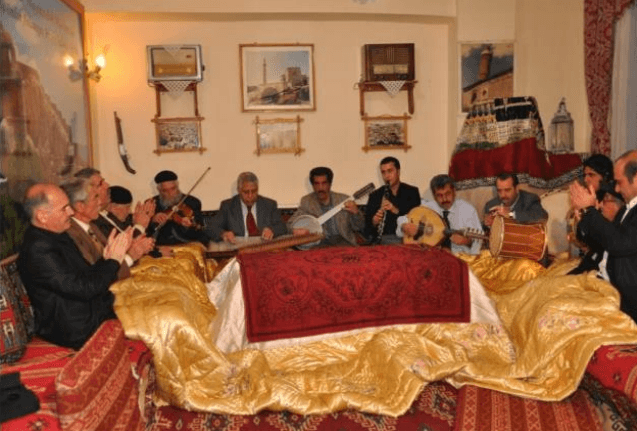
Kürsübaşı Tradition (TRT Archive)
Kürsübaşı gatherings were not merely social events centered on musical performance; they also functioned as forums for social education and cultural transmission. These meetings provided an environment in which religious, philosophical and heroic texts were read and interpreted, community issues were debated, and younger generations were educated in knowledge and etiquette.
Seating arrangements at kürsübaşı assemblies were determined according to the age and social status of participants; conversations typically began with the elderly and knowledgeable individuals and progressed toward the younger members. The gatherings also fulfilled social functions such as seeking solutions to community problems, facilitating reconciliation, and issuing rulings similar to court decisions. Additionally, passages from the Qur’an were recited and prayers were offered during the assemblies.
The kürsü is generally a square wooden table, approximately 50–60 cm high, with four legs. A circular hollow is carved in its center to hold a mangal. This mangal is made from a special mixture of sticky clay and straw and is placed precisely at the center of the kürsü. Charcoal burned on the mangal is fed using fire pokers called carıt, and covered with ash to ensure prolonged burning. This fire provides warmth to those gathered around the kürsü for 10 to 12 hours against the cold.
Special kürsü blankets are spread over the table; around it, sedirs, large cushions, soft seat pads and pillows are arranged. Participants tuck their feet under the blanket, pull it up to their chests for warmth and protection from the cold. The kürsü blanket and seating style are inseparable components of both physical comfort and social ritual.
Meals at kürsübaşı gatherings were prepared through a communal system known as püsün. Participants brought various foods or pooled money to arrange the evening meal. Especially during winter months, fruit püsün were prepared, with seasonal fruits collected and stored during summer served at the table. During kürsübaşı conversations, dried fruits, fruits, ayran, koruk and pomegranate sherbet were commonly served.
Harput music constitutes a distinct musical culture that differs from the classical Anatolian folk tradition, incorporating urban music influences and possessing its own unique maqams and rhythms. At kürsübaşı assemblies, instruments such as the violin, oud, clarinet, kanun, cümbüş, def and darbuka were commonly used. In the past, various traditional instruments such as the çığırtma, zurna, kaval, yaylı tambur, kopuz, ney, mey, kabak kemane and tar were also employed, though some of these are no longer in use today. Regional preferences for certain instruments have been observed in neighboring districts—for example, kaval and mey in Ağın, and zurna in Arıcak.
In kürsübaşı musical performance, a technique known as ayak tutma—producing vocal sounds resembling instrumental music—developed during periods when playing instruments was disapproved of or even considered sinful. As a result, kürsübaşı assemblies sometimes took place without instruments; music was directed and performed vocally.
During the gatherings, music was typically led by elderly participants with musical expertise. Performances began with the Harput Peşrevi (Paşa Göçtü), followed by gazel, hoyrat and kırık melodies. Gazels and hoyrats were recited by master performers, while kırık melodies were performed solo or in chorus. The repertoire was not predetermined but varied according to the collective knowledge of the participants. Care was taken to observe musical rules during maqam transitions, with guidance provided accordingly.
The maqams used in Harput music resemble those of Classical Turkish Music but are known by local names. For example:
Kürsübaşı assemblies were not merely spaces for music and conversation; they played a vital role in transmitting culture, historical knowledge, heroic tales, riddles, jokes, Sufi teachings and community issues from one generation to the next. These assemblies have been critical to the social cohesion and cultural continuity of the Harput people.
From the second half of the 20th century onward, the kürsübaşı tradition gradually began to be forgotten. It was notably revived during folkloric evenings organized in Istanbul by students from Elazığ between 1944 and 1959. Today, Harput music and kürsübaşı culture are being preserved and promoted through music museums and academic research.
Aydın, M., & Ünüvar, Ş. 2020. “Somut Olmayan Kültürel Miras Kapsamında Elazığ Kürsübaşı Geleneği (Elazığ Kürsübaşı Tradition in the Scope of Intangible Cultural Heritage).” *Journal of Gastronomy, Hospitality and Travel* 3 (2): 213–233. Accessed July 3, 2025. https://dergipark.org.tr/tr/download/article-file/1479757.
Cömert, E. 2024. *Elazığ-Harput Yöresi Kürsübaşı Musiki Meclisi Geleneğinin Oluşum ve Değişim Süreçlerinin İncelenmesi*. PhD thesis, 257 pp. Accessed July 3, 2025. .
Elazığ Kültür Portalı. "Kürsübaşı." Accessed July 3, 2025. https://kulturportali.gov.tr/turkiye/elazig/kulturatlasi/kursubasi#:~:text=Uzun%20kış%20gecelerinde%20Harputluların%20hemen,uyuşan%20insanlar%20bir%20topluluk%20oluştururdu.
Fırat Üniversitesi. "Harput Kürsübaşı." Accessed July 3, 2025. https://web.firat.edu.tr/harput/kursubasi.html.
YouTube. "Elazığ Kürsübaşı Geleneği." Accessed July 3, 2025. https://www.youtube.com/watch?v=rRGJUJv6ijE.
No Discussion Added Yet
Start discussion for "Elazığ Kürsübaşı Tradition" article
Characteristics of Kürsübaşı Assemblies
Kürsü and Physical Arrangement
Food and Hospitality Culture
Music and Instruments
Regional Maqams
Social and Cultural Function
The Current Status of the Kürsübaşı Tradition