
This article was automatically translated from the original Turkish version.
The expression “dark side of the Moon” is a popular but scientifically inaccurate term used to describe the lunar hemisphere that is never directly visible from Earth. Since all parts of the Moon’s surface receive periodic sunlight from the Sun, this region is not permanently dark. Therefore, the most accurate descriptions for this region are the “far side of the Moon” or the “back side of the Moon.”
In the history of astronomy, the Moon has been one of the most frequently observed celestial bodies by humanity. However, these observations have also given rise to certain conceptual misconceptions. One such misconception is the phrase “dark side of the Moon.” This term, applied to the lunar hemisphere invisible from Earth, is scientifically incorrect because both sides of the Moon receive sunlight.
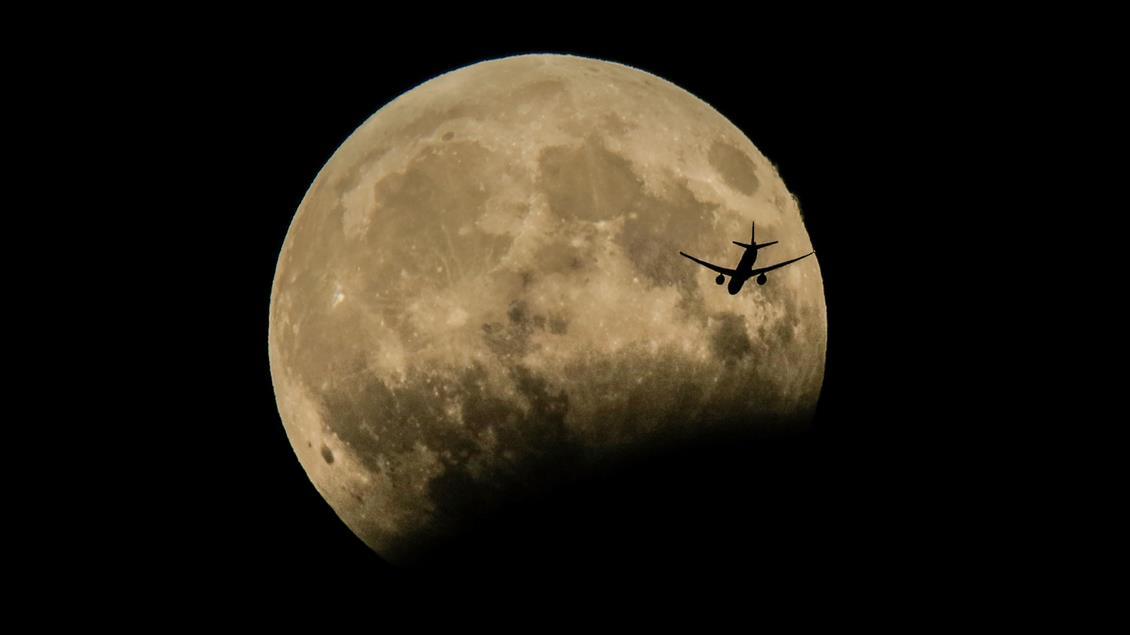
Partial Lunar Eclipse (AA)
The Moon’s rotation period around its own axis is nearly identical to its orbital period around Earth (approximately 27.3 days). This synchronization, known as “tidal locking,” causes the Moon to always present the same face toward Earth. As a result, the opposite hemisphere has never been directly observable from Earth. This phenomenon has led to the mistaken belief that the Moon’s far side remains perpetually dark.
In reality, both hemispheres of the Moon receive sunlight during specific phases of its orbit. During a full moon, the side facing Earth is fully illuminated while the far side is in darkness. Conversely, during a new moon, the far side—unseen from Earth—is bathed in sunlight. This clearly demonstrates the existence of day and night cycles on the lunar surface. Therefore, instead of the term “dark side of the Moon,” more neutral and scientifically accurate terms such as “far side,” “back side,” or “invisible side” should be used. Approximately 59 percent of the Moon’s surface becomes visible over time due to its non-circular orbit. Similar phenomena are observed with many satellites in the Solar System.
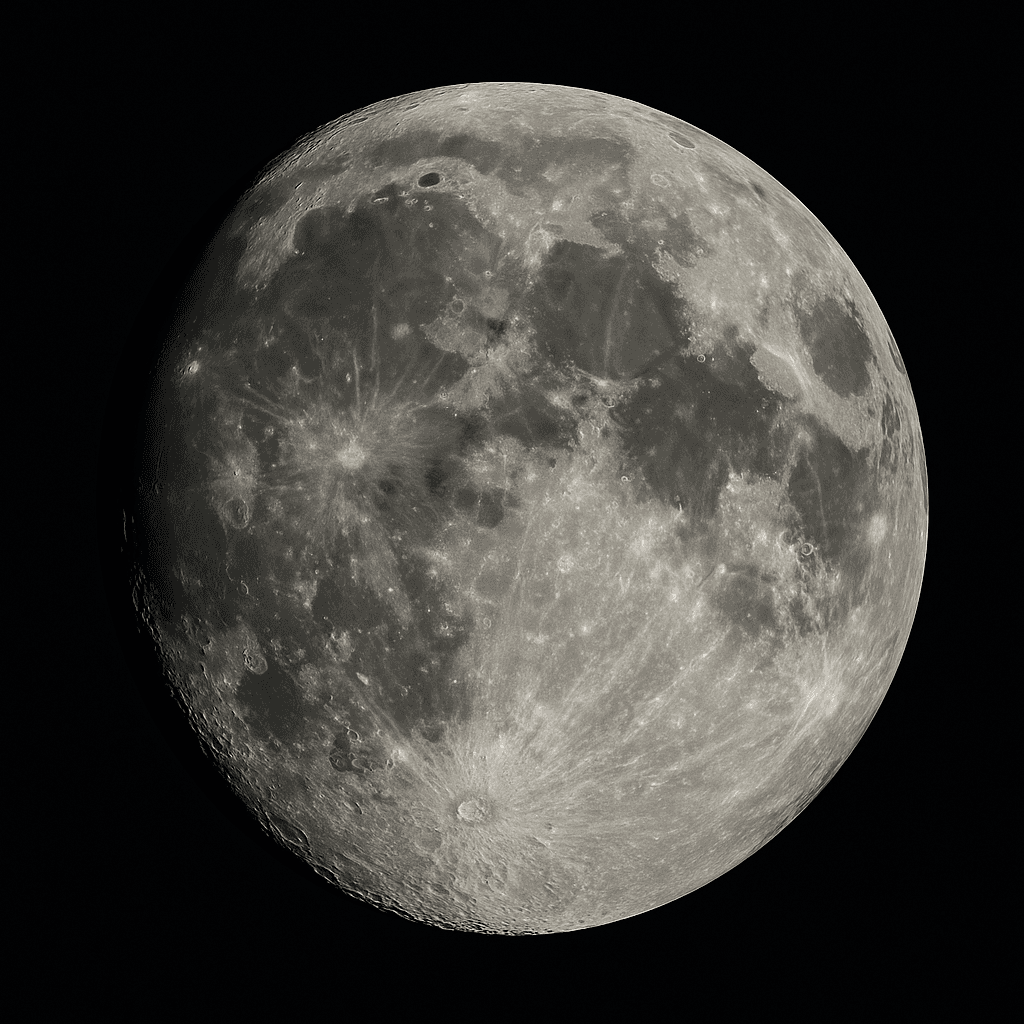
Surface of the Moon, Detailed View (Generated by Artificial Intelligence)
Commonly accepted descriptions state that the Moon orbits around Earth. While this simplification may suffice for educational purposes, it is physically incomplete. In reality, both the Moon and Earth orbit around a common point, their mutual center of mass, known as the barycenter. Due to the significant difference in mass between the two bodies, this barycenter lies much closer to Earth’s center.
Since Earth’s mass is approximately 81 times that of the Moon, the barycenter is located about 1,700 kilometers beneath Earth’s surface. As the Moon travels in an elliptical path around this point, Earth itself makes a small motion around the same center. This understanding provides a more accurate picture of the dynamics of the Earth-Moon system and is particularly important for astrophysical modeling.
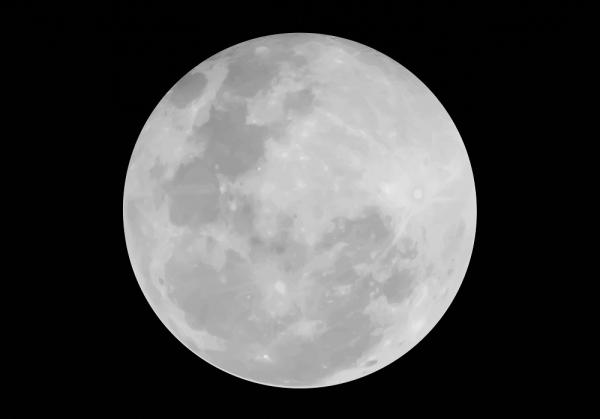
Full Moon (Science Young)
This phenomenon is not unique to the Moon but is observed with many planetary satellites. The cause lies in the strong gravitational tidal forces exerted by Earth. The gravitational pull of both the Sun and the Moon creates tidal effects not only in Earth’s oceans but throughout the entire planet. However, because land masses are much more rigid than oceans, the resulting deformation is far less pronounced.
A satellite initially shaped as a perfect sphere gradually becomes oval-shaped under the gravitational influence of its parent planet. Earth’s shape during tidal bulges is an example of this. One of the bulges always remains oriented toward Earth because this configuration represents the most stable state of the system. Consequently, our consistent view of the same lunar face and the occurrence of tides are excellent demonstrations of how gravitational forces affect planets and their satellites throughout the universe.
Anadolu Ajansı. “Süper Ay.” *Foto Galeri*, September 2, 2015. Accessed July 14, 2025. https://www.aa.com.tr/tr/pg/foto-galeri/super-ay.
Ocak, Mahir E. “Neden Ay’ın Hep Aynı Yüzünü Görürüz?” TÜBİTAK Bilim Genç, January 12, 2015. Accessed July 14, 2025. https://bilimgenc.tubitak.gov.tr/makale/neden-ayin-hep-ayni-yuzunu-goruruz.
Topal, Selçuk. “Güneş Sistemini Tanıyalım: Ay.” *TÜBİTAK Bilim Genç*, November 27, 2023. Accessed July 14, 2025. https://bilimgenc.tubitak.gov.tr/makale/gunes-sistemini-taniyalim-ay.
TÜBİTAK Bilim Genç. “Ay’ın Karanlık Yüzü Gerçekten Karanlık Değildir!” TÜBİTAK Bilim Genç, January 7, 2021. Accessed July 14, 2025. https://bilimgenc.tubitak.gov.tr/bunlari-biliyor-musunuz/ayin-karanlik-yuzu-gercekten-karanlik-degildir.
The Myth of the Moon’s “Dark Side”: Observational Limits and Reality
The Moon’s Invisible Side: Is It Really Dark?
Motion Around the Common Center of Mass of the Moon and Earth
Why Do We Always See the Same Side of the Moon?