This article was automatically translated from the original Turkish version.
Type of Geographical İndication | Traffic Sign | ||||||||
|---|---|---|---|---|---|---|---|---|---|
Registration Number | 170 | ||||||||
Registration Date | 22.02.2013 | ||||||||
Product / Product Group(s) | Cheeses | ||||||||
Province(s) | Diyarbakır | ||||||||
Applicant/Registrant(s) | Diyarbakır Chamber of Commerce and Industry | ||||||||
Diyarbakır örgü peyniri is a traditional cheese variety unique to the city of Diyarbakır in Türkiye’s Southeastern Anatolia Region, officially registered with a geographical indication. It was registered by the Diyarbakır Chamber of Commerce and Industry effective 15 February 2010 and officially recorded as a geographical indication on 22 February 2013. The registration type is a geographical indication and production is limited to the city of Diyarbakır and its districts.
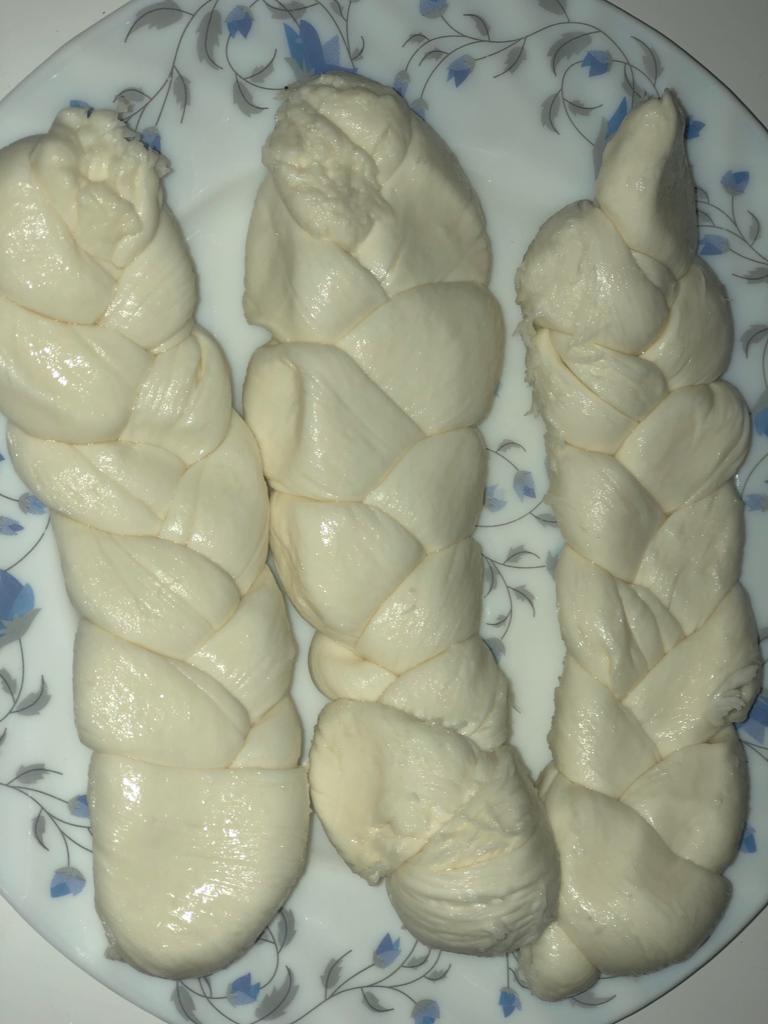
Diyarbakır örgü peyniri resembles white cheese in composition and kaşar cheese in production technology. It is distinguished by its high fat content, homogeneous and elastic structure, semi-hard texture, and unique taste and aroma. It is typically shaped in a braided form, which is its primary visual feature distinguishing it from other cheese types. Its color ranges from cream white to light yellow. It has a shiny, flexible surface that can be separated by hand into thread-like strands. Unlike kaşar cheese, it does not develop a rind, and unlike white cheese, it does not contain gas bubbles.
Its physical and chemical properties fall within the following ranges:
Diyarbakır örgü peyniri is traditionally produced in spring from fresh raw sheep’s milk. When sheep’s milk is unavailable, goat’s milk, cow’s milk, or mixtures of these may be used. The production process includes the following steps:
In alternative home production methods, fresh unsalted white cheese purchased from the market is softened in warm water, kneaded, braided, and then immersed in cold water to set its shape.
The cheese can be consumed fresh or aged in brine. It is placed in lacquered tin or plastic containers and covered with brine containing 10–12% salt. After sealing, it is aged for an average of 90 days at temperatures between +4 °C and +6 °C. Under suitable conditions, its shelf life can reach up to 12 months; at +2 °C, this period may be extended further.
The distinctive taste and aroma of the cheese originate from the local sheep breeds of Diyarbakır (Karakaş, Karacadağ Zom, İvesi) and the rich vegetation on which these animals graze. The region supports 534 plant species belonging to 269 genera across 66 families. This biodiversity directly influences milk quality and, consequently, the uniqueness of the cheese. Traditional knowledge and craftsmanship are integral to its production. In areas without refrigeration, the cheese is buried in the damp soil beneath north-facing trees during autumn and retrieved later, a method that deepens its flavor.
The product is monitored every six months by the Diyarbakır Provincial Directorate of Agriculture and Forestry, the Diyarbakır Chamber of Commerce and Industry, the Faculty of Veterinary Medicine at Dicle University, the Diyarbakır Food Control Laboratory, the Breeder Union of Sheep and Goats, and the Milk Producers Union. Additional inspections may be conducted in case of complaints. During inspections, the braided shape, taste, odor, color, saltiness, physical-chemical properties, packaging, and labeling compliance are evaluated.
Turkish Patent and Trademark Office. "Diyarbakır Örgü Peyniri Coğrafi İşaret Sicil Belgesi." Registration No. 170. February 22, 2013. Accessed October 23, 2025. https://ci.turkpatent.gov.tr/Files/GeographicalSigns/4cc1580b-ab43-4c72-9ad1-080b20329563.pdf.
Türk Patent ve Marka Kurumu. "Diyarbakır Örgü Peyniri." Coğrafi İşaretler Portalı. February 22, 2013. Accessed October 23, 2025. https://ci.turkpatent.gov.tr/cografi-isaretler/detay/38018.

Type of Geographical İndication | Traffic Sign | ||||||||
|---|---|---|---|---|---|---|---|---|---|
Registration Number | 170 | ||||||||
Registration Date | 22.02.2013 | ||||||||
Product / Product Group(s) | Cheeses | ||||||||
Province(s) | Diyarbakır | ||||||||
Applicant/Registrant(s) | Diyarbakır Chamber of Commerce and Industry | ||||||||
No Discussion Added Yet
Start discussion for "Diyarbakır Knitted Cheese" article
Distinctive Characteristics
Production Method
Aging and Storage
Geographical and Ecological Context
Monitoring