


This article was automatically translated from the original Turkish version.

Today, our relationship with technology has transformed from simple tool usage into a profound psychological invasion. The devices in our pockets are no longer merely communication channels; they are the sharpest gears in a vast “attention economy” that demands our focus, our time, and ultimately our inner peace. With every notification, our thoughts fragment; with every endless scroll, hours slip away unnoticed—compelling us to embrace the philosophy of digital minimalism, popularized by Cal Newport. This philosophy is an attempt to renegotiate the invisible, heavy contract modern humans have signed with technology, in favor of our own well-being.
Contrary to common perception, digital minimalism is not a wholesale rejection of technology or a retreat into a cave away from all digital possibilities. Rather, it is the art of integrating technology into our lives with extreme mindfulness and selectivity, guided by a clear higher purpose. Academic literature defines this condition not merely as simple “social media fatigue” but as a deep cognitive erosion. As recent research underscores, digital fatigue stems not from the total time spent in front of screens, but from the constant state of being kept in “response mode” and “readiness mode.”
This perpetual state of stimulation dulls the human brain’s millennia-old capacity for deep thought, trapping the individual in a barrage of superficial and fragmented information. Instead of focusing on a single subject, the mind becomes hyperactive, jumping from one stimulus to another. As a result, the illusion of being “informed” grows stronger, while the ability to delve deeply into topics and engage in critical reasoning weakens. Digital minimalism offers a mental hygiene to reclaim this scattered attention.
One of the greatest tragedies at this point is that the apps and platforms we use are not innocent tools of entertainment. These systems have been meticulously designed in laboratory conditions to exploit the most fundamental weaknesses of human psychology. The variable reward mechanisms of like buttons, the hypnotic effect of infinite scrolling, and the sense of urgency created by notifications are no accident.
As Jean M. Twenge’s research indicates, the central placement of smartphones in daily life has replaced genuine human connection with “fake socialization,” creating a chronic loneliness paradox among individuals. According to Newport’s philosophy, the true cost of every “free” service in the digital world is paid with our most precious and irreplaceable asset: our attention. Therefore, digital minimalism represents an active resistance—a shift from a passive system where algorithms make decisions on our behalf, to one where we reclaim control over our will and our time. This resistance means choosing long-term goals in real life over the instant gratifications offered by screens.
Superficial changes or short-term “detoxes” applied on weekends rarely produce lasting transformation. Thus, digital minimalism proposes a radical “cleansing” process. This involves setting aside all digital habits that are not absolutely essential for life or work for at least thirty days. However, as Tolga Akkuş notes in his book review of “Digital Minimalism,” this process is not merely a “digital diet.” Akkuş emphasizes that Newport’s approach is in fact a philosophical confrontation that forces the individual to rediscover their own values.
This thirty-day period is not a time of deprivation but an opportunity to rediscover how life unfolds without digital noise and artificial light. During this time, the mind, freed from the cheap and immediate dopamine rewards offered by screens, gradually returns to its natural rhythm. When a person overcomes the initial discomfort of solitude and the fear of “missing out” (FOMO), they begin to recognize how profoundly enriching real hobbies, deep engagements, and high-quality leisure time truly are. When hands move from phones to books, musical instruments, or physical creation processes—such as working with machine parts, writing code, or engaging with nature—the reconstruction of mental capacity begins. As Akkuş highlights, these practices do not merely reduce screen time; they cultivate a discipline of “slowing down” against the illusion of speed offered by technology.
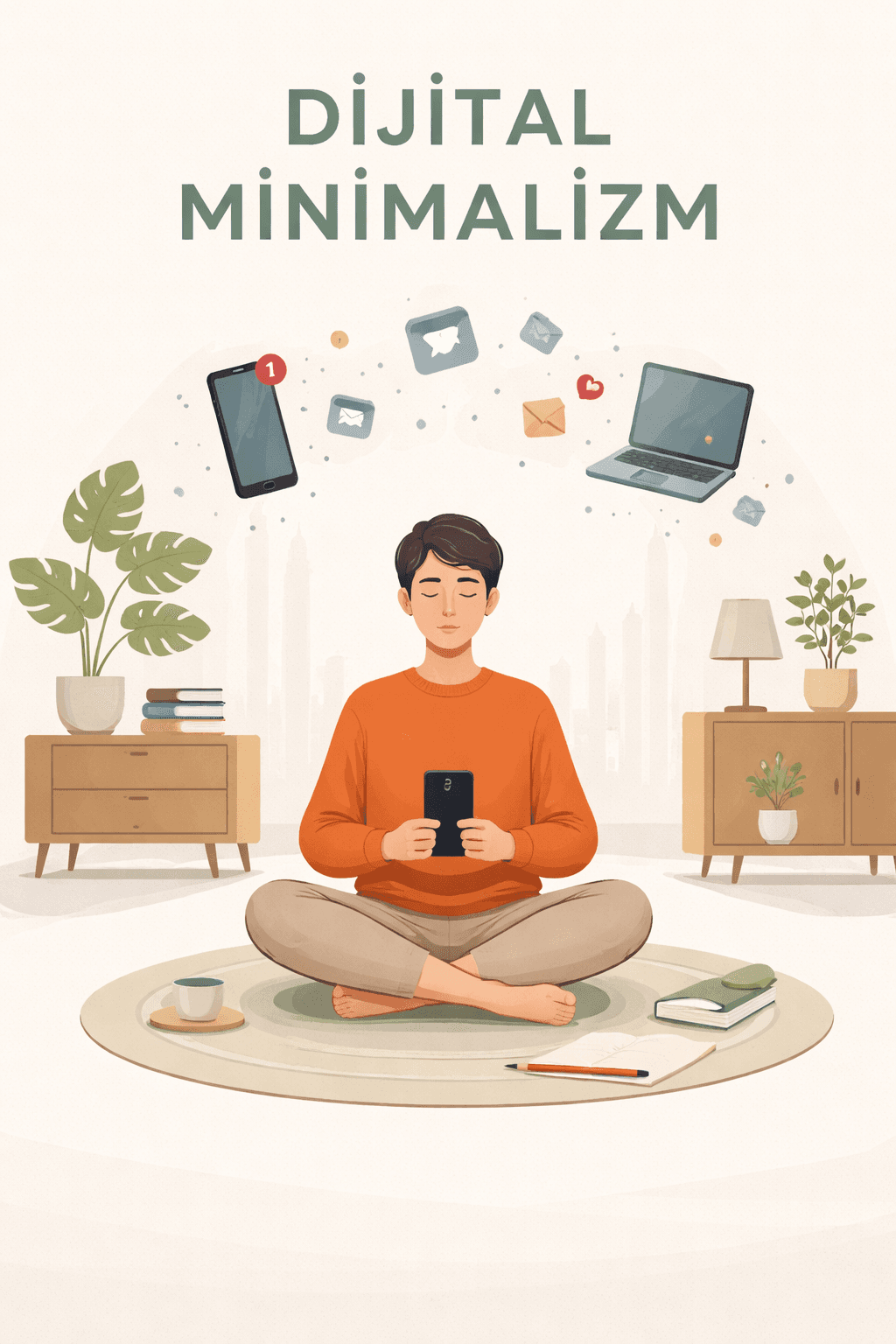
Generated by artificial intelligence.
At the end of the cleansing process, when rebuilding our relationship with technology from scratch, the fundamental question we must ask is not “Is this app somewhat useful?” Instead, we must center the question: “Is this app the most efficient means to support what matters most in my life?” Digital minimalism urges us to subject every tool we reintroduce, every notification setting, and every digital subscription to strict scrutiny. Merely being “useful” does not justify a technology’s permanent and unlimited presence in our lives.
What matters is not allowing technology to manage us according to its own agenda, but using it as a lever to advance our own human values and projects. Ultimately, accepting the loss of things in the glittering but fleeting world behind the screen—JOMO – Joy of Missing Out—is an act of courage: the courage to be fully present at the center of our own lives and realities. Digital minimalism is the greatest gift of freedom modern humans can give themselves and the compass for returning to the real world.
Akkuş, Tolga. “Dijital Minimalizm: Ekran Bağımlılığı ve Teknoloji Yorgunluğu Sarmalından Kurtulmak İçin Bir Yol Haritası.” TRT Akademi 07, no. 14 (2022): 452-457. Accessed March 24, 2026. https://dergipark.org.tr/tr/pub/trta/article/1064029
Twenge, Jean M. “Have Smartphones Destroyed a Generation?” The Atlantic, September (2017). Accessed March 24, 2026. https://www.theatlantic.com/magazine/archive/2017/09/has-the-smartphone-destroyed-a-generation/534198/
The Invisible Cost of Technology and the Anatomy of Cognitive Overload
The War of Will Against Algorithms and the Attention Economy
Digital Cleansing as a Mental Purification Experiment
A Value-Centered Transformation and the Reconstruction of a Quality Life