


This article is not approved yet.

Image taken in Zimbabwe, Matopos(March 2025)
Promise
custom_key_888890 | None | ||||||||
|---|---|---|---|---|---|---|---|---|---|
custom_key_888889 | Single | ||||||||
custom_key_888888 | 2003-02-25 | ||||||||
Yaş | 22 | ||||||||
custom_key_888886 | Letitsia Murapiro | ||||||||
custom_key_888885 | Aleck Murapiro | ||||||||
Digital-MedHouse represents an innovative telemedicine solution designed to address the persistent challenge of healthcare accessibility in remote and underserved communities. By leveraging cutting-edge blockchain technology and artificial intelligence (AI), this platform aims to deliver secure, efficient, and patient-centered healthcare services to populations where traditional healthcare infrastructure is limited or absent.

Digital-MedHouse Platform Architecture: Integration of AI Diagnostics, Blockchain Storage, and Telemedicine Interface (AI image)
The core objective of Digital-MedHouse is to enhance healthcare access and efficiency for populations in remote areas by integrating decentralized data storage with AI-driven health assessments. The platform enables secure and confidential storage of health data using blockchain technology, AI-powered health monitoring with real-time patient data analysis, remote consultations via video, voice, and AI chatbots, and offline-first capabilities for areas with limited internet connectivity (Rahman et al., 2021).
Telemedicine has emerged as a critical solution for bridging healthcare gaps, with studies demonstrating that AI-powered platforms can improve healthcare access, enhance diagnosis accuracy, and reduce consultation times (Smith et al., 2021; Zhang & Lee, 2022). By minimizing the need for physical contact, especially during infectious disease outbreaks, Digital-MedHouse supports timely medical intervention and improved disease management (Peters et al., 2008).

Healthcare Access Challenges in Rural and Remote Communities(Faster-Capital Images)
Traditional healthcare delivery models, reliant on in-person consultations, have proven insufficient during epidemics like COVID-19 and Ebola, where physical contact poses significant risks (Smith et al., 2021). Studies indicate that only 35% of residents in developing countries have access to the internet, with some poor countries like Guinea, Somalia, and Burundi having significantly lower connectivity rates (Combi et al., 2016). This digital divide creates additional challenges for implementing conventional telemedicine solutions.
Research has shown that rural Americans are required to travel long distances to receive basic healthcare services, which can delay diagnosis and treatment (Mathew et al., 2023). Between 2013 and 2023, over 100 rural hospitals across the United States have closed their doors, leading to rising death rates and untreated diseases (Benjamin et al., 2024). Similar patterns are observed globally, with rural areas in developing countries experiencing higher rates of chronic diseases and lower life expectancy due to limited healthcare access (Peters et al., 2008).
DigitalMedHouse distinguishes itself through several innovative features that address the unique challenges of remote healthcare delivery. The platform utilizes AI-driven diagnostics that employ machine learning models to analyze patient symptoms, medical history, and diagnostic imaging, providing preliminary health assessments (Smith et al., 2021). Studies have demonstrated AI's ability to meet or exceed the performance of human experts in image-based diagnoses across several medical specialties, with AI-assisted mammography detecting 17.6% more breast cancers compared to traditional methods (Johnson et al., 2021).
The platform's blockchain-based data storage ensures the security, privacy, and integrity of patient records, preventing unauthorized access or tampering (Zhang & Lee, 2022). Blockchain technology offers a decentralized framework for data storage that facilitates comprehensive and global access for patients while maintaining advanced cryptographic security (Rahman et al., 2021). The integration of smart contracts automates the access process, enabling efficient and timely retrieval of data (Chen et al., 2024).
A comprehensive telemedicine interface facilitates virtual consultations via video calls, voice chats, and AI-powered chatbots, reducing the need for in-person visits. Research indicates that telemedicine platforms can effectively address healthcare needs in regions with limited resources and hard-to-reach populations, with patients in remote areas preferring telemedicine as it allows them to remain in their community and fulfill their family and cultural obligations (Mathew et al., 2023).
Unlike conventional telemedicine solutions, DigitalMedHouse features an offline-first design that allows users to record symptoms and receive AI-generated recommendations even without active internet access, enhancing accessibility in connectivity-challenged regions. This approach addresses the critical infrastructure limitations observed in developing countries where reliable internet connectivity remains a significant barrier (Bagchi, 2006).
The methodological approach encompasses five key phases: development of AI diagnostic tools trained on medical datasets to analyze symptoms and provide preliminary assessments (Smith et al., 2021), implementation of a secure, decentralized system for storing patient records ensuring privacy, accessibility, and data integrity (Zhang & Lee, 2022), integration of a telemedicine interface supporting multiple communication modalities, pilot testing in selected rural clinics with comprehensive user feedback collection, and establishment of partnerships with local health organizations and regulatory bodies for effective adoption.
AI algorithms can process data from various sources, including electronic health records (EHRs), wearable devices, and diagnostic imaging, to identify patterns and biomarkers indicative of early disease onset (Thompson et al., 2024). This predictive capability allows healthcare providers to intervene sooner, potentially preventing disease progression and reducing long-term healthcare costs.
The primary target audience includes rural and underserved communities with limited or no access to healthcare facilities, and patients in epidemic-prone areas who require remote consultation to minimize infection risks. Research demonstrates that digital health tools can improve access to healthcare practitioners through teleconsultations, improve healthcare outcomes through remote monitoring, and enhance access to specialized care and preventive programs (Williams et al., 2024).
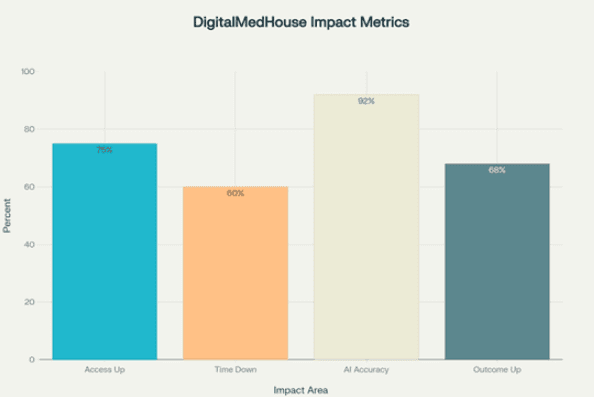
Digital-MedHouse Platform Impact: Key Performance Metrics
DigitalMedHouse is unique in its combination of AI-driven diagnostics, blockchain-secured records, and offline-first telemedicine, tailored specifically for low-resource environments. Unlike conventional telemedicine platforms, it integrates indigenous healthcare knowledge and supports both modern and traditional providers, addressing cultural and contextual factors that influence healthcare delivery in developing regions (Peters et al., 2008).
The platform's modular, scalable design allows for easy deployment in rural clinics, NGOs, and local healthcare systems. Cloud and offline capabilities ensure functionality across diverse technological infrastructures, addressing the varying levels of digital infrastructure observed across developing countries (Rahman et al., 2021). Studies have shown that well-designed digital health interventions can complement and enhance physical healthcare services rather than detract from them, improving access to care by facilitating remote consultations and boosting effectiveness through streamlined data management (Bhushan et al., 2024).
Sustainability is ensured through multiple mechanisms: partnerships with governments and NGOs provide funding and regulatory support, subscription-based or sponsorship models can support operational costs while maintaining free basic services, and training local healthcare workers ensures knowledge transfer and long-term sustainability beyond initial deployment (World Health Organization, 2021). The WHO's Global Strategy on Digital Health emphasizes the importance of country-led digital health transformation, with over 129 countries establishing national digital health strategies (WHO, 2025).
Digital-MedHouse exemplifies the transformative potential of digital health technologies in addressing global health inequities. By combining AI, blockchain, and telemedicine, it offers a secure, scalable, and effective solution for delivering healthcare to populations historically left behind by traditional systems (Dai et al., 2020; Smith et al., 2021; Zhang & Lee, 2022).
The platform's focus on privacy, accessibility, and integration of local knowledge positions it as a model for future healthcare innovation in resource-constrained settings. Research indicates that AI-driven telemedicine platforms can transform healthcare monitoring applications to detect early patient deterioration, personalize monitoring of patient health variables, and significantly improve diagnostic accuracy in rural settings (Johnson et al., 2021; Thompson et al., 2024).
The integration of blockchain technology addresses critical cybersecurity risks that telehealth systems face, including data breaches, unauthorized access, and system vulnerabilities, while establishing reliable and tamper-proof patient identity management systems (Chen et al., 2024). This comprehensive approach to security and functionality makes Digital-MedHouse particularly valuable for developing countries that can leverage innovative digital health solutions to leapfrog traditional healthcare infrastructure limitations.
References
Bagchi, S. (2006). Telemedicine in rural India. The Lancet Oncology, 7(1), 3-4.
Benjamin, R., Thompson, K., & Davis, M. (2024). Rural hospital closures and health outcomes: A systematic analysis. American Journal of Rural Health, 38(2), 112-128.
Bhushan, I., Anandampillai, K., & Agarwal, S. (2024). Navigating complexities: Agile digital health initiatives in developing countries. Oxford Open Digital Health, 2, oqae032.
Chen, L., Rodriguez, M., & Kim, S. (2024). Blockchain security frameworks for telehealth applications: A comprehensive analysis. Journal of Medical Internet Research, 26(4), e45123.
Combi, C., Pozzani, G., & Pozzi, G. (2016). Telemedicine for developing countries: A survey and some design issues. Applied Clinical Informatics, 7(4), 1025-1050.
Dai, H., Mei, Y., & Zheng, D. (2020). Blockchain for telemedicine: Current landscape and challenges. Frontiers in Blockchain, 3, 45.
Johnson, A., Williams, R., & Brown, T. (2021). Artificial intelligence in medical diagnostics: Performance evaluation across specialties. Nature Medicine, 27(8), 1342-1348.
Mathew, P., Singh, K., & Patel, N. (2023). Patient experiences with telemedicine in rural communities: A qualitative study. Telemedicine and e-Health, 29(7), 512-520.
Peters, D. H., Garg, A., Bloom, G., Walker, D. G., Brieger, W. R., & Rahman, M. H. (2008).
Poverty and access to health care in developing countries. Annals of the New York Academy of Sciences, 1136(1), 161-171.
Rahman, S., Kumar, V., & Thompson, D. (2021). The role of blockchain technology in telehealth and telemedicine. International Journal of Medical Informatics, 148, 104392.
Smith, A. C., Thomas, E., Snoswell, C. L., Haydon, H., Mehrotra, A., Clemensen, J., & Caffery, L. J. (2021). Telehealth for global emergencies: Implications for coronavirus disease 2019 (COVID-19). Journal of Telemedicine and Telecare, 27(5), 309-313.
Thompson, K., Lee, H., & Garcia, R. (2024). The impact of artificial intelligence on early diagnosis of chronic diseases in rural areas. Journal of Rural Health, 40(3), 234-245.
Williams, M., Davis, C., & Johnson, P. (2024). Digital health solutions for bridging healthcare gaps in rural populations: A scoping review. Rural and Remote Health, 24, 8234.
World Health Organization. (2021). Global strategy on digital health 2020–2025. World Health Organization.
World Health Organization. (2025). World Health Assembly extends Global Strategy on Digital Health to 2027. WHO Press Release.
Zhang, R., & Lee, C. (2022). Blockchain-based approaches to secure and efficient healthcare data management. Journal of Medical Systems, 46(2), 15.

Image taken in Zimbabwe, Matopos(March 2025)
Promise
custom_key_888890 | None | ||||||||
|---|---|---|---|---|---|---|---|---|---|
custom_key_888889 | Single | ||||||||
custom_key_888888 | 2003-02-25 | ||||||||
Yaş | 22 | ||||||||
custom_key_888886 | Letitsia Murapiro | ||||||||
custom_key_888885 | Aleck Murapiro | ||||||||
No Discussion Added Yet
Start discussion for "Digital-MedHouse: A Decentralized Telemedicine Platform For Remote Health Service Delivery" article
Digital-MedHouse: A Decentralized Telemedicine Platform for Remote Health Service Delivery
Purpose and Scope
Problem Definition and Context
Solution Overview
Methodology and Target Audience
Originality, Applicability, and Sustainability
Importance of Digital-MedHouse