


This article was automatically translated from the original Turkish version.
+2 More
Digital Divide is a concept that refers to the socio-economic and technical inequalities between those who have access to Information and Communication Technologies (ICT) and those who do not, as well as between those who can use these technologies effectively and those who cannot. This phenomenon was first discussed in the 1980s in relation to telephone access but gained importance from the late 1990s onward to describe inequalities in access to the internet and computer technologies.
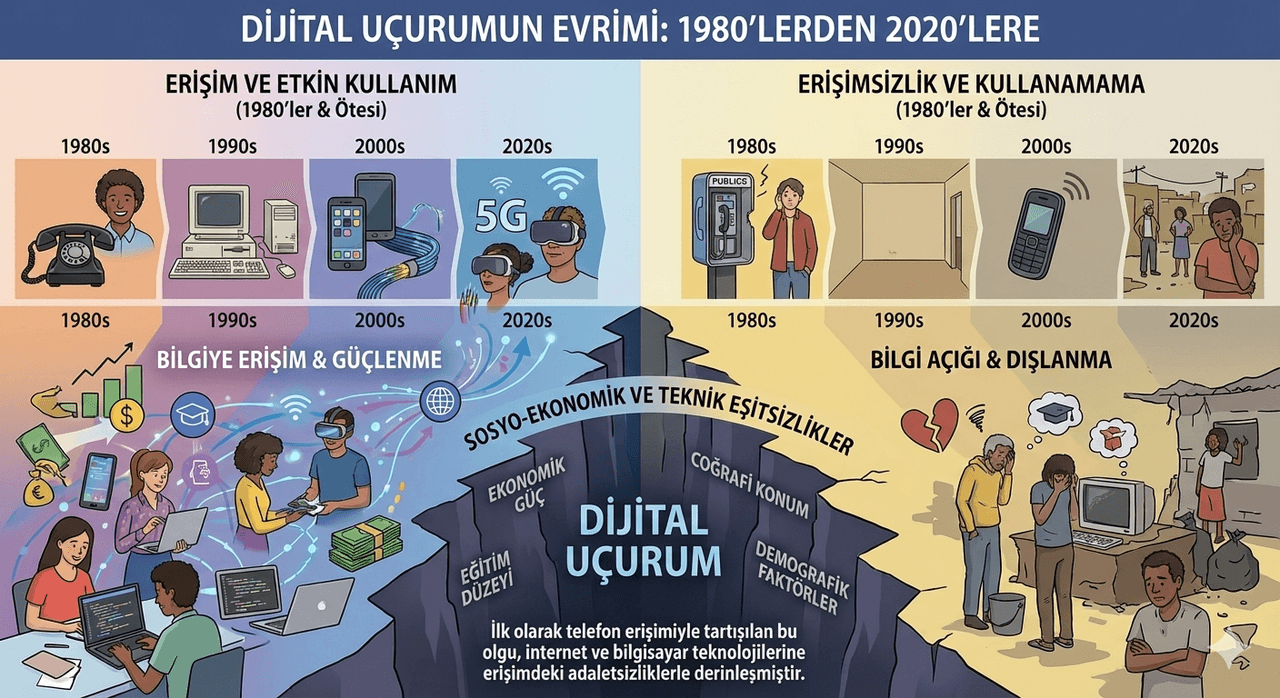
A Visual Representing the Digital Divide (Generated by Artificial Intelligence.)
This level defines the disparity between individuals and communities in their ability to access fundamental Information and Communication Technologies such as computers hardware software and the internet. Economic power is emphasized as the primary determinant of this level of the divide.
Analyses based on Gross National Income show that high-income countries and households possess infrastructure such as fiber optics and broadband internet while low-income groups are deprived of these physical resources. This constitutes the first stage in creating a “knowledge gap.” Furthermore the concentration of technological infrastructure in urban areas and the insufficient access of rural regions to these services give the first-level digital divide a geographic dimension.
This stage emerges after physical access is secured and concerns the ability to use technology effectively. Illustrated through the concept of “social media literacy” this level encompasses individuals’ skills in analyzing evaluating and producing content within ethical frameworks. Even when access is available a competence gap exists between those who use digital tools only for passive consumption such as entertainment and those who use them for information creation and problem solving. At this point age education level and social gender roles emerge as key factors directly influencing individuals’ digital skills and their rate of technology adoption.
This level describes the distribution of tangible benefits derived from technology use. Research indicates that individuals who use digital tools correctly and effectively gain advantages in expanding their social networks building trust relationships and acquiring knowledge-based power. This phenomenon is defined as an increase in “social capital.” At the third level the divide is measured by how active participation in the digital world translates into real-world economic well-being career opportunities and social status.
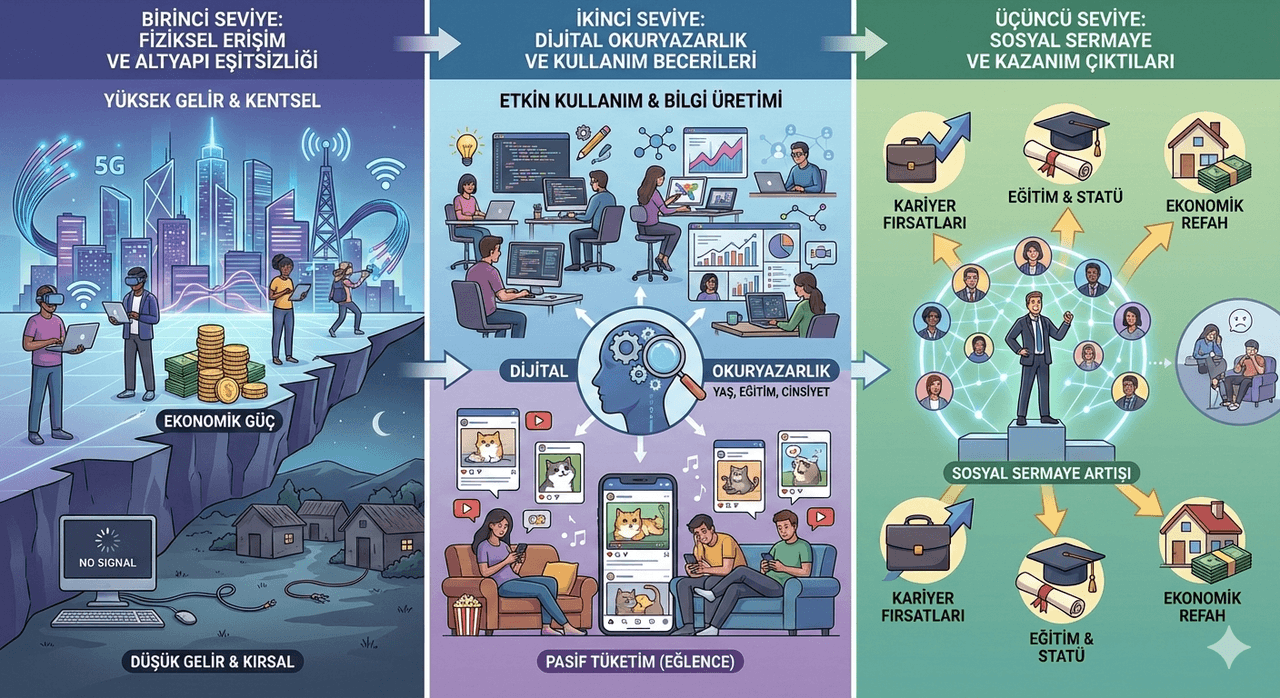
A Visual Representing the Levels of the Digital Divide (Generated by Artificial Intelligence.)
The digital divide is not attributable to a single cause but is a multi-layered structure shaped by interrelated economic demographic geographic and cultural variables. The main elements contributing to this inequality are grouped under the following headings:
Economic power at both macro and micro levels is the primary determinant of the digital divide. There is a direct correlation between a country’s Gross National Income and its level of access to information; high-income societies easily access fiber optic infrastructure and broadband technologies while low-income societies face a “knowledge gap.” At the household level low purchasing power not only limits access to hardware but also makes internet usage costs unaffordable pushing individuals out of the digital ecosystem.
The age factor creates a pronounced “generational divide” in the process of digitalization. Younger generations naturally adapt to digital tools while the elderly exhibit lower rates of technological adaptation and usage motivation. Education level directly affects not only the ability to use technological tools but also the capacity to derive meaningful outcomes from them (second-level divide). As education levels rise the use of digital tools for information acquisition and production increases.
Especially in developing regions social gender acts as a barrier to digital participation. Socio-cultural pressures and unequal opportunities significantly affect women’s access to technology and their digital skills. This situation leads to the formation of a male-dominated structure in the digital world and deprives women of the opportunities offered by the information society.
Regional disparities reflect the physical dimension of the digital divide. Concentration of infrastructure investment in urban centers places individuals in rural areas at a disadvantage. This phenomenon known as the “urban-rural divide” means that an individual’s speed and quality of access to information are restricted solely due to their place of residence.
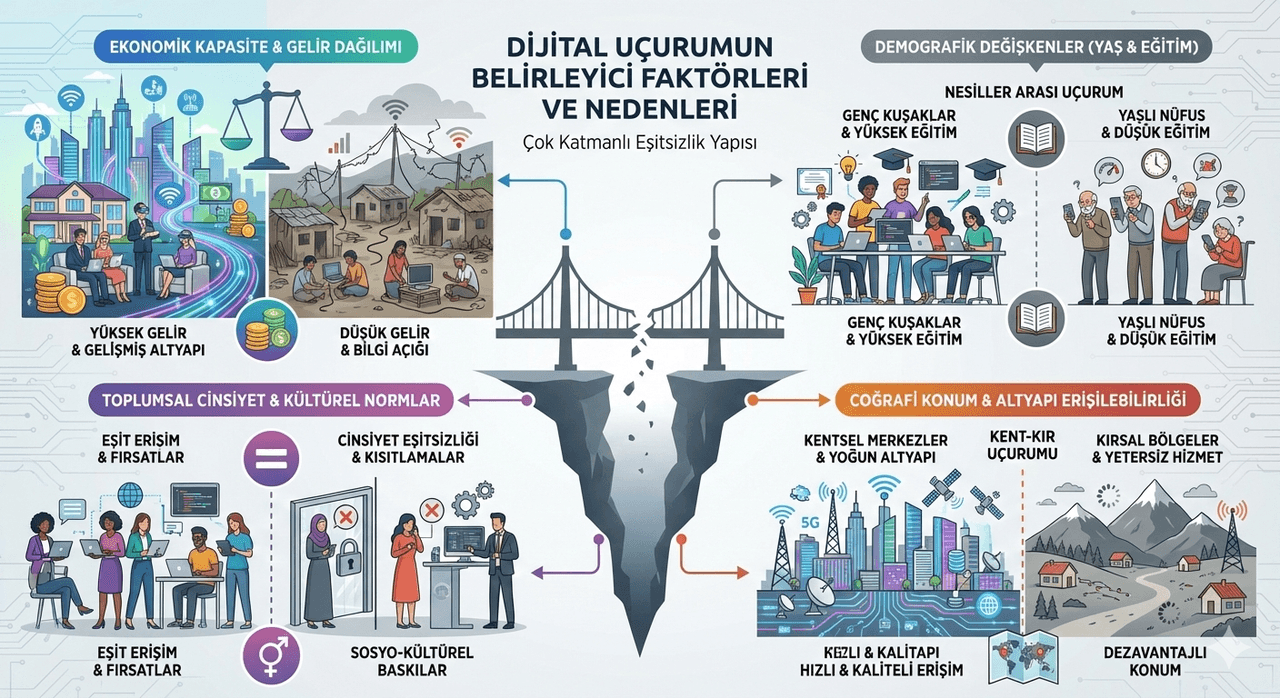
A Visual Representing the Determining Factors and Causes of the Digital Divide (Generated by Artificial Intelligence.)
Although the process of digitalization promises to eliminate physical distances it constructs new and unequal spaces in cyberspace rooted in geographic origins. The geographic manifestation of the digital divide is examined at three primary levels: global regional and local (urban-rural).
Globally access to information exhibits an asymmetric distribution according to countries’ levels of development. Advanced Western economies are at the center of digitalization with high-speed fiber optic networks and widespread broadband access while developing countries remain on the periphery due to inadequate infrastructure and high costs. This “global digital divide” is not merely a technological gap but a strategic divergence that determines nations’ competitiveness in the knowledge economy.
Within national borders the digital divide materializes through disparities in infrastructure investment between urban and rural areas. In industrialized and densely populated urban centers the quality and speed of internet services provided by service providers are at their highest levels while rural neighborhoods affected by geographic barriers or low profitability continue to face basic connectivity problems. Documented “spatial injustice” reinforces the disadvantage of rural residents by restricting their access to education healthcare and public services through digital channels.
In Türkiye a clear digital inequality is observed along the west-east axis and between metropolitan and peripheral areas. In industrialized regions such as Marmara and Aegean household internet access and technology usage rates exceed the national average while in Eastern and Southeastern Anatolia these rates lag behind due to infrastructure and socio-economic reasons. This demonstrates that digital transformation does not occur at the same speed or quality across all regions but rather transports existing regional development disparities into the digital realm.
Ay, Serhat, and Taner Kılıç. “Coğrafi Dijital Uçurum: Türkiye’de Dijital Dönüşümün Kentsel-Kırsal, Bölgesel ve Cinsiyet Eşitsizlikleri”. *Journal of Geography*, no. 46 (May 2023): 111–122. Accessed January 4, 2026.https://dergipark.org.tr/en/pub/iucografya/article/1169477
Coşkun Değirmen, Gül, Z. Beril Akıncı Vural, and İbrahim Özbükercı. “Bilgi Toplumu ve Dijital Uçurum Unsurlarının Ülkelerin Gayri Safi Milli Hasıla’sına Göre Yorumlanması: Bir Durum Saptaması.” *İnönü Üniversitesi İletişim Fakültesi Elektronik Dergisi (İNİF E-Dergi)*, 1(2), 102–118. Accessed January 4, 2026.https://dergipark.org.tr/tr/pub/inifedergi/article/566359
Kartal, Osman Yılmaz, Akan Deniz Yazgan, and Remzi Y. Kıncal. “Bilişim Çağında Sosyal Sermayenin Yeni Belirleyicileri: Dijital Uçurum ve Sosyal Medya Okuryazarlığı.” *Ahi Evran Üniversitesi Kırşehir Eğitim Fakültesi Dergisi* 18, no. 2 (2017): 353–373. Accessed January 4, 2026.https://dergipark.org.tr/en/pub/kefad/article/853273
Kayış, Hasan Hüseyin. “Dijital Eşitsizlikleri Yakından İncelemek: Dijital Uçurum Buzdağının Görünen Yüzü Müdür?” *Ege Üniversitesi İletişim Fakültesi Yeni Düşünceler Hakemli E-Dergisi*, no. 15, pp. 109–124. Accessed January 4, 2026.https://dergipark.org.tr/en/pub/euifydhed/article/936603

Levels of the Digital Divide
First Level: Physical Access and Infrastructure Inequality
Second Level: Digital Literacy and Usage Skills
Third Level: Social Capital and Outcome Gains
Determining Factors and Causes
Economic Capacity and Income Distribution
Demographic Variables
Social Gender and Cultural Norms
Geographic Location and Infrastructure Accessibility
Geographic Dimensions and Regional Inequalities
Global Digital Divide
Regional and Local Urban-Rural Divide
Regional Differences in Türkiye