


This article was automatically translated from the original Turkish version.
Dielectric Barrier Discharge (DBD) is a type of electrical discharge in which one or more dielectric (insulating) layers are positioned between two electrodes. DBD systems, typically designed to operate at atmospheric pressure DBD systems, generate electric forces that interact with the surrounding air by creating an ionized gas medium (plasma). These systems are particularly used in flow control applications, especially in surface discharge configurations, under the name "plasma actuators".
In a DBD system, one electrode is covered with a dielectric material while the other is in direct contact with air. When an alternating current (AC) is applied to the two electrodes, charge accumulates over time on the dielectric surface. These charges ionize air molecules via the electric field, initiating a flow known as ion wind. The collision of ionized particles with neutral molecules results in momentum transfer, generating a flow parallel to the surface.
This mechanism can vary depending on the applied voltage, frequency, electrode geometry, and properties of the ambient gas. The plasma can be sustained without forming an electric arc due to the system’s self-limiting structure. This makes DBD a safe and controllable method for plasma generation at atmospheric pressure.
Typical operating voltages are in the kilovolt range and frequencies are in the kilohertz range. The overlapping region between the electrodes is where the electric field is concentrated and plasma is generated. Plasma typically initiates at the exposed edge of the electrode and propagates toward the dielectric surface.
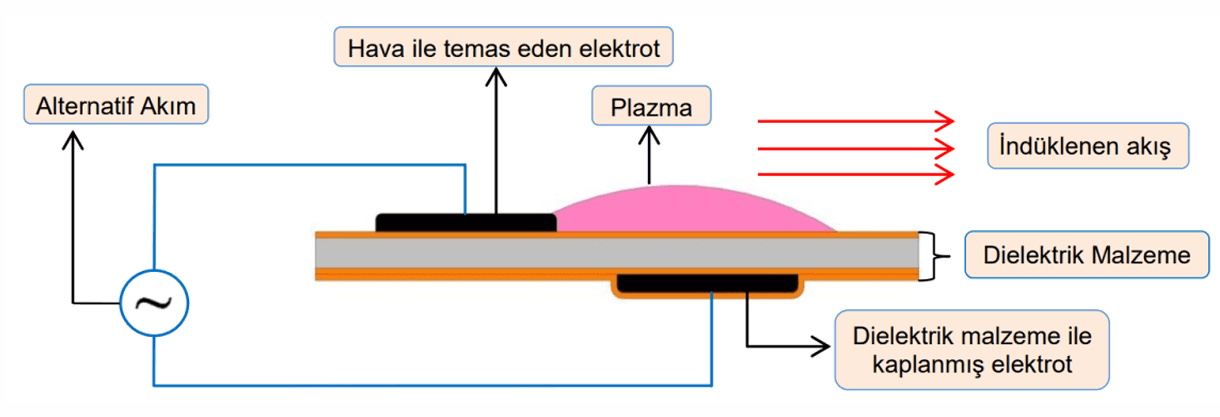
Dielektrik Bariyer Deşarj Plazma Şeması (ResearchGate)
DBD plasma actuators are widely used to delay flow separation on aerodynamic surfaces, reduce drag, and increase lift. They can be integrated onto aircraft wing profiles, helicopter rotors, turbine blades, compressor blades, and other bluff bodies such as landing gear.
DBD systems offer advantages such as the absence of moving parts, light weight, rapid response, integrability into surfaces, and low energy consumption. Additionally, they require less maintenance compared to conventional methods. However, the forces generated by DBD actuators are limited and their effectiveness may remain constrained in high-speed flows.
Benmeddour, Farid, Boualem Benouar, and Salim Oucief. "Seismic Hazard Assessment in the North of Algeria." Natural Hazards and Earth System Sciences 2, no. 1/2 (2002): 61–68.
Moreau, Eric. "Single Dielectric Barrier Discharge Plasma Enhanced Aerodynamics: Physics, Modeling and Applications." Journal of Physics D: Applied Physics 40, no. 3 (2007): 605–636.
Yıldız, Can. "Uçak Kanatlarında Ortaya Çıkan Türbülansların Sayısal Olarak İncelenmesi." Bachelor's thesis, Niğde Ömer Halisdemir Üniversitesi, 2022.

No Discussion Added Yet
Start discussion for "Dielectric Barrier Discharge" article
Operating Principle
Applications
Advantages and Limitations