This article was automatically translated from the original Turkish version.
+1 More
Didim Temple of Apollo
Location | Yenihisar (Didim) Aydın/Türkiye | ||||||||
|---|---|---|---|---|---|---|---|---|---|
Type | Cult center Temple Settlement | ||||||||
Foundation | 8th century BCE – 6th century BCE | ||||||||
Architectural Style | Ionic Style, Dipteros (Double Row of Columns) | ||||||||
Size | 85.15 x 38.39 metres (Temple) 53.63 x 21.71 metres (Sacred Courtyard) | ||||||||
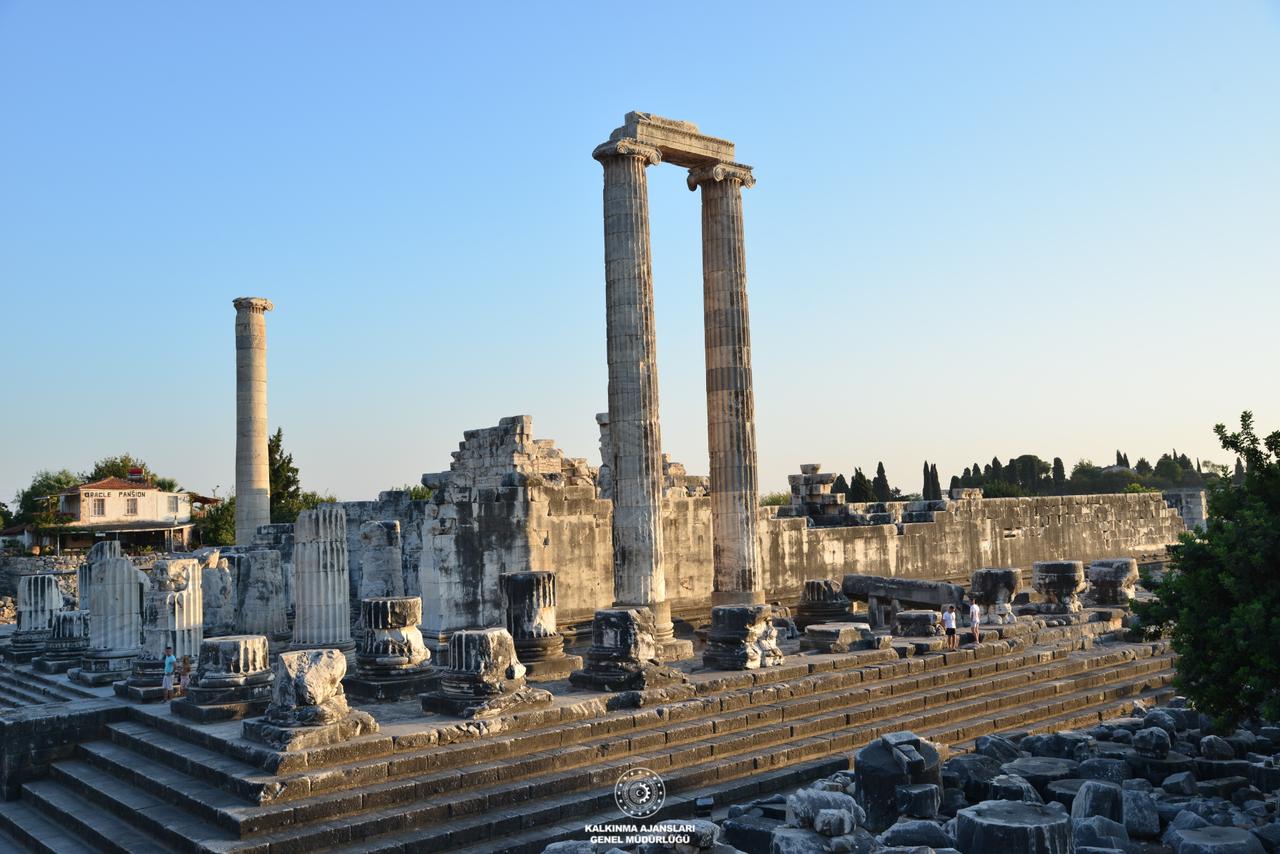
Didim Apollo Temple is regarded as the third largest temple of the ancient world and one of the best-preserved temples of antiquity, located in the coastal region of the Aegean, near the delta of the Büyük Menderes River. This temple holds a special position as a settlement and cultural center. Today, the temple is situated in the district center of Yenihisar (Didim), within the Aydın Province, in the ancient region of Didyma.
The origins of the Apollo Temple date back to a sanctuary built in the 7th century BCE. This Archaic period sanctuary began as a temenos, meaning “land dedicated to the gods,” and was transformed into a grand temple during the 6th century BCE, the golden age of Ionia. According to legend, the god Apollo taught the secrets of prophecy to Branchus, a shepherd in the Didyma region, who then built the first temple to Apollo beside the laurel grove and water spring. Descendants of Branchus, known as the “Branchidae,” managed the temple for many centuries. For this reason, Didyma was also known as “Brankhidai,” or “Land of the Branchidae.”
In the 6th century BCE, the temple was destroyed by the Persians in the early 5th century BCE. Burned in 494 BCE, it was rebuilt starting in 311 BCE during the Seleucid period, with its dimensions expanded. However, the construction of the temple was never fully completed. The structure visible today, begun in the 4th century BCE, continued into the Roman period, but was left unfinished due to high costs and regional conflicts. The temple began to lose its significance before 250 CE and was completely abandoned in 385 CE by order of Emperor Theodosius.
With the spread of Christianity, a basilica was constructed in the temple’s central courtyard (adyton) during the 5th or 6th century CE, but this basilica was later destroyed by an earthquake. Historians note that the greatest destruction of the temple occurred during the major Aegean earthquake of 1493; after this event, the temple fell into ruins and the foundations of the village of Yoran emerged around it.
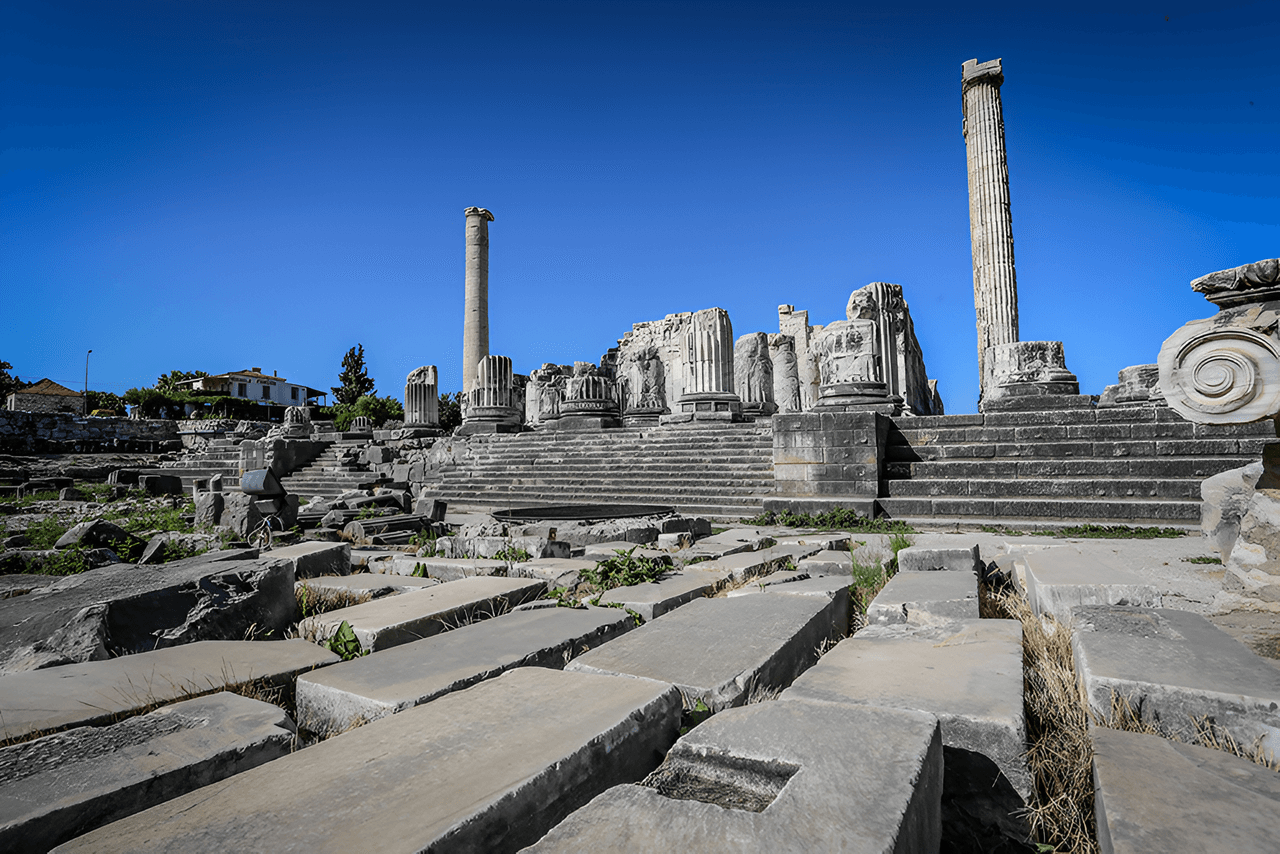
The Apollo Temple is a dipteros measuring 85.15 by 38.39 meters, meaning it is surrounded by a double row of columns. It features 21 columns on each side, 8 in front, and 9 at the rear, totaling 112 columns. The columns, including their bases and capitals, stand 19.60 meters high, and some are adorned with Corinthian-style leafed capitals. The temple was built on a seven-step base 3.5 meters high, with a staircase of 14 steps at its entrance.
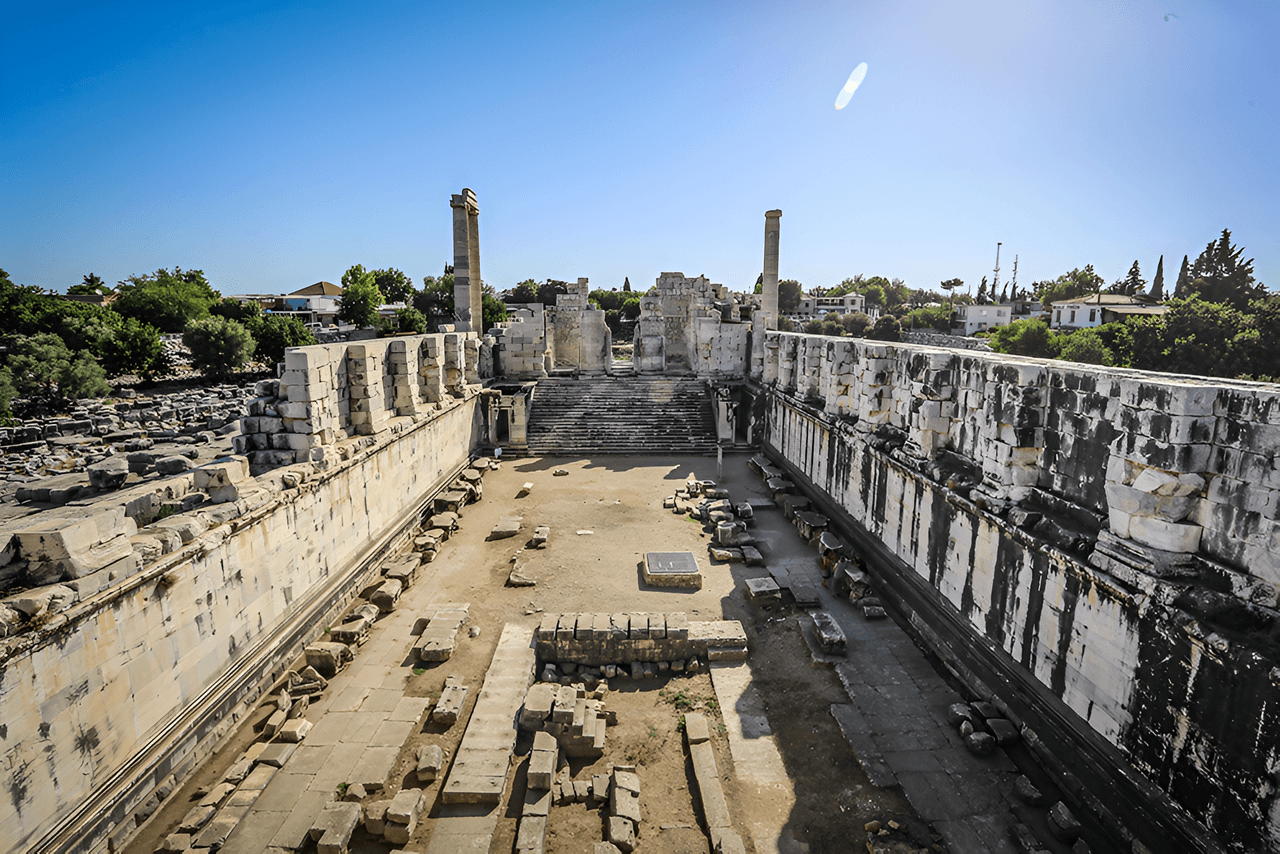
The central courtyard (naos) measures 53.63 by 21.71 meters and is enclosed by walls over 25 meters high. This courtyard is open to the sky and has an undecorated stone floor; it contains a sacred water spring and a small Hellenistic temple (naiskos). At the western end of the courtyard is a sekos where the cult statue stood, while at the eastern end is a 14.04 by 8.74 meter marble-clad hall where prophecies were delivered. Each marble block on the floor of this hall weighs approximately 70 tons.
The temple’s design was modeled after the Temple of Artemis in Ephesus and planned as its counterpart. However, it remains the third largest temple in the world after the Temple of Artemis and the Heraion on Samos. Excavations conducted between 1906 and 1913 brought the temple to light, and it has since been partially restored with a protective wall constructed around its perimeter.
Apollo Temple (Didim Municipality)
The temple is connected to the “Sacred Way,” a route approximately 16.5 kilometers long that begins at the sacred gate of ancient Miletus. This 5 to 7.5 meter wide path leads to the Panormos harbor (modern-day Mavişehir), turns south, and ends at the temple’s votive terrace. The first 5 to 6 kilometers of the path were decorated with seated human statues, recumbent lions, and sphinxes.
The Apollo Temple is renowned as an oracle center. In antiquity, belief in magic, divination, and prophecy were fundamental elements guiding daily life. Apollo, worshipped as the god of light and sun, transformed the temple into a sacred center. The famous historian Herodotus notes that in the 7th century BCE, Pharaoh Necho II of Egypt and King Croesus of Lydia offered valuable gifts to the temple.
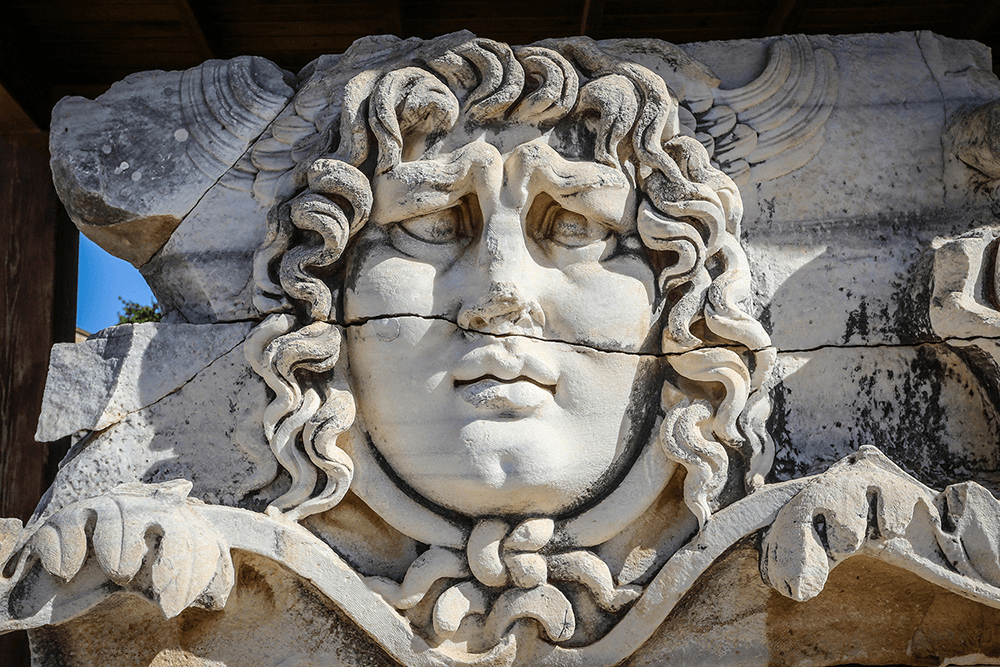
Medusa figures stand out as protectors of the temple. In Greek mythology, Medusa, one of the Gorgons, was the only mortal sister with snakes for hair, a terrifying face, and the power to turn people to stone with her gaze. The word “Gorgo” means “terrible, fearsome” in Greek. For this reason, Medusa’s head was incorporated into the temple’s architecture to protect sacred structures.
Apollo Temple (Didim Municipality)
Today, the temple reflects the remains of antiquity. Foundations visible in the central courtyard preserve traces of the early temple, while remnants of the basilica built in place of the Hellenistic naiskos also remain. Severely damaged by the 1493 earthquake, the temple lay in ruins for centuries, though the fertile land around it continued to be used by local communities. The Apollo Temple, both for its architectural features and its significance as an oracle center, is one of the Aegean’s most valuable cultural heritage sites.
Aydın İl Directorate of Culture and Tourism. "Apollon Tapınağı." Accessed April 3, 2025.https://aydin.ktb.gov.tr/TR-64419/apollon-tapinagi.html.
Didim Belediyesi. "Apollon Tapınağı." Accessed April 3, 2025.https://www.didim.bel.tr/sayfa/4137/apollon-tapinagi.
Ministry of Culture and Tourism of the Republic of Türkiye. "Didim Apollon Tapınağı." *Müzeler*. Accessed April 3, 2025.https://muze.gov.tr/muze-detay?SectionId=DDM01&DistId=DDM.

Didim Temple of Apollo
Location | Yenihisar (Didim) Aydın/Türkiye | ||||||||
|---|---|---|---|---|---|---|---|---|---|
Type | Cult center Temple Settlement | ||||||||
Foundation | 8th century BCE – 6th century BCE | ||||||||
Architectural Style | Ionic Style, Dipteros (Double Row of Columns) | ||||||||
Size | 85.15 x 38.39 metres (Temple) 53.63 x 21.71 metres (Sacred Courtyard) | ||||||||
No Discussion Added Yet
Start discussion for "Didim Temple of Apollo" article
History
Architectural Features
Sacred Way
Oracle Center and Medusa
Current Condition