


This article was automatically translated from the original Turkish version.
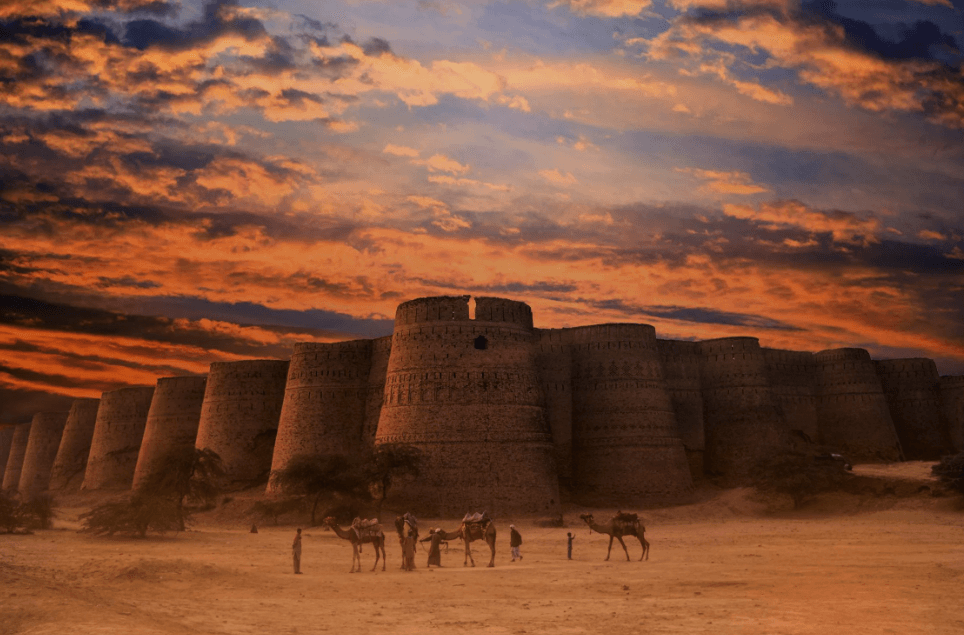
Deraver Castle
Construction Date(s)(Text) | It was first built in the 9th century by the Rajput Bhatti Dynasty | ||||||||
|---|---|---|---|---|---|---|---|---|---|
Reconstruction | It was rebuilt in 1733 by Bahawalpur Nawab Sadeq Mohammad | ||||||||
Location | Cholistan Desert Pakistan Punjab Province | ||||||||
Derawar Fort (English: Derawar Fort) is a historic desert fortress located in eastern Pakistan, in the Bahawalpur region of the Punjab province. Situated in the heart of the Cholistan Desert, approximately 100 kilometers south of Bahawalpur, the fort is among the rare structures from the medieval period to have survived to the present day in South Asia. It holds historical significance at both local and global levels due to its architectural grandeur, military-strategic location, and cultural continuity.
Derawar Fort is generally believed to have been originally constructed in the 9th century by the Bhatti Rajputs, a Rajput tribe. However, the structure standing today was rebuilt in 1733 by Sadiq Muhammad Khan I, the founder of Bahawalpur. The fort served as the military headquarters and administrative center of the Bahawalpur Princely State and became a regional power center under the influence of the Nawab family. Over time, it also gained strategic importance for securing trade routes and controlling water resources.
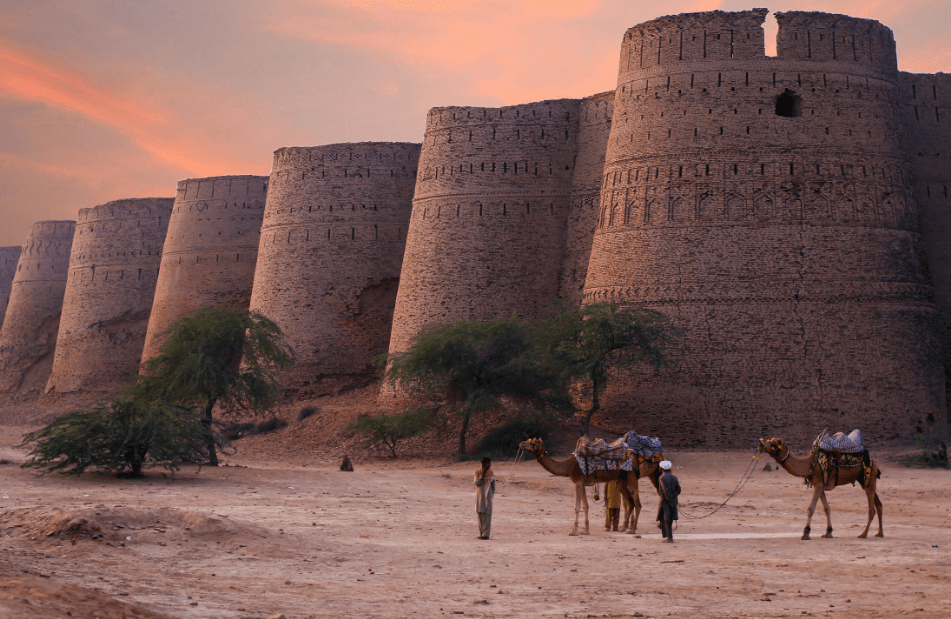
Derawar Fort (Syed Hasan Mehdi, pexels)
The fort features a symmetrical defensive structure encompassing an area of approximately 1.5 kilometers and consisting of 40 cylindrical bastions, each 30 meters high. Built from brick, the fort’s design reflects both local construction techniques and elements of Islamic architecture. Each bastion is connected to thick walls that rise sharply from the surrounding plains. This robust construction has contributed significantly to the fort’s survival over centuries.
Despite the harsh and arid climate of the Cholistan Desert, Derawar Fort has endured as a testament to human settlement. It is considered part of a larger settlement complex that includes mosques, water reservoirs, and tombs belonging to the Nawab family. Additionally, underground water channels known as qanats in the vicinity made life possible in the region. The sacredness and cultural significance attributed to the fort by the local population demonstrate that it is not only a historical monument but also a vital element of social identity.
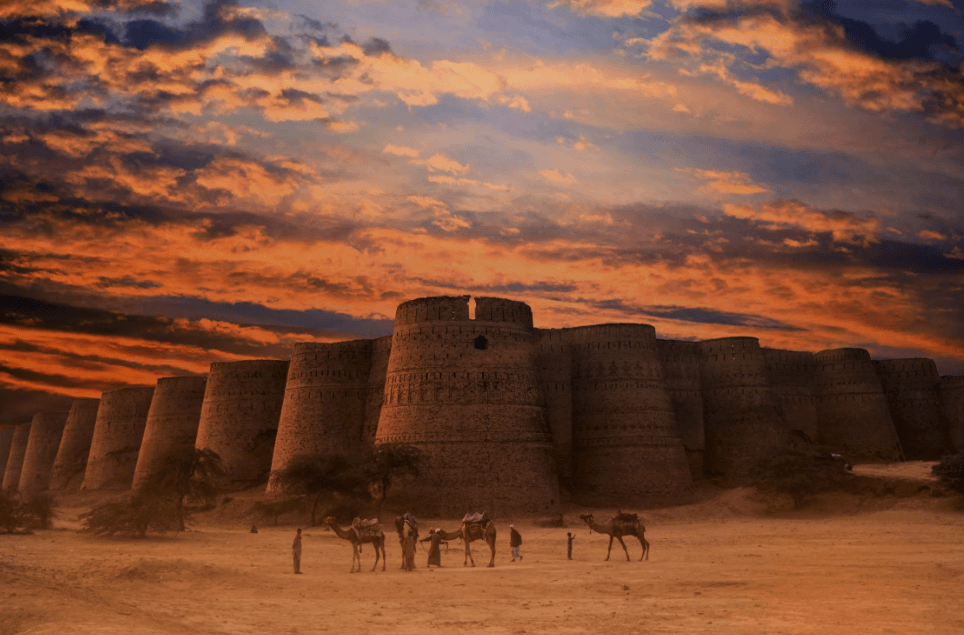
Derawar Fort (Syed Hasan Mehdi, pexels)
In 2016, Pakistan included Derawar Fort in the UNESCO World Heritage Tentative List under the title “Derawar and Bahawalpur Monuments.” The nomination emphasizes the fort’s architectural uniqueness, cultural continuity, and historical identity. According to UNESCO, Derawar is described as a structure that “represents the common heritage of humanity” and “has endured despite the erosive effects of time.” The nomination also highlights the urgent need for conservation and restoration efforts at the site.
Derawar Fort has faced various environmental threats, particularly over the last century. Rain erosion, extreme temperature fluctuations, lack of maintenance, and structural deterioration threaten the fort’s physical integrity. Efforts are being made to transform the surrounding area into a tourist and cultural attraction through annual events such as the Cholistan Desert Rally, aiming to raise public awareness and support for the fort’s preservation.
Anadolu Ajansı. “Çöl Güzeli Deraver Kalesi 12 Yüzyıldır Ayakta.” Anadolu Ajansı, March 22, 2022. Accessed May 12, https://www.aa.com.tr/tr/dunya/col-guzeli-deraver-kalesi-12-yuzyildir-ayakta/2539955.
Hasnain, Syed Mehdi. *Bulutlu Gökyüzü Altında Binanın Yakınında Üç Kahverengi Deve*. Pexels. Accessed May 12, 2025. https://www.pexels.com/tr-tr/fotograf/bulutlu-gokyuzu-altinda-binanin-yakininda-uc-kahverengi-deve-815883/.
Hasnain, Syed Mehdi. *Günbatımında Derawar Kalesi*. Pexels. Accessed May 12, 2025. https://www.pexels.com/tr-tr/fotograf/gunbatiminda-derawar-kalesi-815880/.
UNESCO World Heritage Centre. “Derawar and the Forts of Bahawalpur.” UNESCO World Heritage Centre, 2016. Accessed May 12, https://whc.unesco.org/en/tentativelists/6108/.

Deraver Castle
Construction Date(s)(Text) | It was first built in the 9th century by the Rajput Bhatti Dynasty | ||||||||
|---|---|---|---|---|---|---|---|---|---|
Reconstruction | It was rebuilt in 1733 by Bahawalpur Nawab Sadeq Mohammad | ||||||||
Location | Cholistan Desert Pakistan Punjab Province | ||||||||
History
Architectural Features
Natural and Cultural Context
UNESCO World Heritage Tentative Listing
Current Status and Conservation