


This article was automatically translated from the original Turkish version.
Data warehouse is an information management system that collects large volumes of data from various systems into a single centralized repository for analysis. These systems provide critical information especially for decision support systems and business intelligence applications.
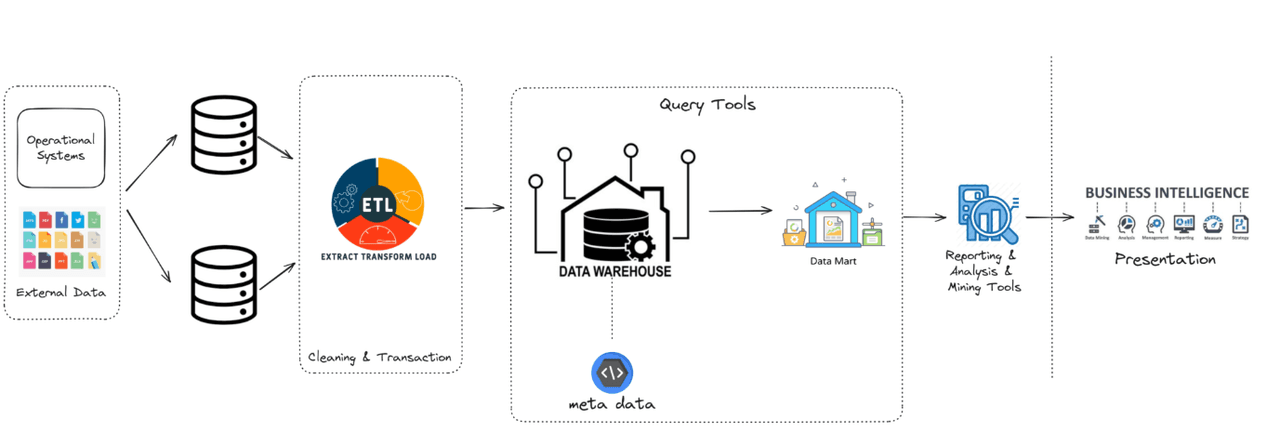
Basic Architecture of a Data Warehouse (Credit: veribilimiokulu.com)
Several key features distinguish data warehouses from traditional databases:
The primary purpose of data warehouses is to integrate data from disparate systems and enable organizations to make more accurate and informed decisions. Key use cases include:
Data warehouses have become an important tool for organizations ranging from large enterprises to small businesses. Today, with cloud-based solutions, data warehouses have become more accessible and scalable.
1. Data Source Layer: Data from various departments of the organization are collected at this layer. These data originate from operational databases (Oracle, MySQL), CRM systems (Salesforce, HubSpot), websites (Google Analytics), sensors, and other sources. This layer serves as the initial point of entry for data from diverse sources.
2. Data Ingestion Layer: At this layer, collected data are cleaned, transformed, and loaded into the data warehouse. These processes are typically carried out using ETL tools (Informatica, Talend). This layer ensures data are prepared for analysis.
3. Data Storage Layer: Data loaded into the warehouse are stored at this layer. This layer ensures secure and organized storage of data.
4. Data Access Layer: This layer enables users to access data in the warehouse. Access is typically provided through SQL queries, reporting tools (Tableau, Power BI), and analytical tools (R, Python). This layer ensures easy and fast access to data.
5. Metadata Layer: This layer stores information about the data warehouse itself, including the meaning, origin, and usage of data. Metadata management tools (IBM InfoSphere, Informatica Metadata Manager) are used here. This layer is essential for understanding the context and source of the data.
6. Data Processing Layer: At this layer, collected data are analyzed and transformed. Machine learning and artificial intelligence models (TensorFlow, PyTorch) are commonly used here. This layer is necessary for extracting insights from data.
7. Presentation Layer: In this final layer, data from the warehouse are presented visually to users. Tools such as charts, graphs, and dashboards (Tableau, Power BI) are used. This layer is where data reach end users and provides visual tools to interpret information.
A data warehouse is a heterogeneous collection of data sources organized under a unified schema. Two main approaches are used in building data warehouses: the Inmon Approach (Top-Down Approach) and the Kimball Approach (Bottom-Up Approach).
This approach involves constructing a data warehouse based on an enterprise data model. First, a single comprehensive data warehouse is built that encompasses all data elements and reflects the overall operations of the organization. This warehouse is designed to meet all data needs of the enterprise. Afterward, data marts are created for specific functional areas or business processes. These data marts use data extracted from the central warehouse to address the data requirements of particular functions or processes.
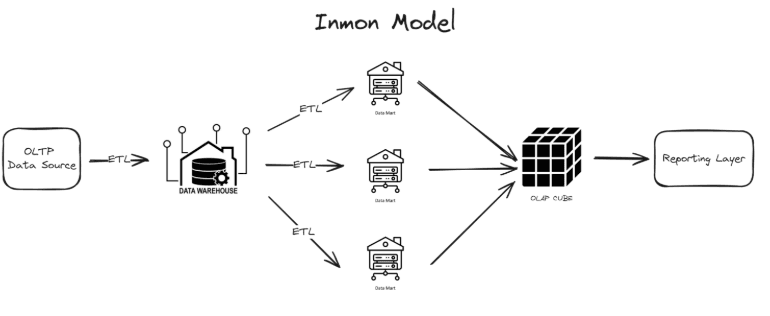
Inmon Model (Credit: veribilimiokulu.com)
This original and effective approach involves creating specialized data marts that serve specific business areas. Each data mart organizes and prepares information for analysis focused on a particular domain. Subsequently, these data marts are integrated to form a comprehensive enterprise data warehouse. This approach typically yields faster and more efficient results while enhancing overall system flexibility. The Kimball approach is a method organizations can use to quickly derive value and gain rapid access to needed information.
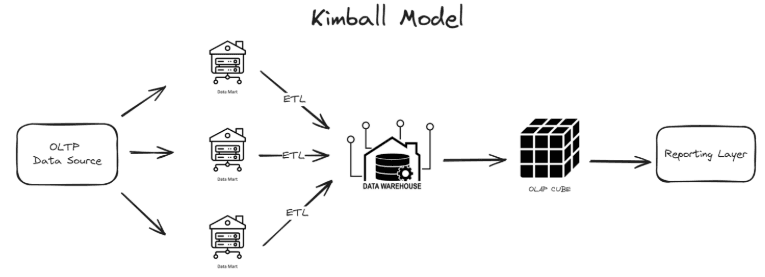
Kimball Model (Credit: veribilimiokulu.com)
Data warehouses are widely used across various industries:
Traditional data warehouse architectures are optimized for structured data. However, with the emergence of Big Data, there has been a growing need to analyze unstructured and semi-structured data. Data warehouses have been integrated with Big Data technologies such as Hadoop and Spark to expand their data processing capabilities.

Generated by artificial intelligence tools.
Data warehouse technology is generally divided into three main categories, each fulfilling a specific function and complementing the others. Taking an e-commerce company’s data warehouse as an example, the types can be defined as follows:
Operational Data Warehouse (ODS): The purpose of an ODS is to accelerate daily operations. The ODS captures and stores data from daily transactions on an e-commerce platform. This data includes critical information such as orders, customers, products, and payments. With an ODS, we can quickly perform queries such as:
Enterprise Data Warehouse (EDW): The EDW stores all of the company’s data and enables analysis of its historical performance and forecasting of future trends. Compared to the ODS, the EDW can store more data and perform more complex analyses. This helps the company evaluate its operations with a broader perspective and make strategic decisions. The EDW supports complex queries and analyses such as:
Data Mart: A data mart extracts and optimizes subsets of data focused on a specific subject from the EDW. For example, a marketing data mart may contain data such as customers, purchase histories, and demographic information. This enables the marketing department to:
Baykal, Abdullah. "Veri madenciliği uygulama alanları." Dicle Üniversitesi Ziya Gökalp Eğitim Fakültesi Dergisi 7, (2006): 95-107.Accessed Adresi.
Hewlett Packard Enterprise. "What is a Data Warehouse?"
IBM. "What is a data warehouse?" (2024).Accessed Adresi.
Kayademir, Seda. "Veri Ambarı Nedir?" (2024).Accessed Adresi.
Microsoft Documentation. "What is a data warehouse?"
Seker, Sadi Evren. "Veri Ambarı (Data Warehouse)." YBS Ansiklopedi 2, no. 4 (2015): 7-13.Accessed Adresi.

Key Features of a Data Warehouse
Purpose of Data Warehouses
Components of a Data Warehouse
Data Warehouse Architectural Approaches
Inmon Approach (Top-Down Approach)
Kimball Approach (Bottom-Up Approach)
Applications of Data Warehouses
Relationship Between Data Warehouse and Big Data
Differences Between Data Warehouse and Big Data
Types of Data Warehouses