This article was automatically translated from the original Turkish version.
The modern era's greatest paradox is that while living in history's most "connected" period, we experience its deepest "disconnection". Today, streets, cafés, schools, and even the most private corners of our homes are filled with people physically together yet spiritually miles apart. We do not know those we call our closest, yet we can become friends with people we would not recognize if we passed them on the street. “If you are in my heart, even if you are in Yemen, you are beside me. But if you are not in my heart, even if you are beside me, you are counted as being in Yemen.” Could these old sayings have been written for our times? What kind of era is this, where a child is driven to commit murder by killing another’s child, yet the mother sitting in the next room remains unaware? What kind of era, what kind of generation, is this that turns the distant into the near and the near into the distant?
I personally call this condition "crowded loneliness". It is the inner state of individuals with thousands of followers but not a single true friend to confide in at night, of those who wake up staring at screens yet remain oblivious to the family member beside them. This text will examine in full detail how human nature has been stunted by digital shackles, the vast chasm between technology and screen addiction, and how the role of parenting has been handed over to a "digital caregiver". At least, that is what I will try to do. For unfortunately, this subject does not have as much detail as we would need to fully address it. Because the human being we are studying is not here. Everyone is locked in their homes, in their rooms, playing games!
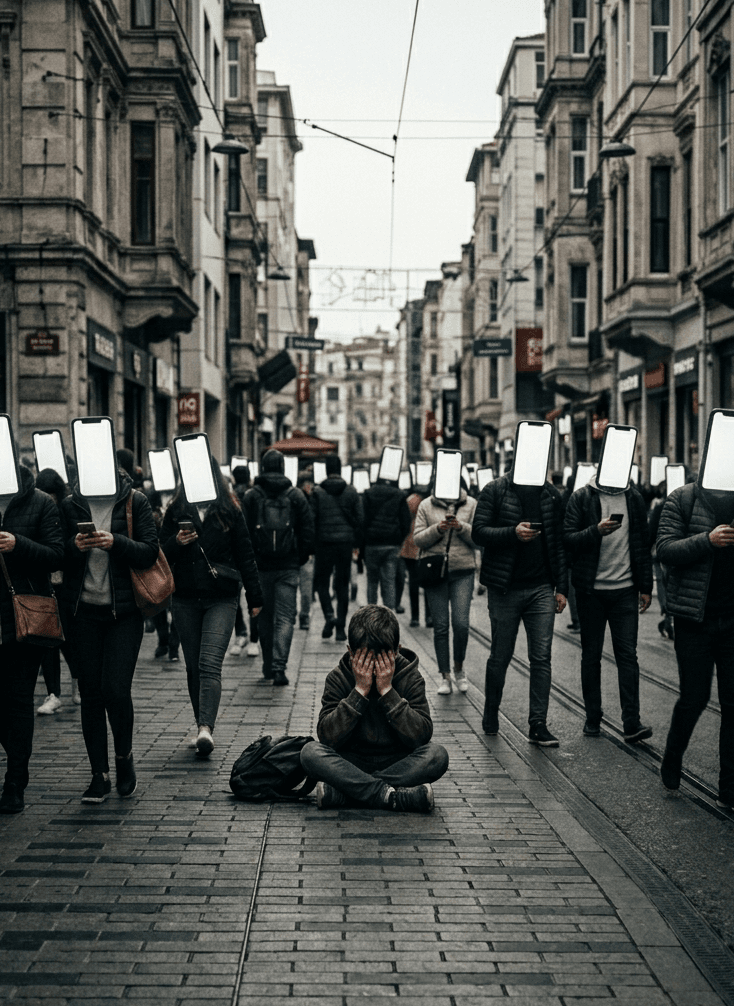
Crowded Loneliness (Image Generated by Artificial Intelligence)
Human beings are, by biological, psychological, and spiritual design, social creatures. This sociability is not merely a dry exchange of information or transmission of a message; rather, human nature is designed to crave the warmth of a glance, the sincere tremble in a voice, and the touch of a hand on the shoulder. Yet today, children, adolescents, and even adults in maturity are attempting to satisfy this innate need with the cold, lifeless, and artificial pixels offered by social media tools. This effort is like a man trying to quench his thirst by drinking seawater—the more he drinks, the more thirsty he becomes; the more connected he feels, the more isolated he grows.
Communication built through social media cannot, must not, and never will be a mimicry of true sociability. Humanity has become so distant from nature and so yearning for it that before sleeping, people project artificial forests onto the wall beside their beds! This new way of life, utterly contrary to human nature, alienates the individual within crowds while numbing them with a false sense of community. Hours spent staring at screens are, in truth, moments when the soul is abandoned to profound loneliness. A generation is growing up today that cannot make eye contact, is incapable of feeling another’s pain in their heart, and has lost all capacity for empathy. Our nature rebels daily against this digital prison, and this rebellion manifests as social anxiety, chronic depression, and a deep crisis of meaning. In a world where the place of true friendship has been taken by the number of followers, human spiritual health becomes incompatible with the laws of nature.
In society, especially among younger generations and parents who console themselves by saying their children are growing up "in the technological age", there exists a dangerously misleading belief: we mistake spending excessive time on social media and knowing every feature of digital platforms for being "intimate with technology". In reality, this is not using technology, but allowing technology to use you like a commodity—to see you as nothing more than a "product for sale". We must clearly distinguish between these two concepts.
Technology is, in fact, a tremendous force for human benefit. Yet "knowing technology" is not merely swiping your finger across an app screen. True technological literacy means learning to code, designing algorithms, performing data analysis, and developing new digital tools to solve problems. Civilization advances when humans master technology and use it as a tool of production. A young person who learns to code speaks the language of technology and adds value to the world.
On the other hand, screen addiction is not a skill, but a form of enslavement. Losing oneself in an endless cycle of content created by others, surrendering to the dopamine spiral triggered by likes and notifications, turns a person into nothing more than a passive consumer. Today, when young people say "I know technology", they mean only that they can quickly navigate app interfaces. True technological knowledge is production-oriented and mind-expanding, while today’s screen addiction is like an opiate that numbs. Technology is a bridge that makes life easier; screen addiction is forgetting how to cross the bridge and remaining suspended on it.
Once, a person’s character was shaped by books, the culture of the neighborhood they were born into, the manners they observed in their family, and the quality of their chosen friends. Knowledge was distilled, reflection was practiced, morality was internalized through lived experience and example. Today, the architect of character is no longer libraries, but personalized, human-made algorithms. People no longer build their own identity through their own will; they purchase an identity from the vitrines social media offers them.
Especially children and adolescents in developmental stages are constructing their identities upon the figures of "influencers" or "phenomena" they see on social media—lives filled with artificial glitter, devoid of depth and intellectual accumulation. Instead of losing themselves in the pages of a book and building their own world of thought, finding their own words, they imitate the lives, movements, and thoughts of others within the shallow confines of 15-second videos. This is a global catastrophe that kills individuality and gives birth to the "mass-produced human" typology.
Friendships are no longer built on shared values, common struggles, or mutual sacrifice, but on shared digital trends and consumption habits. How can a generation that communicates by showing a video on their phone rather than looking into each other’s faces ever penetrate each other’s souls? The result is even more tragic: rootless, principle-less, shallow individuals whose character shifts like a windflower, shaped only by the direction the wind—algorithms and social media—blows. These scrolling contents, replacing books, dull the mind and reduce the human being to nothing more than a "spectator".
Modern family life's greatest problem is people living under the same roof yet becoming strangers to one another. Today, digital walls inside our homes are thicker than physical ones. Parents believe they are giving their children a "toy" when they hand them a tablet or phone. Yet these devices are no longer mere toys—they have become the new authority in the home, the child’s new teacher, and the true parent.
Unfortunately, the institution of parenthood has been shelved in the modern era. Parents now see their responsibilities toward their children as limited to meeting physical needs—food, clothing, shelter. A parent who rejoices, "My child sits quietly in their room, away from the dangers outside," remains unaware that their child is in the dark corridors of the cyber world, in the arms of pedophiles, cyberbullies, and perverted ideologies. When phones and computers begin to parent, the parent’s respect, authority, and above all, their very meaning in the child’s life, vanish.
In a room, a child buried in their screen does not even sense the presence of the parent beside them. The sacred bond of life between them has been severed. In this atmosphere of disconnection, children are driven toward suicide, drugs, or various criminal networks by cyberbullying, the sense of inadequacy created by false ideals of perfection, and digital loneliness. Parents mistake their children’s silence for "good behavior", when in fact that silence is a cry for help, the loudest scream possible. Parents who do not hear this scream in their own homes become the greatest cause of death for the children of other parents. As the role of parenting is handed over to digital tools, the concept of family is rotting from within and losing its sacredness.
If we do not urgently and decisively say "stop" to this trajectory, we will inherit a future in which only bodies remain in the physical world, while souls, minds, and wills are imprisoned in the servers of global technological giants. We must certainly elevate technology—we must take giant strides in every field, from cybersecurity to software development. But while doing so, we must not sacrifice the values that make us human, our nature, and our social bonds. Leaving our children to the mercy of screens is no different from releasing them into a wild forest unarmed and unprotected. We need to return to tables where phones are not allowed during dinner, where we meet each other’s eyes. We must return to the unique scent of books, to the sweat of real play on the street, and to the sincerity of a neighbor knocking on the door.
Please do not forget this!
Technology is an instrument of civilization as long as it serves human will, but a catastrophe scenario as long as it enslaves the human soul—and we do not wish to become accustomed to such scenarios. Social media does not connect us to each other; rather, it tears us apart, locking each of us into separate cells of the same digital prison. The key to these cells is remembering that we are human again and listening to the voice of our nature. True sociability is not on a screen; it is the opposite of what I have criticized here.【1】
Cabadak, Gözde. "Yayımlanmamış Blog Yazısı." Date Published May 4, 2026.
[1]
Cabadak, Gözde. "Unpublished Blog Post." Date of Writing 4 May 2026.