


This article was automatically translated from the original Turkish version.
+1 More
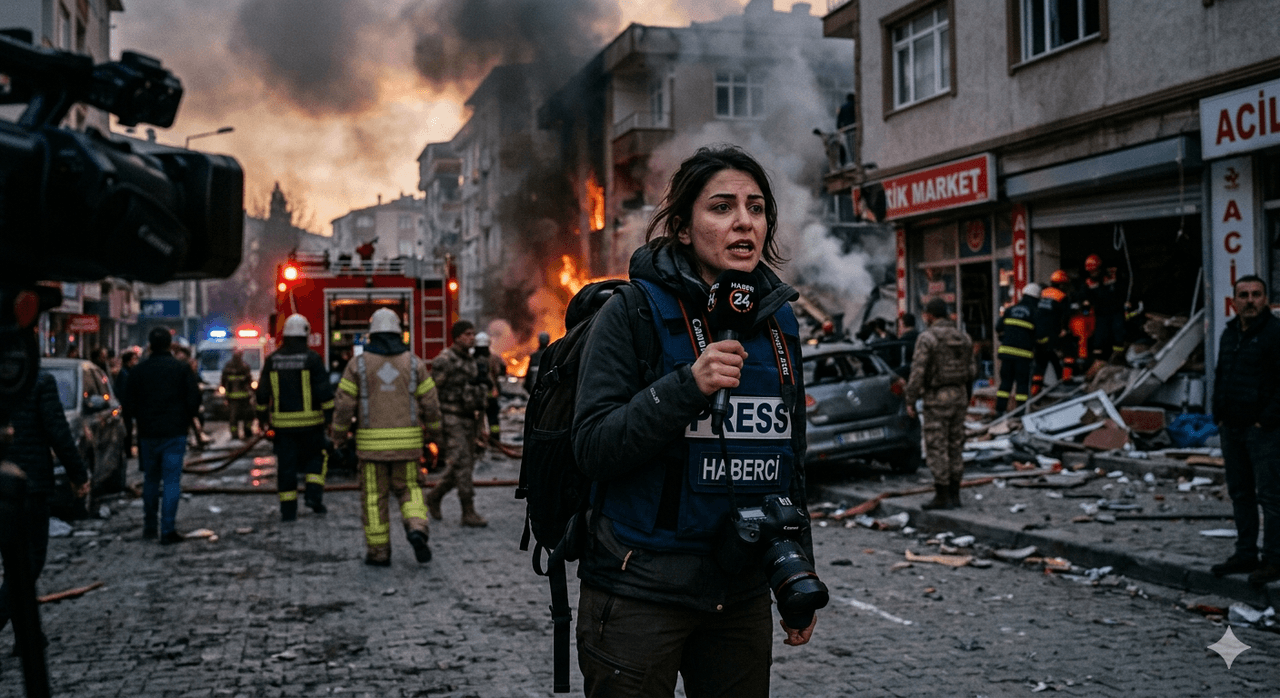
Crisis Journalism (Generated with Artificial Intelligence.)
Crisis Types | Natural disasters, Public health crises, Socio-political crises, Economic downturns | ||||||||
|---|---|---|---|---|---|---|---|---|---|
Critical Functions | Crisis management, Public information, Social memory formation | ||||||||
Common Ethical Violations | Sensationalism, Privacy violation, Disinformation | ||||||||
Communication Channels | Traditional media, Digital media, Social networks | ||||||||
Basic Principle | Objectivity Truth Public interest Humanity | ||||||||
Communication Channels | Traditional media Digital media Social networks | ||||||||
Common Ethical Violations | Sensationalism Privacy violation Disinformation | ||||||||
Critical Functions | Crisis management Public information Social memory formation | ||||||||
Crisis Types | Natural disasters Public health crises Socio-political crises Economic crises | ||||||||
Crisis Communication is a specialized field encompassing all activities related to the production, processing, and dissemination of information by mass media during extraordinary periods such as wars, international tensions, terrorist acts, economic crises, pandemics, and natural disasters. This process, distinct from routine journalism practices, assumes a strategic role in reconstructing social reality and managing the crisis.
Crisis situations determine how media produce information and how these contents psychologically affect audiences. In sudden crises such as natural disasters, media use live broadcasts from the field, dynamic visuals, and fictional sound elements to create in viewers the feeling that they are direct witnesses to the event.
In public health crises such as pandemics, the situation takes on a different dimension by increasing the coefficients of risk and uncertainty. During such periods, societal demand for reliable information rises, while media content that emphasizes fear and anxiety can significantly influence public perception and opinion during the crisis.
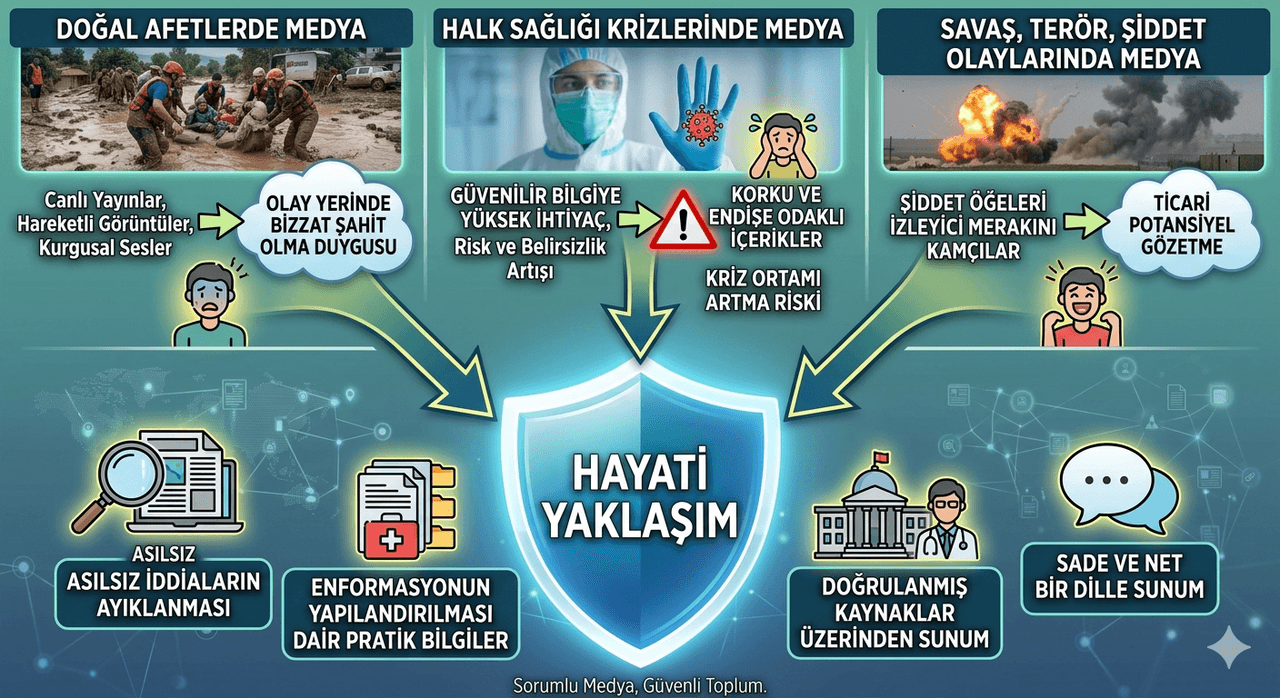
The Role of Media in Crisis Periods: Risks and Solutions (Generated by Artificial Intelligence)
In crises involving war, terrorism, and violent incidents, a similar commercial potential is observed, with elements of violence sometimes exploited to heighten viewer curiosity. Therefore, the essential approach across all types of crises is to filter out unfounded claims, structure information clearly, and present verified practical guidance on how the public can protect itself, using simple and precise language.
In news production processes, individual rights to privacy, personal confidentiality, and safety are fundamental considerations under journalistic ethics and international human rights standards. Special care must be taken to avoid non-consensual use of visuals or disclosure of identifying information, particularly when children and vulnerable groups are involved.
Journalists, whose physical presence on the ground and the narratives they construct directly shape public will and social perception, must adhere to calmness, measured language, objectivity, and rigorous information verification as core professional principles during crises and emergencies, both for ethical integrity and news reliability.
International standards require journalists operating during crises and disasters to place the principles of “do no harm” and “humanity” at the center of their professional practice and uphold these values.【1】Trauma-informed journalism approaches treat crisis victims not merely as sources of information but as individuals whose traumatic experiences and potential psychological impacts must be respectfully considered throughout the reporting process.
The management of crises and journalistic activities do not end with the resolution of the acute phase or the disappearance of immediate danger; rather, they enter a new phase of responsibility. In the post-crisis period, the media’s primary duty is to objectively examine the failures experienced, physical and structural damages, negative societal perceptions, and long-term strategic planning, while consistently maintaining long-term follow-up. At this stage, news organizations are expected to subject their own reporting practices during the crisis to self-critical review and use error analysis to cleanse social memory of manipulative elements and reinforce it with accurate information.
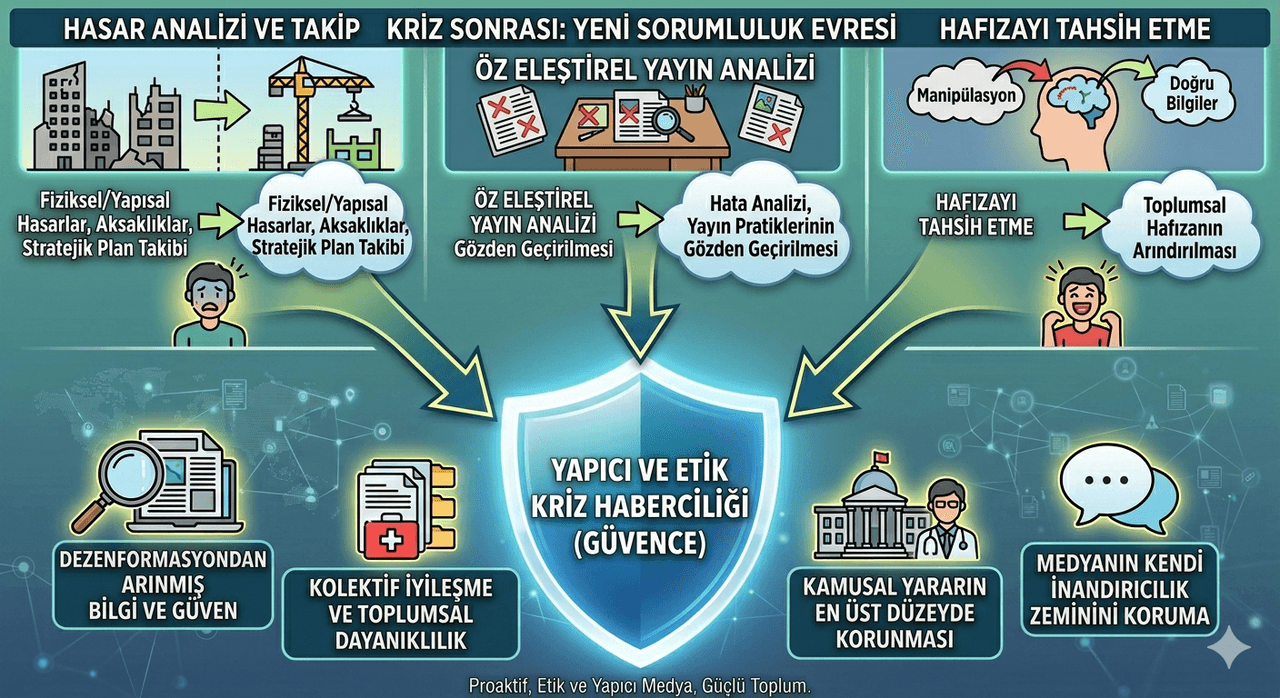
Post-Crisis Process and Social Memory (Generated by Artificial Intelligence)
When crisis reporting violates professional ethical principles and is conducted through disinformation and manipulation, it leads to difficult-to-repair economic, political, and psychological damage in society while simultaneously undermining the media’s own credibility.
Crisis communication practices conducted proactively, constructively, and within the framework of universal ethical standards are among the key elements studied in communication research for their impact on social resilience, collective healing processes, and the public good.
By their nature, crises require extraordinary governance and emergency intervention, creating fertile ground for violations of professional ethical principles in media content. Exaggeration of news for ratings or ideological gain, fragmentation of events from their broader context, and exclusive focus on sensational moments are among the most common ethical failures.
Fragmented journalism obscures cause-and-effect relationships, preventing society from learning lessons from crises and generating a distorted perception of reality. Particularly in visual media, the broadcast of images of dead bodies, severely injured individuals, suffering persons, and crying children leads to the exploitation of tragedy and the violation of victims’ rights. Media outlets racing against time and driven by the urge to be first often transmit unverified data from the field, a fundamental factor that undermines public trust.
Alongside advancing communication technologies, crisis communication has evolved beyond traditional television and newspaper publishing to become an integrated system with social media platforms. Social networks serve as simultaneous, multidirectional, and rapid communication bridges among public institutions, civil society organizations, search-and-rescue teams, and individuals during crises. While this enhances the dissemination of urgent needs and the creation of social awareness, it also carries significant risks.
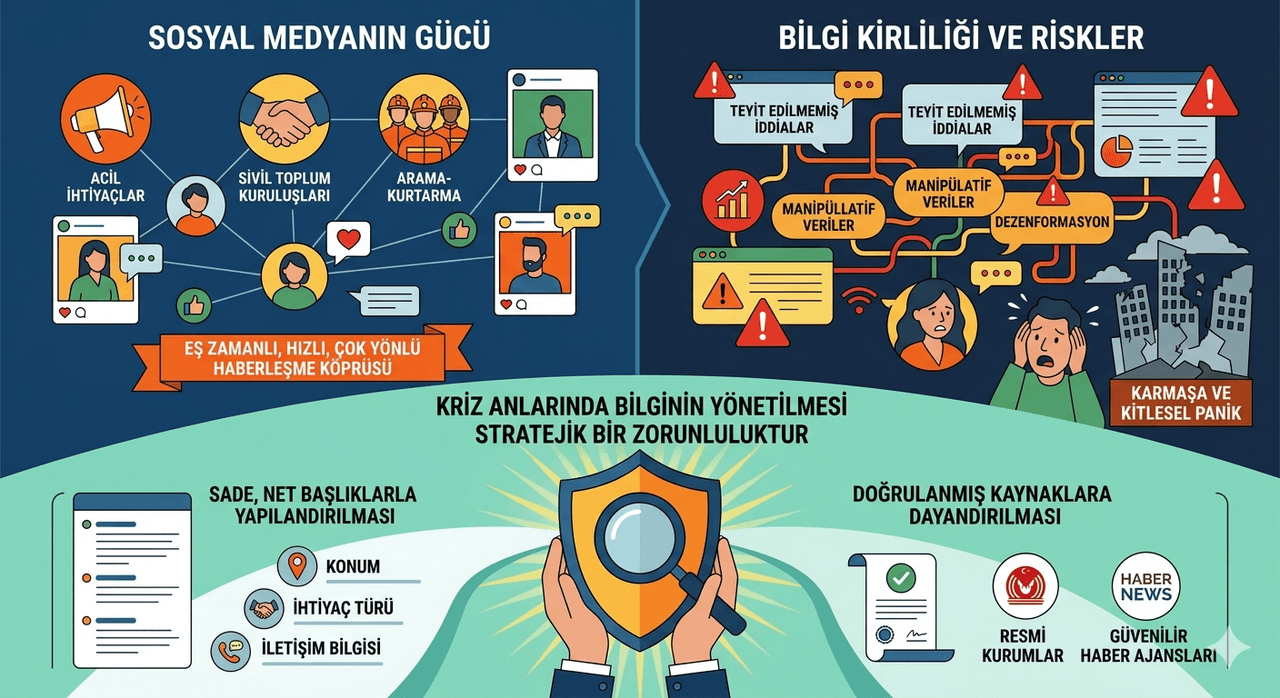
A Visual on Constructive and Ethical Crisis Communication (Generated by Artificial Intelligence)
The unregulated nature of social media can facilitate the spread of unverified claims, manipulative data, and disinformation, leading to information pollution, confusion, and mass panic in the public sphere.
Therefore, managing information during crises—structuring it with clear, simple headlines and grounding it in verified sources—is a strategic necessity.
From the perspective of media organizations and journalistic practice, it is observed that crisis situations are always associated with commercial potential and viewed as opportunities. Elements of violence and action in events such as war, terrorism, and attacks are used to stimulate viewer curiosity, while natural disasters such as floods, earthquakes, and hurricanes provide material for content centered on individual tragedies, suffering, and destitution.
The dependence of television networks and digital platforms on economic revenues from advertising and sponsorship agreements creates an imperative to achieve high ratings and viewership rates. Indeed, competitive conditions within the industry drive news programs and broadcasters to make their content more striking, exaggerated, and sensational in order to reach larger audiences.
Anadolu Ajansı. "Krizde doğru haber alma hakkı." Anadolu Ajansı. Accessed May 28, 2026. https://www.aa.com.tr/tr/teyithatti/blog/krizde-dogru-haber-alma-hakki-/1815526
Dağ, Harun, and Kartal, Zafer. "İlişkisel bağlamda kriz iletişimi ve kriz haberciliği." Akademik Araştırmalar, Volume 2, 252–261. Accessed May 28, 2026. https://www.researchgate.net/publication/357340023_ILISKISEL_BAGLAMDA_KRIZ_ILETISIMI_VE_KRIZ_HABERCILIGI
Presidency of Communications. "Disaster Journalism: Practice, Ethics, and Security Guide." Presidency of Communications Publications, pp. 1-338. Accessed May 28, 2026. https://yayinlar.iletisim.gov.tr/uploads/afet-haberciligi-tr.pdf
Çaplı, Bülent Mehmet, and Taş, Oğuz. "Kriz haberciliği." *Televizyon Haberciliğinde Etik*, Ankara: Fersa Yayıncılık, pp. 237–250. Accessed May 28, 2026. https://www.academia.edu/3823922/Kriz_Habercili%C4%9Fi
Çetinkaya, Ebru. "Kriz haberciliği ve etik: Televizyon haberlerinde koronavirüs pandemisi ATV ve FOX TV örneği." Master's thesis, Akdeniz Üniversitesi Sosyal Bilimler Enstitüsü, pp. 1–171. Accessed May 28, 2026. http://dspace.akdeniz.edu.tr/bitstream/handle/123456789/7018/T07687.pdf?sequence=1&
Özkan, Mücahit. “Kriz Haberciliği ve Etik Sorunsalı: Kahramanmaraş Deprem Örneği”. *Kocaeli Üniversitesi İletişim Fakültesi Araştırma Dergisi*, no. 27: 1–20. Accessed May 28, 2026. https://dergipark.org.tr/tr/pub/kilad/article/1755187
[1]
Presidency of Communication, "Disaster Journalism: Practical, Ethical and Safety Guide," Presidency of Communication Publications, p.153, accessed 28 May 2026, https://yayinlar.iletisim.gov.tr/uploads/afet-haberciligi-tr.pdf

Crisis Journalism (Generated with Artificial Intelligence.)
Crisis Types | Natural disasters, Public health crises, Socio-political crises, Economic downturns | ||||||||
|---|---|---|---|---|---|---|---|---|---|
Critical Functions | Crisis management, Public information, Social memory formation | ||||||||
Common Ethical Violations | Sensationalism, Privacy violation, Disinformation | ||||||||
Communication Channels | Traditional media, Digital media, Social networks | ||||||||
Basic Principle | Objectivity Truth Public interest Humanity | ||||||||
Communication Channels | Traditional media Digital media Social networks | ||||||||
Common Ethical Violations | Sensationalism Privacy violation Disinformation | ||||||||
Critical Functions | Crisis management Public information Social memory formation | ||||||||
Crisis Types | Natural disasters Public health crises Socio-political crises Economic crises | ||||||||
Communication Approaches According to Crisis Types
Professional Responsibilities and Trauma Awareness
Post-Crisis Processes and Social Memory
Ethical Issues and Major Violations
Social Media and Information Management
Competition and Ratings Factor