This article was automatically translated from the original Turkish version.
Team(s) | Squamata | ||||||||
|---|---|---|---|---|---|---|---|---|---|
Family | Colubridae | ||||||||
Conservation Status | IUCN: Least Concern | ||||||||
Specie(s) | Pantherophis guttatus | ||||||||
Average Size | 70–120 cm | ||||||||
Genus | Pantherophis | ||||||||
Subteam | Serpentes | ||||||||
Class | Reptilia | ||||||||
Habitat | Forests suburbs agricultural lands rocky areas grasslands | ||||||||
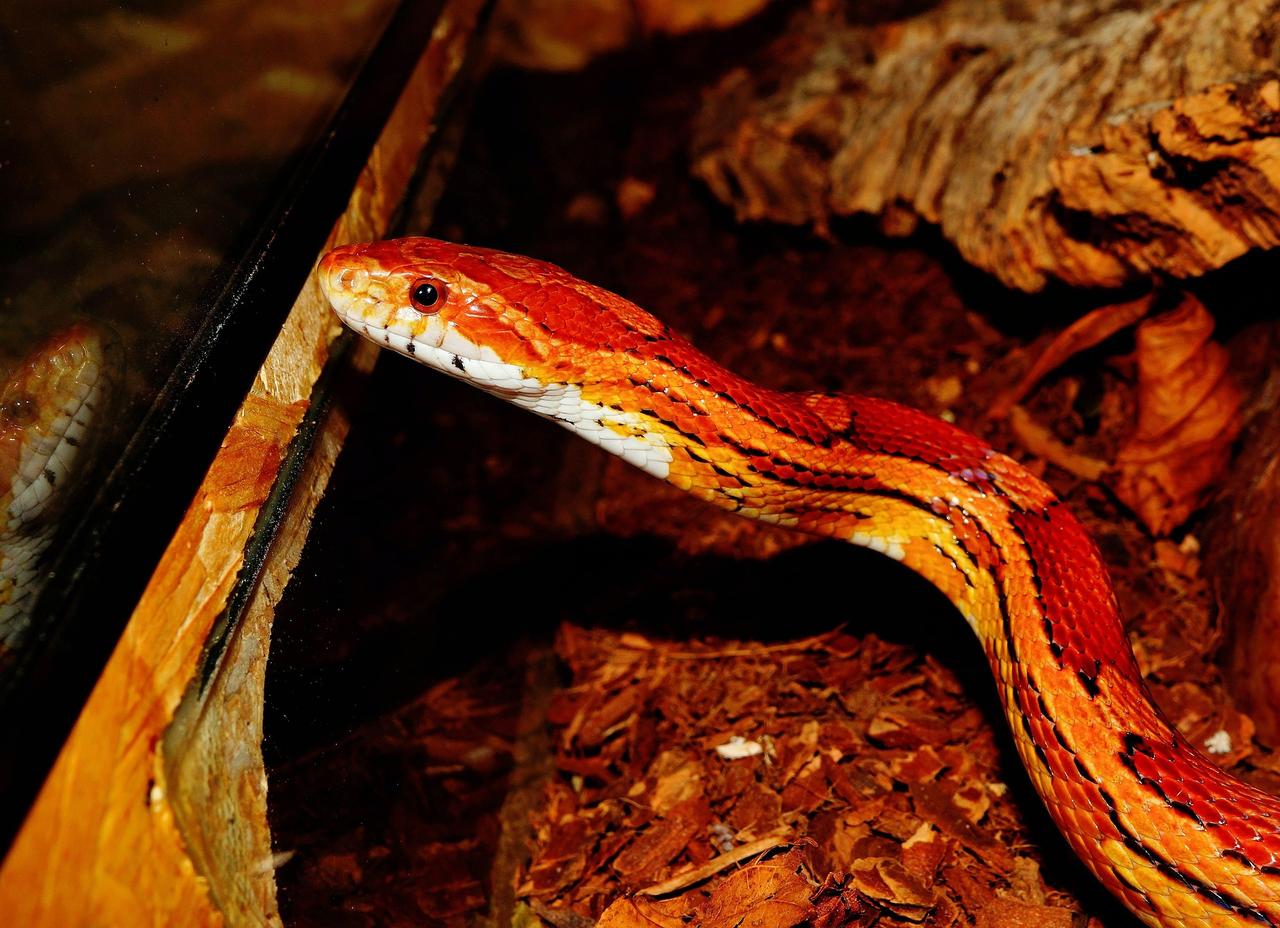
The cornsnake Pantherophis guttatus is a species of snake belonging to the family Colubridae within the class Reptilia, phylum Chordata, and kingdom Animalia. Although previously classified as Elaphe guttata, phylogenetic studies have led to the reclassification of New World rat snakes into the genus Pantherophis, separating them from Old World species. Genetic analyses have revealed that this species is more closely related to kingsnakes within the tribe Lampropeltini. Currently, two subspecies are recognized: Pantherophis guttatus and P. guttatus emoryi.
The natural range of the species extends from the eastern and southern interior regions of the United States to northern Mexico. It is observed across a broad area from New Jersey to Florida and westward through Mississippi and Louisiana to Texas. A terrestrial species, the cornsnake inhabits a wide variety of habitats including deciduous forests, rocky areas, grasslands, fields, and farm buildings in suburban regions. Although it generally prefers low elevations, it has been recorded at altitudes up to 1800 meters above sea level.
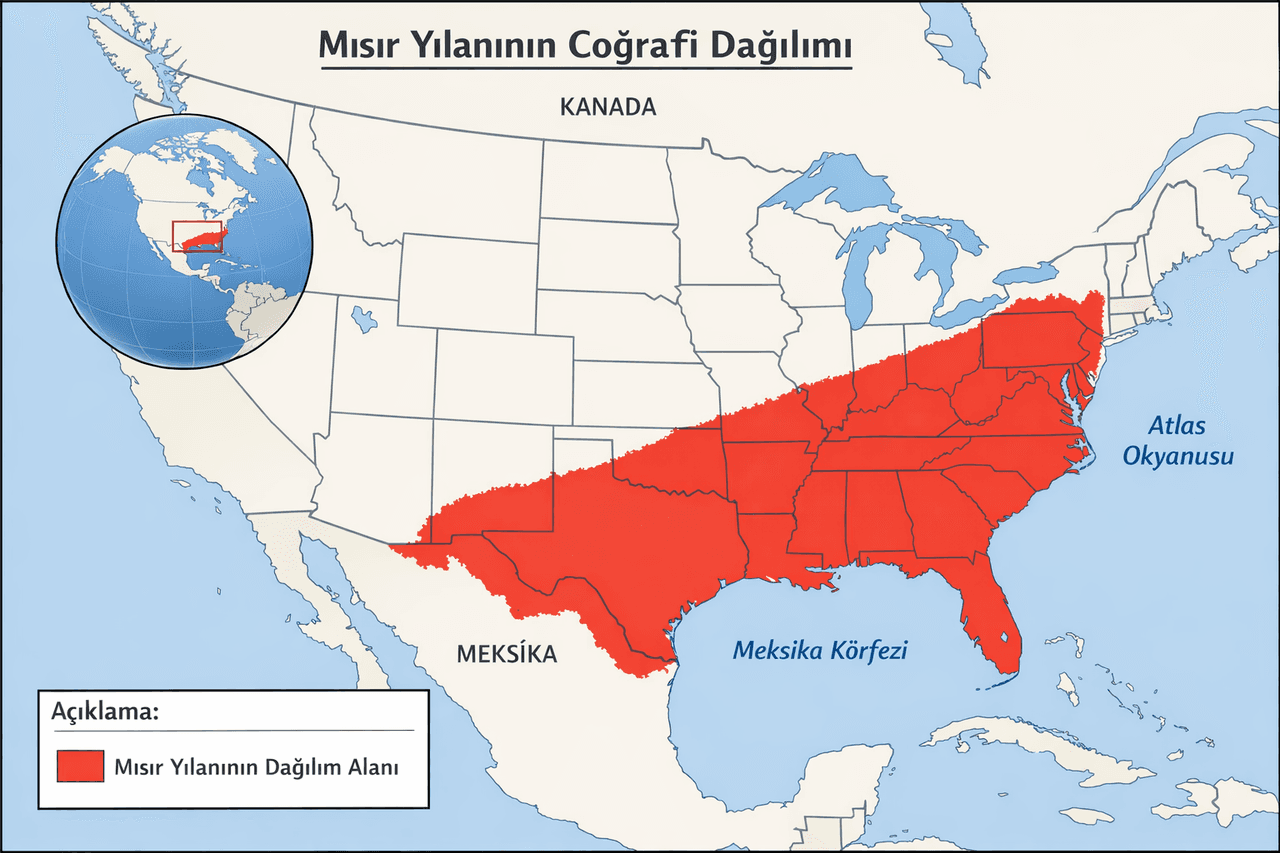
Geographic Distribution of the Cornsnake (Generated by Artificial Intelligence)
A nonvenomous species, the cornsnake is characterized by prominent large dorsal blotches and a checkerboard pattern of black and white on its ventral scales. Body coloration is typically shades of brown with reddish-orange tones, though regional variations in gray or yellow occur. Adult individuals typically range from 70 to 120 cm in length and exhibit sexual dimorphism, with males being larger than females. Additionally, males have a greater number of subcaudal scales while females have more ventral scales. The relatively narrow head and square-shaped dorsal blotches help distinguish it from venomous copperheads in similar habitats.
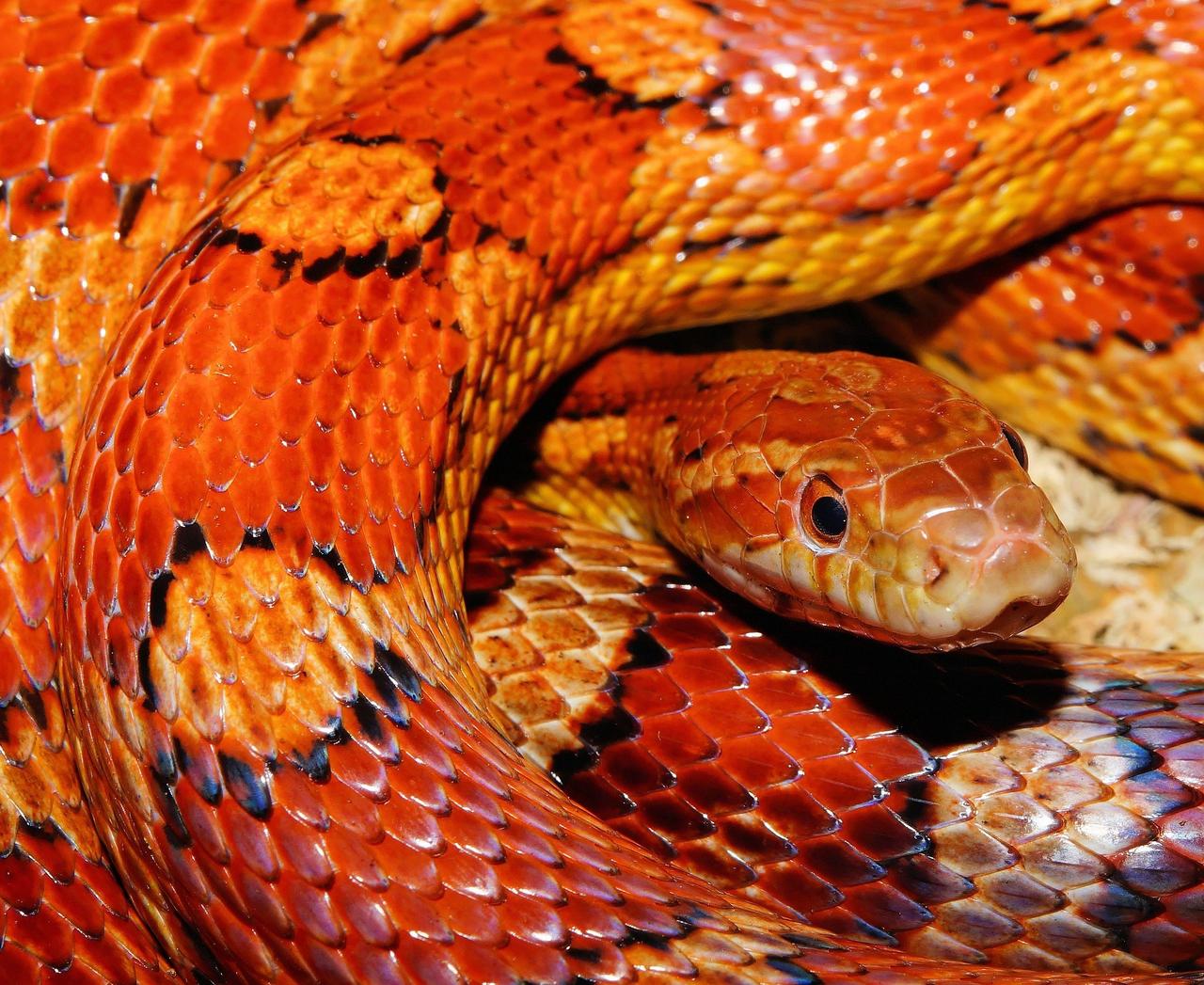
Cornsnake (Pixabay)
Cornsnakes have poor eyesight and rely primarily on their sense of smell to perceive their environment. They collect odor molecules using their tongues and analyze them via the Jacobson’s organ in the roof of the mouth. This mechanism allows them to detect not only the presence but also the direction of scents. Additionally, they can detect ground vibrations through their bodies to locate prey or predators. Although they lack external ears, they achieve stereophonic hearing and directional localization through vibrations transmitted from the jawbones to the inner ear. Communication, particularly during the breeding season, occurs primarily through pheromones.
Cornsnakes employ a carnivorous feeding strategy and kill their prey by constriction. Rodents constitute more than 50 percent of their diet, but they also consume birds, bird eggs, amphibians, and other reptiles. In regions such as Florida, where reptiles form the primary food source, individuals tend to attain smaller body sizes. The digestive process is characterized by a metabolic increase known as specific dynamic action; oxygen consumption peaks 24 hours after feeding and returns to baseline levels within approximately 72 hours. After feeding, cornsnakes exhibit postprandial thermophily, preferring warmer areas to accelerate digestion.【1】
The breeding season is concentrated between March and May, depending on climate. Males engage in dominance contests, with the victor gaining mating rights. Females lay approximately 10 to 30 cylindrical eggs in warm, humid cavities. Incubation lasts about two months at the optimal temperature of 27.8 °C. Cornsnake embryos exhibit an exponential pattern of oxygen consumption throughout development, indicating continuous growth until the final stages. Hatchlings are fully developed upon emergence and receive no parental care.【2】
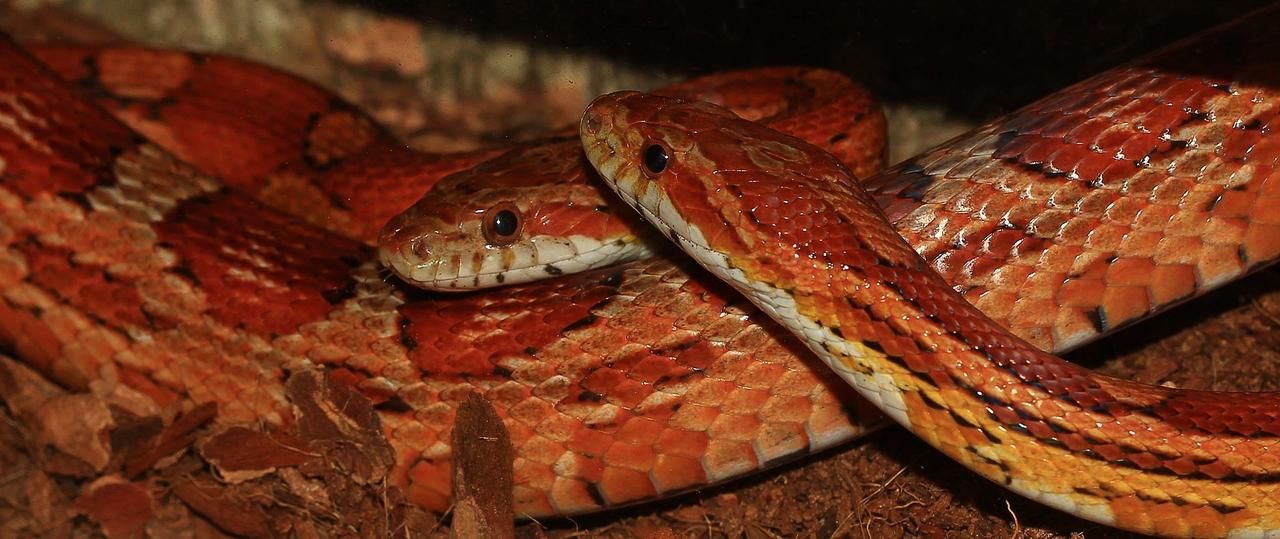
Cornsnake (Pixabay)
Primarily diurnal, the species may become crepuscular in warmer climates or seasons. Activity patterns typically follow a bimodal structure, with peaks during April–May and August–September. During winter months, from October to April, they hibernate in rock crevices or caves, although this period is significantly shorter in southern populations. During shedding, cornsnakes often display aggressive or reclusive behavior and may experience a loss of appetite.
Cornsnakes play a critical role in controlling rodent populations, thereby helping to prevent disease transmission and crop damage in both natural ecosystems and agricultural areas. Natural predators include large birds, carnivorous mammals, and larger snake species. Listed as Least Concern on the IUCN Red List, the species is not currently threatened with extinction despite habitat loss. While generally avoiding human contact, it may bite if cornered. Additionally, it is a popular species in the pet trade, with captive individuals recorded to live over 32 years.
Bird, William M., Philip Peak, and Danna L. Baxley. "NATURAL HISTORY AND MERISTICS OF AN ALLOPATRIC POPULATION OF RED CORNSNAKES, PANTHEROPHIS GUTTATUS (LINNAEUS, 1766) IN CENTRAL KENTUCKY, USA." Journal of North American Herpetology, no. 1 (May 2015): 6–11. Accessed March 28, 2026. https://doi.org/10.17161/jnah.vi1.11899
Gallardo, Celeste R., James R. Stewart, and Joseph R. Bidwell. "Developmental energetics in the oviparous corn snake, *Pantherophis guttatus*, confirms a conservative evolutionary pattern in snakes." *Comparative Biochemistry and Physiology Part A: Molecular & Integrative Physiology* 291 (2024): 111592. Accessed March 28, 2026. https://doi.org/10.1016/j.cbpa.2024.111592
Hogrefe, S. "Pantherophis guttatus." *Animal Diversity Web*. 2012. Accessed March 28, 2026. https://animaldiversity.org/accounts/Pantherophis_guttatus/
Paulick, Karsten. "astar natter mısır yılanı sürüngen." *Pixabay*. Accessed March 28, 2026. https://pixabay.com/tr/photos/astar-natter-m%c4%b1s%c4%b1r-y%c4%b1lan%c4%b1-s%c3%bcr%c3%bcngen-1089942/
Paulick, Karsten. "yılan sürüngen hayvan mısır yılanı." Pixabay. Accessed March 28, 2026. https://pixabay.com/tr/photos/y%c4%b1lan-s%c3%bcr%c3%bcngen-hayvan-m%c4%b1s%c4%b1r-y%c4%b1lan%c4%b1-579682/
Sievert, L. M., Y. Suita, D. M. Mayes, and others. "Specific dynamic action, postprandial thermophily, and the impact of temperature on gastric digestion in the cornsnake *Pantherophis guttatus*." *Zool. Stud.* 52, no. 33 (2013). Accessed March 28, 2026. https://doi.org/10.1186/1810-522X-52-33
Silvia. "Mısır Yılanı Astar." Pixabay. Accessed March 28, 2026. https://pixabay.com/tr/photos/m%c4%b1s%c4%b1r-y%c4%b1lan%c4%b1-astar-588654/
Silvia. "astar mısır yılanı sarı sürüngen." Pixabay. Accessed March 28, 2026. https://pixabay.com/tr/photos/astar-m%c4%b1s%c4%b1r-y%c4%b1lan%c4%b1-sar%c4%b1-s%c3%bcr%c3%bcngen-1191741/
[1]
L. M. Sievert, Y. Suita, D. M. Mayes and others, "Specific dynamic action, postprandial thermophily, and the impact of temperature on gastric digestion in the cornsnake Pantherophis guttatus," Zool. Stud. 52, no. 33 (2013), Access Date: 28 March 2026. https://doi.org/10.1186/1810-522X-52-33
[2]
S. Hogrefe, "Pantherophis guttatus," Animal Diversity Web, 2012, access date: 28 March 2026, https://animaldiversity.org/accounts/Pantherophis_guttatus/

Team(s) | Squamata | ||||||||
|---|---|---|---|---|---|---|---|---|---|
Family | Colubridae | ||||||||
Conservation Status | IUCN: Least Concern | ||||||||
Specie(s) | Pantherophis guttatus | ||||||||
Average Size | 70–120 cm | ||||||||
Genus | Pantherophis | ||||||||
Subteam | Serpentes | ||||||||
Class | Reptilia | ||||||||
Habitat | Forests suburbs agricultural lands rocky areas grasslands | ||||||||
No Discussion Added Yet
Start discussion for "Corn Snake (Pantherophis guttatus)" article
Geographic Distribution and Ecological Habitat Preferences
Morphological Structure and Physical Description
Sensory Perception and Communication Mechanisms
Feeding Ecology and Digestive Physiology
Reproductive Biology and Embryonic Development
Behavioral Patterns and Seasonal Activity
Ecosystem Role and Conservation Status