


This article was automatically translated from the original Turkish version.
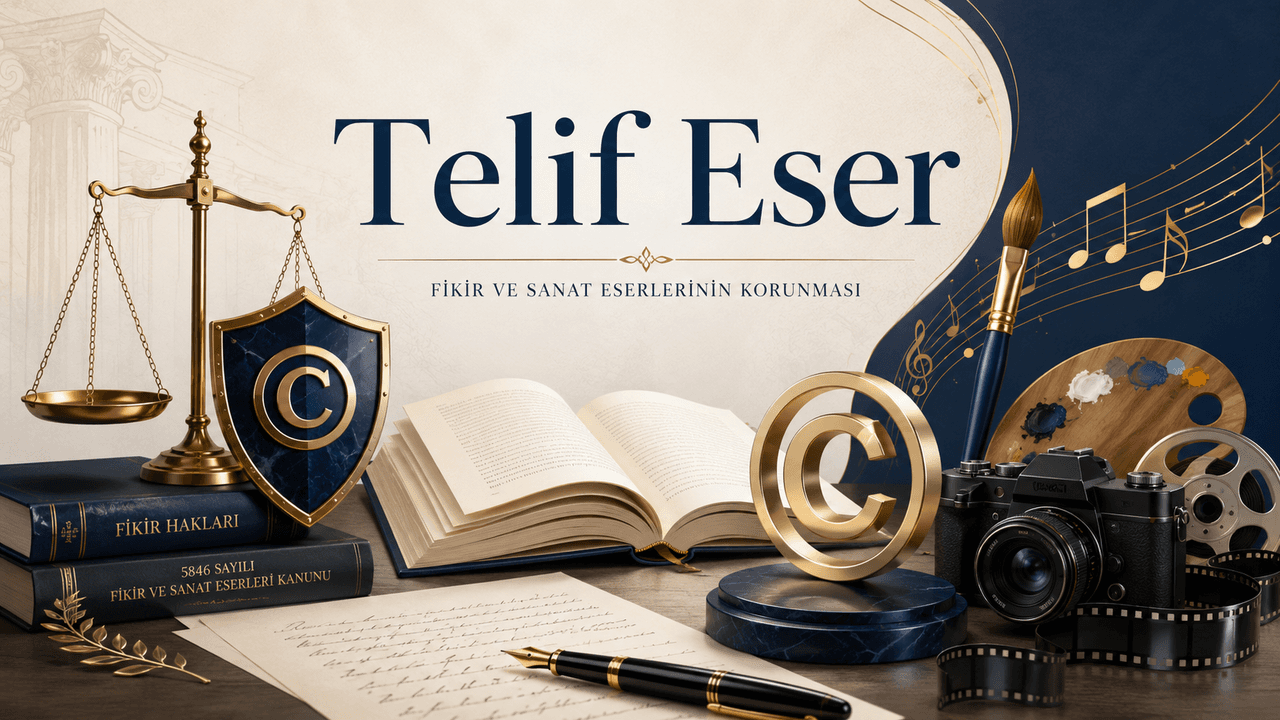
Generated with visual artificial intelligence.
Definition(s) | A work that is the product of original intellectual or artistic effort and is protected by law | ||||||||
|---|---|---|---|---|---|---|---|---|---|
Main Areas | Publishing, art, science and digital content | ||||||||
Rights | Moral and economic rights | ||||||||
Fundamental Law in Türkiye | Law No. 5846 on Intellectual and Artistic Works | ||||||||
International Basis | Berne Convention | ||||||||
A copyright work refers to products resulting from intellectual or artistic effort that possess original characteristics and are eligible for protection under legal systems. Globally, copyright protection typically covers works created in literary, scientific, and artistic fields. This protection focuses not on the subject matter of the work but on the original expression of ideas. Therefore, ideas, methods, concepts, or themes alone do not benefit from copyright protection. They must be concretized through a form of expression such as writing, music, visual arts, cinema, software, or similar means.
The concept of a copyright work is largely addressed within international frameworks under either the “copyright” or “author’s rights” systems. In the Anglo-Saxon legal tradition, the concept of “copyright” emphasizes primarily the reproduction, publication, and economic use of the work, whereas in continental European legal tradition, the personal bond between the author and the work is also strongly emphasized. Nevertheless, in modern copyright legal systems, both economic rights and moral rights hold significant importance.
One of the key international instruments for the protection of copyright works worldwide is the Berne Convention for the Protection of Literary and Artistic Works. Adopted in 1886, the Berne Convention aims to ensure the protection of literary and artistic works and to safeguard the rights of authors at the international level. The Convention grants authors the authority to control how, under what conditions, and by whom their works are used.【1】
According to the Berne Convention, three fundamental principles stand out in terms of copyright protection. The first is the principle of national treatment, which requires that a work created or published in a contracting country be protected in the same manner in other contracting countries. The second is the principle of automatic protection, which states that protection arises without the need for any registration or formalities. The third is the principle of independent protection, which holds that the protection of a work is assessed independently of whether it is protected in its country of origin.【2】
Within this framework, copyright works are recognized as intellectual products protected not only within national boundaries but also under international legal systems. However, the scope, duration, exceptions, and enforcement of protection may vary according to each country’s domestic legal regulations.
Although copyright works are classified under varying terminologies from country to country, globally protected works largely consist of literary, scientific, artistic, musical, audiovisual, and digital works.
Literary and scientific works include books, articles, novels, poems, short stories, screenplays, textbooks, scientific studies, reports, and similar written products. The protected element in these works is not the subject matter itself but the original manner of its expression. For example, a historical event, scientific topic, or social issue may be addressed by anyone. However, the specific expression of such topics by a particular author through unique language, narrative, and structure may qualify for copyright protection.
Musical works are creations expressed through sound and possessing musical qualities. Compositions, songs, instrumental pieces, and similar products fall within this category. Elements such as melody, rhythm, harmony, lyrics, and arrangement are of significance in terms of protection. The performance, recording, reproduction, and digital use of a musical work are separately evaluated under copyright law.
Visual art works include paintings, sculptures, graphics, photographs, illustrations, architectural designs, and similar visually oriented creations. Protection for these works is based on their originality of expression, irrespective of their aesthetic or artistic value. For a work to benefit from copyright protection, it must reflect the creator’s own creative contribution.
Cinema and audiovisual works result from the combination of moving images with sound, music, screenplay, editing, and visual storytelling elements. Films, documentaries, animations, television productions, and similar works belong to this category. Because such works often involve contributions from multiple individuals such as directors, screenwriters, composers, producers, and performers, rights ownership relationships can be more complex than in other types of works.
With the advancement of digital technologies, computer programs, databases, digital designs, online content, e-books, digital illustrations, video content, and games have gained importance under copyright law. Works produced or published in digital media may benefit from copyright protection as long as they meet the criteria of originality and expression. Being accessible on the internet does not imply that a work may be freely used.
Copyright protection begins with the creation of the work in most legal systems. Under the Berne Convention, many countries do not require registration or application for copyright protection. Therefore, a work may benefit from copyright protection from the moment it is created in an original form. However, some countries offer optional registration or deposit systems to facilitate proof of authorship.【3】
The application of copyright rights occurs through the exercise and enforcement of rights granted to the author. These rights are generally divided into two categories: economic rights and moral rights. Economic rights encompass uses such as reproduction, publication, distribution, translation, adaptation, performance, recording, broadcasting, and communication to the public.【4】 Moral rights preserve the personal connection between the author and the work. These include the right to have the author’s name credited and the right to object to any modification that could harm the author’s reputation.【5】
Licensing plays a vital role in the application of copyright. The author may grant or license specific rights to use the work to others, subject to limitations on duration, territory, language, format, or manner of use. Contracts in publishing, music, cinema, software, and digital content industries are fundamental tools for implementing copyright rights.
Copyright is not an absolute or unlimited right. Certain limited uses are permitted for purposes such as education, research, news reporting, criticism, quotation, personal use, and public interest. However, these exceptions vary by country and are generally applied with consideration of the purpose, scope, proportionality, and obligation to credit the source.
In Türkiye, the protection of copyright works is governed both by international treaties to which it is a party and by national legislation. One of the key international instruments to which Türkiye is a party is the Berne Convention for the Protection of Literary and Artistic Works of 1886. According to Türkiye’s General Directorate of Copyright under the Ministry of Culture and Tourism, the Berne Convention is the first multilateral international agreement designed to ensure the protection of intellectual and artistic works beyond national borders. The Convention was adopted on 9 September 1886 in Bern, Switzerland, and has been revised on various occasions, most recently in 1979. It defines literary and artistic works and regulates the economic and moral rights of authors as well as the duration and conditions of these rights. Türkiye acceded to the 1948 version of the Convention on 1 January 1952 and became a party to the Paris Act revised in 1979 in 1995.【6】
At the national level, copyright works in Türkiye are primarily regulated by Law No. 5846 on Intellectual and Artistic Works. This Law defines the moral and economic rights of authors of intellectual and artistic works, as well as related rights holders and other interested parties, and establishes the principles for their protection.【7】
According to Law No. 5846, a work is an intellectual or artistic product that bears the personal characteristics of its author and falls within one of the categories of works listed in the Law. This definition establishes two fundamental criteria for copyright protection in Türkiye. The first is that the product must bear the personal characteristics of its author, meaning it must reflect the author’s individual and creative contribution. The second criterion is that the product must belong to one of the categories of works specified in the Law. Therefore, in Türkiye, copyright protection is directed not toward abstract ideas themselves but toward their concrete and original expression.【8】
Law No. 5846 on Intellectual and Artistic Works classifies works into four main categories: works of science and literature, musical works, fine arts works, and cinematic works.【9】
Works of science and literature include written texts, scientific studies, literary works, computer programs, and similar products. Books, articles, novels, poems, textbooks, scientific reports, and screenplays are examples of such works.
Musical works encompass all types of musical compositions, whether vocal or instrumental. Compositions, songs, instrumental music, and similar products fall within this category. In musical works, both the lyrics and the musical composition may be protected separately or together under copyright.
Fine arts works include paintings, sculptures, architectural works, photographs, graphic works, cartoons, and similar visual products. Originality and aesthetic expression are essential in these works.
Cinematic works are creations consisting of sequences of moving images and possessing audiovisual unity. Films, documentaries, animations, and similar productions are included in this category.
In Türkiye, rights over copyright works are divided into moral rights and economic rights. Moral rights include the right to disclose the work to the public, the right to be identified as the author, the right to prevent alterations to the work, and the right to preserve the integrity of the work. These rights aim to safeguard the personal connection between the author and the work.
Economic rights encompass the authority to derive economic benefit from the work. Rights of exploitation, reproduction, distribution, performance, and communication to the public are included among economic rights. These rights belong to the author or other rights holders. Unauthorized reproduction, publication, distribution, digital sharing, or commercial use of a work may constitute copyright infringement.
In Türkiye, the duration of copyright protection lasts for the lifetime of the author and for seventy years after their death. If there are multiple authors, the term is calculated from the death of the last surviving author. In cases where the author is unknown or the author is a legal entity, protection lasts for seventy years from the date the work is made publicly available.【10】
Copyright arises upon creation of the work. Therefore, under Turkish law, registration or deposit is not required for copyright to come into existence. However, optional registration or deposit may be carried out to facilitate proof of ownership. This procedure is not a right-creating act but an administrative measure designed to assist in establishing evidence.
In Türkiye, the concept of copyright work has broad application in publishing, music, cinema, fine arts, digital content, software, academic publishing, and the cultural industry. Particularly in book publishing, the term “copyright work” is often used to refer to original works directly created by the author, excluding translations or adaptations. However, from a legal perspective, the decisive factor is not whether the work is a translation but whether it bears the author’s personal characteristics and falls within one of the categories of works listed in the Law.
With the advancement of digital publishing, the protection of copyright works in Türkiye is no longer limited to printed materials. E-books, audiobooks, digital images, online videos, software, digital music content, and texts published on the internet are also subject to copyright law. Therefore, the concept of copyright work is a fundamental legal and cultural concept, both for traditional cultural and artistic production and for the digital content economy.
Türkiye Cumhuriyeti. “5846 Sayılı Fikir ve Sanat Eserleri Kanunu.” Accessed June 7, 2026. https://www.mevzuat.gov.tr/MevzuatMetin/1.3.5846.pdf Türkiye Cumhuriyeti Kültür ve Turizm Bakanlığı Telif Hakları Genel Müdürlüğü. “Edebiyat ve Sanat Eserlerinin Korunmasına İlişkin Bern Sözleşmesi.” Accessed June 7, 2026. https://telifhaklari.ktb.gov.tr/TR-332363/edebiyat-ve-sanat-eserlerinin-korunmasina-iliskin-bern-sozlesmesi.html Türkiye Cumhuriyeti Kültür ve Turizm Bakanlığı Telif Hakları Genel Müdürlüğü. “Telif Hakkı Kaç Yıl Süreyle Korunur?” Accessed June 7, 2026. https://telifhaklari.ktb.gov.tr/TR-332373/telif-hakki-kac-yil-sureyle-korunur.html Türkiye Cumhuriyeti Kültür ve Turizm Bakanlığı Telif Hakları Genel Müdürlüğü. “Telif Hakkı Nedir?” Accessed June 7, 2026. https://telifhaklari.ktb.gov.tr/TR-332375/telif-hakki-nedir.html World Intellectual Property Organization. “Berne Convention for the Protection of Literary and Artistic Works.” Accessed June 7, 2026. https://www.wipo.int/en/web/treaties/ip/berne/index World Intellectual Property Organization. “Copyright.” Accessed June 7, 2026. https://www.wipo.int/en/web/copyright World Intellectual Property Organization. “Summary of the Berne Convention for the Protection of Literary and Artistic Works (1886).” Accessed June 7, 2026. https://www.wipo.int/en/web/treaties/ip/berne/summary_berne
[1]
World Intellectual Property Organization, “Berne Convention for the Protection of Literary and Artistic Works.” Erişim tarihi: 7 Haziran 2026. https://www.wipo.int/en/web/treaties/ip/berne/index
[2]
World Intellectual Property Organization, “Summary of the Berne Convention for the Protection of Literary and Artistic Works (1886).” Erişim tarihi: 7 Haziran 2026. https://www.wipo.int/en/web/treaties/ip/berne/summary_berne
[3]
World Intellectual Property Organization, “Copyright.” Erişim tarihi: 7 Haziran 2026. https://www.wipo.int/en/web/copyright
[4]
World Intellectual Property Organization, “Copyright.” Erişim tarihi: 7 Haziran 2026. https://www.wipo.int/en/web/copyright
[5]
World Intellectual Property Organization, “Copyright.” Erişim tarihi: 7 Haziran 2026. https://www.wipo.int/en/web/copyright
[6]
Türkiye Cumhuriyeti Kültür ve Turizm Bakanlığı Telif Hakları Genel Müdürlüğü, “Edebiyat ve Sanat Eserlerinin Korunmasına İlişkin Bern Sözleşmesi.” Erişim tarihi: 7 Haziran 2026. https://telifhaklari.ktb.gov.tr/TR-332363/edebiyat-ve-sanat-eserlerinin-korunmasina-iliskin-bern-sozlesmesi.html
[7]
Türkiye Cumhuriyeti, “5846 Sayılı Fikir ve Sanat Eserleri Kanunu.” Erişim tarihi: 7 Haziran 2026. https://www.mevzuat.gov.tr/MevzuatMetin/1.3.5846.pdf
[8]
Türkiye Cumhuriyeti, “5846 Sayılı Fikir ve Sanat Eserleri Kanunu.” Erişim tarihi: 7 Haziran 2026. https://www.mevzuat.gov.tr/MevzuatMetin/1.3.5846.pdf
[9]
Türkiye Cumhuriyeti, “5846 Sayılı Fikir ve Sanat Eserleri Kanunu.” Erişim tarihi: 7 Haziran 2026. https://www.mevzuat.gov.tr/MevzuatMetin/1.3.5846.pdf
[10]
Türkiye Cumhuriyeti Kültür ve Turizm Bakanlığı Telif Hakları Genel Müdürlüğü, “Telif Hakkı Kaç Yıl Süreyle Korunur?” Erişim tarihi: 7 Haziran 2026. https://telifhaklari.ktb.gov.tr/TR-332373/telif-hakki-kac-yil-sureyle-korunur.html

Generated with visual artificial intelligence.
Definition(s) | A work that is the product of original intellectual or artistic effort and is protected by law | ||||||||
|---|---|---|---|---|---|---|---|---|---|
Main Areas | Publishing, art, science and digital content | ||||||||
Rights | Moral and economic rights | ||||||||
Fundamental Law in Türkiye | Law No. 5846 on Intellectual and Artistic Works | ||||||||
International Basis | Berne Convention | ||||||||
The Concept of Copyright Work Worldwide
Types of Copyright Works
Literary and Scientific Works
Musical Works
Visual Art Works
Cinema and Audiovisual Works
Digital Works and Software
Application of Copyright Works
Legal Regulation of Copyright Works in Türkiye
Types of Copyright Works in Türkiye
Works of Science and Literature
Musical Works
Fine Arts Works
Cinematic Works
Rights Over Copyright Works in Türkiye
Duration of Protection and Registration in Türkiye
Scope and Importance of Copyright Works in Türkiye