


This article was automatically translated from the original Turkish version.
+2 More
The store system is the collective structural and electromechanical-electronic systems that enable the carriage and safe release of external loads—such as munitions, fuel tanks, reconnaissance pods, and electronic pods—on aircraft during missions. This system allows for the carriage of loads without disrupting their aerodynamic stability during flight and ensures their precise, controlled, and safe separation at the designated moment and in the correct direction and speed. Store systems can also be found on fighter aircraft, attack helicopters, unmanned aerial vehicles (UAVs/MAVs), and certain specialized civil aviation platforms.
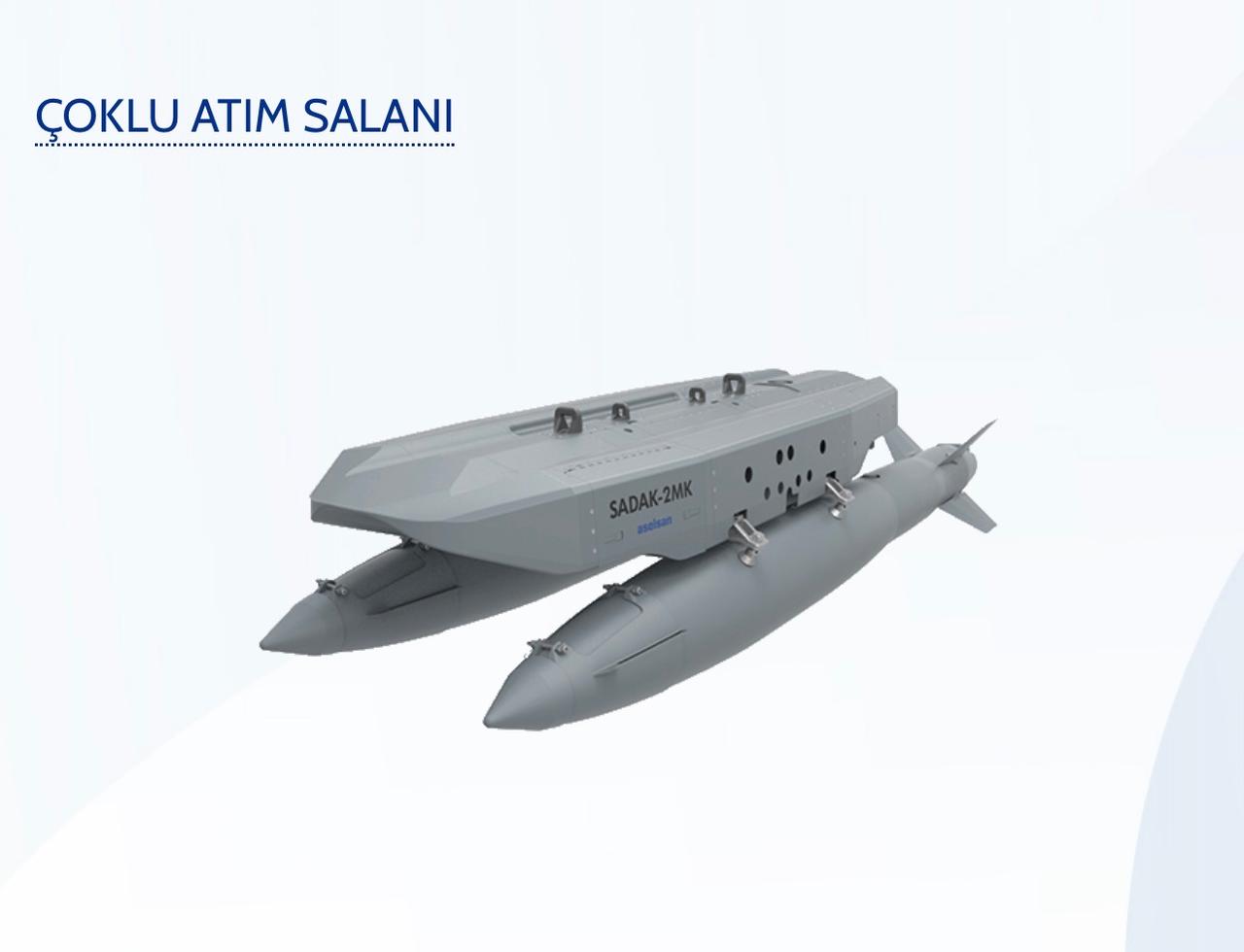
Multiple Store (Aselsan)
The store system consists of three fundamental elements: the pylon, the store mechanism, and the munition/load interface. The pylon is a mounting component fixed to the aircraft fuselage or wing that supports the load. It incorporates various mounting rails, electrical connectors, and the store mechanism. The store mechanism is the system responsible for releasing the munition from the aircraft. These mechanisms can operate using electromechanical, pneumatic, or in some cases pyrotechnic systems. The munition/load interface facilitates communication and power transfer between the carried load and the aircraft’s systems. This interface also enables digital data exchange with modern munitions.
The primary function of the store system is to securely retain the carried load during flight and release it upon command. The pilot’s release command, issued from the cockpit, is transmitted via the flight computer to the store mechanism. Upon receiving this command, mechanical locks are disengaged and the munition is ejected downward from the aircraft either by gravity or through an ejector system. Ejector systems ensure the munition is released at a speed and angle that prevents it from colliding with turbulent airflow or the aircraft structure. This process is carried out while accounting for variables such as the weight of the released load, aircraft speed, flight angle, and wind effects.
Mechanical store systems feature manual or motorized locking mechanisms and typically rely on gravity-based release mechanisms. These systems are commonly used on low-speed aircraft or with simpler munitions.
Pneumatic store systems use pressurized air to push munitions downward away from the aircraft. They are preferred in high-speed and high-altitude missions where it is critical to avoid contact between the munition and the aircraft fuselage.
Electromechanical store systems are the most widely used today. These systems are integrated with the aircraft’s computer systems and allow the release timing to be determined by mission software. They also enable digital communication with the munition.
Smart store systems are equipped with onboard processors and control units, support two-way data exchange with the carried munition, and can carry multiple munitions. They are primarily used in UAVs/MAVs.
Store systems are used on fighter aircraft to carry air-to-air and air-to-ground munitions. External fuel tanks are also transported via these systems and can be jettisoned during missions if necessary. In MAVs, small-scale and precision store systems are employed. Although these systems are typically designed for single munitions, some models can carry multiple munitions. In attack helicopters, anti-tank missiles, rocket systems, and laser-guided munitions are integrated with store systems. Additionally, parachute-based cargo drop systems on cargo aircraft are also a form of store system.
The MAU-12 bomb rack, used by the United States, is an electromechanical store system developed for conventional bombs. The BRU-61/A system, designed for multiple munitions, can carry four small-diameter bombs simultaneously. In Türkiye, ASELSAN-developed Smart Rack store systems are employed on UAVs such as Bayraktar TB2, AKSUNGUR, and ANKA. These systems are compatible with smart munitions such as MAM-L and MAM-C. Munitions developed by TÜBİTAK SAGE, such as HGK and KGK, can also be integrated with modern store systems.
Safety is the highest priority in store systems. Safety pins and pre-flight checks prevent accidental munition release while the aircraft is on the ground. During flight, the store system becomes active based on the mission profile. Before release, the munition is electronically verified; if an error or malfunction is detected, the release is aborted. Some systems include sensors that detect environmental factors such as vibration, pressure, and temperature. Additionally, software locks prevent the pilot from inadvertently releasing munitions.
The use of store systems dates back to the early 20th century. The process began during World War I with the manual dropping of hand grenades from aircraft and advanced during World War II with the development of specialized bomb release systems. The emergence of high-speed jets during the Cold War necessitated the aerodynamic and structural redesign of store systems. Beginning in the 2000s, the widespread adoption of digital and smart munitions required store systems to be equipped with data communication infrastructure. Today, advanced, precisely controlled store systems are used on both manned and unmanned platforms.
ASELSAN. "SADAK-2MK / SADAK-4T." Accessed July 22, 2025. https://www.aselsan.com/tr/cozumlerimiz/54/gudum-ve-arayici-baslik-sistem-teknolojileri.
Altınay Savunma. "Salan Sistemleri." Accessed July 22, 2025. https://www.altinaysavunma.com/tr/urunler/salan-4.
Anadolu Ajansı. “Milli Muharip Uçak KAAN’ın Silahları İçin Kritik Millileştirme.” Accessed July 22, 2025. https://www.aa.com.tr/tr/savunma-sanayisi/milli-muharip-ucak-kaanin-silahlari-icin-kritik-millilestirme/3205842.
Anadolu Ajansı. “Milli İHA’ların Yeni Mühimmatı KAYI İlk Kez Sergilendi.” Accessed July 22, 2025. https://www.aa.com.tr/tr/bilim-teknoloji/milli-ihalarin-yeni-muhimmati-kayi-ilk-kez-sergilendi/2722944.

Structural Components
Operating Principle
System Types
Applications
Example Systems and Applications
Safety Features
History and Development