


This article was automatically translated from the original Turkish version.
+1 More
Because the concept of conflict denotes a social phenomenon, it has multiple definitions linked to individual perspectives. Some generally accepted definitions in this regard are listed below.
There are two main approaches to conflict: modern and traditional. These are presented in the table below.
Table on approaches to conflict.
The causes of conflict are examined from two perspectives: organizational and personal/individual. Organizational causes include:
From the other perspective, personal/individual causes of conflict include:
Fundamentally, the causes of conflict stem from individuals, emotions, thoughts, ideas, behaviors, and attitudes, while within team collaboration, they arise from cohesion, communication, dedicated work, and available resources.
Conflicts occurring in society, systems, and organizations are classified and analyzed in various ways. The types of conflict at the individual level are as follows:
Intragroup conflict types can be classified as follows:
Another perspective categorizes conflicts as vertical and horizontal. Vertical conflict arises from hierarchical relationships within an organization’s command structure. Managers play a significant role in vertical conflicts, influencing both their occurrence and management management of conflict.
Horizontal conflict occurs among individuals at the same organizational level. Like other types of conflict, when well-managed, it can enhance performance through healthy competition; when poorly managed, it can lead to negative outcomes.
The subject of conflict is crucial in its resolution. Conflicts at the action or procedural level are easier to resolve; however, when they escalate to the principle level, resolution becomes more difficult. In such cases, it may be beneficial for one party to make a concession to bring the conflict back from the principle level to the action or procedural level.
When examining the parties involved in conflict from a personal perspective, some examples of how individuals behave in conflict situations based on personality traits are provided below.
Understanding how personality traits influence outcomes is important. In particular, being able to predict how individuals will behave in conflict situations can accelerate the resolution process.
Various management models offer temporary solutions to conflicts in organizations. These are methods applied during the conflict and designed to provide short-term relief.
Avoidance is defined as an individual or team distancing themselves from a choice they believe will cause them greater harm. For example, an employee who is unhappy in their job but cannot find comparable pay elsewhere may choose to remain in their current position, which is considered avoidance.
From an organizational perspective, avoidance refers to managers ignoring conflicts between employees. It is assumed that employees will resolve their own problems over time, and decisions regarding the conflict are delayed. While this approach can sometimes help resolve conflict, it can also intensify it and lead to more negative outcomes.
The accommodation strategy involves behaviors aimed at satisfying the other party by disregarding differences. It can also be described as fully accepting the other party’s demands during a conflict. This strategy is often employed when an individual believes that expressing their own needs would escalate the conflict further.
Compromise is defined as a strategy in which the parties to a conflict reach a mutual solution by making reciprocal concessions. It is a strategy in which there is no clear winner or loser, and balancing personal and shared interests is essential. While it achieves agreement between both parties and is less risky than accommodation, it does not generate major problems afterward. However, it is still classified among temporary resolution strategies because it does not resolve the root cause of the conflict but only provides a temporary agreement that addresses the conflict only for the moment.
The smoothing strategy involves emphasizing the need for long-term cooperation and its benefits to the parties, while downplaying the significance and urgency of the situation. Through this behavior, the manager encourages conflicting parties to focus on unity and solidarity rather than highlighting their differences.
This strategy involves the manager using the authority granted by their position to resolve conflicts. The manager implements a strategy without considering the interests of either party, and it is enforced upon the parties. When used frequently, this method can reduce employee morale and motivation.
Management models that provide permanent solutions to conflicts are highly beneficial in the long term, aiming to resolve issues at their root rather than merely suppressing them temporarily.
This is the opposite of avoidance and involves actively addressing conflict in a positive manner. It is defined as the manager bringing the parties together to jointly identify the causes of disagreement and then collaboratively finding a solution. When management decides to gather the necessary information from within the organization, it must create an environment conducive to resolution. To this end, it must establish flexible authority delegation, build infrastructure for innovation, and implement a multidirectional communication and information system that allows free flow of ideas.
This approach is achieved by introducing new resources within the organization. If conflict arises from material or immaterial constraints, management can resolve it by increasing available resources.
This method is based on altering and restructuring the organization’s structure to eliminate conflicts. Changes occur through modifications to employees’ job descriptions. In this context, improved interactions and mutual understanding among employees can lead to positive outcomes.
This approach involves removing individuals involved in conflict from the organization, either fully or partially. It may mean completely removing an individual from the organization or retaining them but redirecting them to a different process. For example, if two managers in a project clash due to overlapping authority, assigning one of them to a different project exemplifies this approach.
The primary method for changing behavior in conflict situations is educational efforts aimed at influencing behavior and beliefs. Individuals causing conflict are placed under managerial supervision for training, and their progress is monitored. Ultimately, their responses and attitudes toward similar future situations are assessed to determine appropriate solutions. This approach aims to develop individuals intellectually, end the conflict, and prepare them for how to behave in future situations. Relevant training examples include:
In this approach, existing active goals are replaced by new, shared objectives. Sometimes destructive conflicts in organizations arise because employees view events solely through their own perspectives and responsibilities, focusing narrowly on their own departments. To address this, a common and overarching goal must be established to guide employees.
Positive consequences of conflict on individuals include:
Negative consequences include:
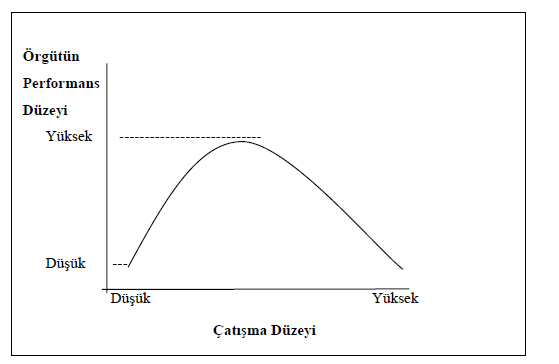
Örgütsel çatışma yönetimi stratejileri üzerinde psikolojik güçlendirme ve duygusal zekâ düzeyinin etkilerine yönelik bir tablo. (Kılıç E, s. 134)
As shown in the graph above, an increase in the level of conflict initially has a positive effect on organizational performance. However, once it exceeds the optimal level, it leads to a significant decline in performance.
Apipalakul, Chanya, et al. “Conflict Management on Use of Watershed Resources.” *Procedia - Social and Behavioral Sciences* 91 (2013): 554–563.https://www.sciencedirect.com/science/article/pii/S1877042814038415.
Karabakkal, Hasan, and Alev Torun. “Kamu Ar-Ge Merkezi Çalışanlarının Çatışma Nedenleri ve İşlevsel Çatışma Yönetimi Becerileriyle İlgili Görüşleri.” *Bucak İşletme Fakültesi Dergisi* 2, no. 1 (2019): 39–53.https://www.researchgate.net/publication/341061441_Kamu_Ar Ge_Merkezi_Calisanlarinin_Catisma_Nedenleri_ve_Islevsel_Catisma_Yonetimi_Becerileriyle_Ilgili_Gorusleri.
Kılıç, Eren. “Örgütsel Çatışma Yönetimi Stratejileri Üzerinde Psikolojik Güçlendirme ve Duygusal Zekâ Düzeyinin Etkilerine Yönelik Bir Araştırma.” Master's thesis, İstanbul Üniversitesi, Sosyal Bilimler Enstitüsü, 2019.https://tez.yok.gov.tr/UlusalTezMerkezi/tezDetay.jsp?id=_M7TMe_7LaIFT0R-rAYyTg
Kıral, Erkan. "Çatışma ve Kriz Yönetimi." Eğitim Yönetimi: Kuram ve Uygulama içinde, edited by Cemalettin Özdemir, Pegem Akademi, 2019, pp. 175–194.
Oachesu, Madalina. “Conflict Management, a New Challenge.” *Procedia Economics and Finance* 39 (2016): 807–814.https://www.sciencedirect.com/science/article/pii/S2212567116302556.
Shahmohammadi, Nayereh. “Conflict Management Among Secondary School Students.” *Procedia - Social and Behavioral Sciences* 159 (2014): 630–635.https://www.sciencedirect.com/science/article/pii/S1877042814065689.
Tabassi, Amin Akhavan. “Conflict Management Style of Team Leaders in Multi-Cultural Work Environment in the Construction Industry.” *Procedia Computer Science* 121 (2017): 1034–1041.https://www.sciencedirect.com/science/article/pii/S1877050917321981.
Özdemir, Aytül Ayşe, and others. *Çatışma ve Stres Yönetimi-I*. Eskişehir: Anadolu Üniversitesi Yayınları, 2014.https://www.okuryazar.com.tr/kitap/catisma-ve-stres-yonetimi-1.

Causes of Conflict
Types of Conflict
Subject and Parties of Conflict
Temporary Resolution Strategies
Avoidance Strategy
Accommodation Strategy
Compromise Strategy
Smoothing Strategy
Power Use Strategy
Permanent Resolution Strategies
Problem-Solving Approach
Resource Expansion Approach
Structural Change Approach
Replacing Conflict Parties Approach
Behavior Modification Approach
Goal Setting Approach
CONSEQUENCES OF CONFLICT
Consequences of Conflict on Individuals
Consequences of Conflict on Organizations