

This article was automatically translated from the original Turkish version.
+2 More
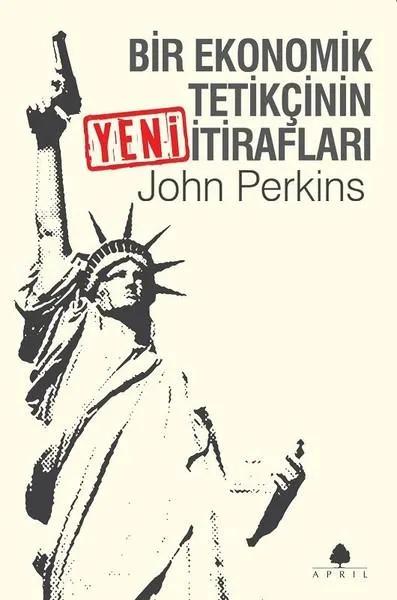
Publisher(s) | April Yayıncılık | ||||||||
|---|---|---|---|---|---|---|---|---|---|
Number of Pages(Text) | 408 pages | ||||||||
Translator(s) | Kerem Ergener Murat Kayı | ||||||||
Author(s) | John Perkins | ||||||||
Subject Headings | Ethical dilemmas US foreign policy International finance New colonialism Global economy | ||||||||
Genre | Political Economy Memoir Narrative | ||||||||
Original Title | The New Confessions of an Economic Hit Man | ||||||||
John Perkins’ book Confessions of an Economic Hit Man is an autobiographical account of his experiences while working for multinational corporations and the U.S. government. The book details how developing countries were burdened with debt, driven into economic dependency, and subsequently subjected to political or military intervention, while also tracing the inner transformation and moral reckoning of an individual.
Perkins’s testimony reveals how seemingly positive practices such as development aid and infrastructure investment were in fact tools that reproduced global power relations and fostered dependency. In this regard, the book opens a discussion on the ethical dimensions of global capitalism and offers an alternative economic-political interpretation.
According to Perkins, economic hit men (EHMs) are consultants who propose excessive loans to developing countries for large infrastructure projects. These loans are typically channeled to Western companies, provide little real benefit to the host country’s development, and are structured so that repayment becomes impossible. Through this method, countries are made dependent on the IMF, the World Bank, and other international financial institutions.
“We were the men who built empires through debt—an empire conquered without armies…” (John Perkins)
Perkins names the central mechanism of this system “corporatocracy.” Under this model, multinational corporations shape global decisions by influencing financial institutions, media, and governments. In this process, media manipulation, academic influence, and cultural hegemony are also employed. All of this is grounded in a triad of “debt, coercion, and intervention when necessary.”
The institutions involved in this strategy include:
In the 1970s, Indonesia held strategic importance for the United States following the OPEC crisis. In projects in which Perkins participated, billions of dollars in infrastructure loans were proposed to the country. These loans financed power plants, ports, and roads. However, the majority of the funds flowed to U.S.-based engineering firms, leaving Indonesia saddled with unpayable debt.
President Jaime Roldós attempted to renegotiate agreements with U.S. corporations to ensure that Ecuador’s natural resources benefited its people. Perkins claims these efforts were sabotaged by “jackals” (political assassination teams) and that Roldós died shortly afterward in a plane crash.
Similarly, Panamanian head of state Omar Torrijos challenged U.S. dominance over the Canal. He refused to cooperate with U.S.-backed corporations and pursued independent policies. According to Perkins, Torrijos also died shortly thereafter under similar circumstances. Both deaths have been widely suspected as political assassinations.
In 1953, Prime Minister Mosaddegh’s efforts to nationalize Iran’s oil were terminated by a coup supported by the CIA and MI6. Perkins presents this event as an example of the military mechanisms activated when economic hit man strategies fail.
Perkins participated in economic direction projects in various Latin American countries over different periods. Saudi Arabia represents a distinct case: rather than debt-based leverage, a model of direct strategic cooperation is applied. Billions of dollars in contracts for U.S. engineering firms are secured through exclusive agreements between the Saudi government and Western corporations.
In the book, these institutions are not portrayed merely as providers of financial support but as regulators of global hegemony. Developing countries are forced, in exchange for debt, to privatize public assets, cut budgets for education and health, and open natural resources to foreign investors.
In his updated editions of 2016 and 2023, Perkins argues that China has adopted the same economic hit man methods used by the United States. In return for highways, ports, and government buildings constructed across Africa, countries become dependent on China through the supply of raw materials and political concessions.
The book is not merely a political-economic analysis; it is also a moral accounting. Perkins enters a kind of spiritual purification process through his work on environmental projects in the Amazon. Writing the book is part of this process. He expresses it thus:
“Writing this book was my salvation. I could no longer live without sharing what I knew.”
In his speech on YouTube Perkins directly explains the role of economic hit men, describing how governments are manipulated to serve the interests of multinational corporations. “The core of this system is fear and debt,” he says, emphasizing that economic dependency forms the foundation of modern imperialism.
Confessions of an Economic Hit Man by John Perkins (Aziz Akbiyik)
The book has been criticized by some academic circles for insufficient documentation. However, its basis in personal testimony and its alternative economic-political interpretation have opened significant debate in the social sciences. It is frequently cited in critiques of debt, development narratives, and multinational corporations.
Akbıyık, Aziz. *Ekonomi Tetikçisi John Perkins'in İtirafları [Türkçe].* YouTube video, 22:53. September 15, 2018. https://www.youtube.com/watch?v=0nR-m0Cvyu0.
Altuğ, Fatih. “Kitap Değerlendirmesi: Bir Ekonomik Tetikçinin İtirafları.” Coğrafi Bilimler Dergisi 15, no. 2 (2017): 187–189. https://dergipark.org.tr/tr/pub/aucbd/issue/44453/550922.
Perkins, John. *Bir Ekonomik Tetikçinin İtirafları*. PDF book. Accessed July 2, 2025. http://www.ozetkitap.com/kitaplar/bir_ekonomi_tetikci.pdf.
Perkins, John. *Confessions of an Economic Hit Man*. Trans. Murat Kayı. İstanbul: April Yayıncılık, 2017.
Perkins, John. “An Economic Hit Man Confesses and Calls to Action | John Perkins.” YouTube video, 54:52. TEDx Talks, August 9, 2015. Accessed July 2, 2025. https://youtu.be/btF6nKHo2i0.
“Bir Ekonomik Tetikçinin Yeni İtirafları.” 1000Kitap. Accessed July 2, 2025. https://1000kitap.com/kitap/bir-ekonomik-tetikcinin-yeni-itiraflari--94424.

Publisher(s) | April Yayıncılık | ||||||||
|---|---|---|---|---|---|---|---|---|---|
Number of Pages(Text) | 408 pages | ||||||||
Translator(s) | Kerem Ergener Murat Kayı | ||||||||
Author(s) | John Perkins | ||||||||
Subject Headings | Ethical dilemmas US foreign policy International finance New colonialism Global economy | ||||||||
Genre | Political Economy Memoir Narrative | ||||||||
Original Title | The New Confessions of an Economic Hit Man | ||||||||
No Discussion Added Yet
Start discussion for "Confessions of an Economic Trigger (Book)" article
Economic Hit Man
Institutional Structure: Corporatocracy and Surveillance Capitalism
Country Examples: Traces of Economic Hit Man Activities on the Ground
Indonesia
Ecuador: Jaime Roldós
Panama: Omar Torrijos
Iran: Mohammad Mosaddegh
Colombia, Saudi Arabia
Surveillance Institutions: IMF and the World Bank
The China Model: New Hit Men
Inner Transformation and Moral Accountability
Video Narrative: Perkins’s Testimony
Criticism and Academic Responses