This article was automatically translated from the original Turkish version.
Scientific Name(s) | Troglodytes troglodytes | ||||||||
|---|---|---|---|---|---|---|---|---|---|
Branch | Chordata | ||||||||
Weight(s) | 8-13 g | ||||||||
Size(s) | 9-11 cm | ||||||||
Family | Troglodytidae | ||||||||
Conservation Status | LC (Low risk) | ||||||||
Incubation Period | 12-20 days | ||||||||
Average Lifespan | 6 years | ||||||||
Class | Aves | ||||||||
World | Animalia | ||||||||
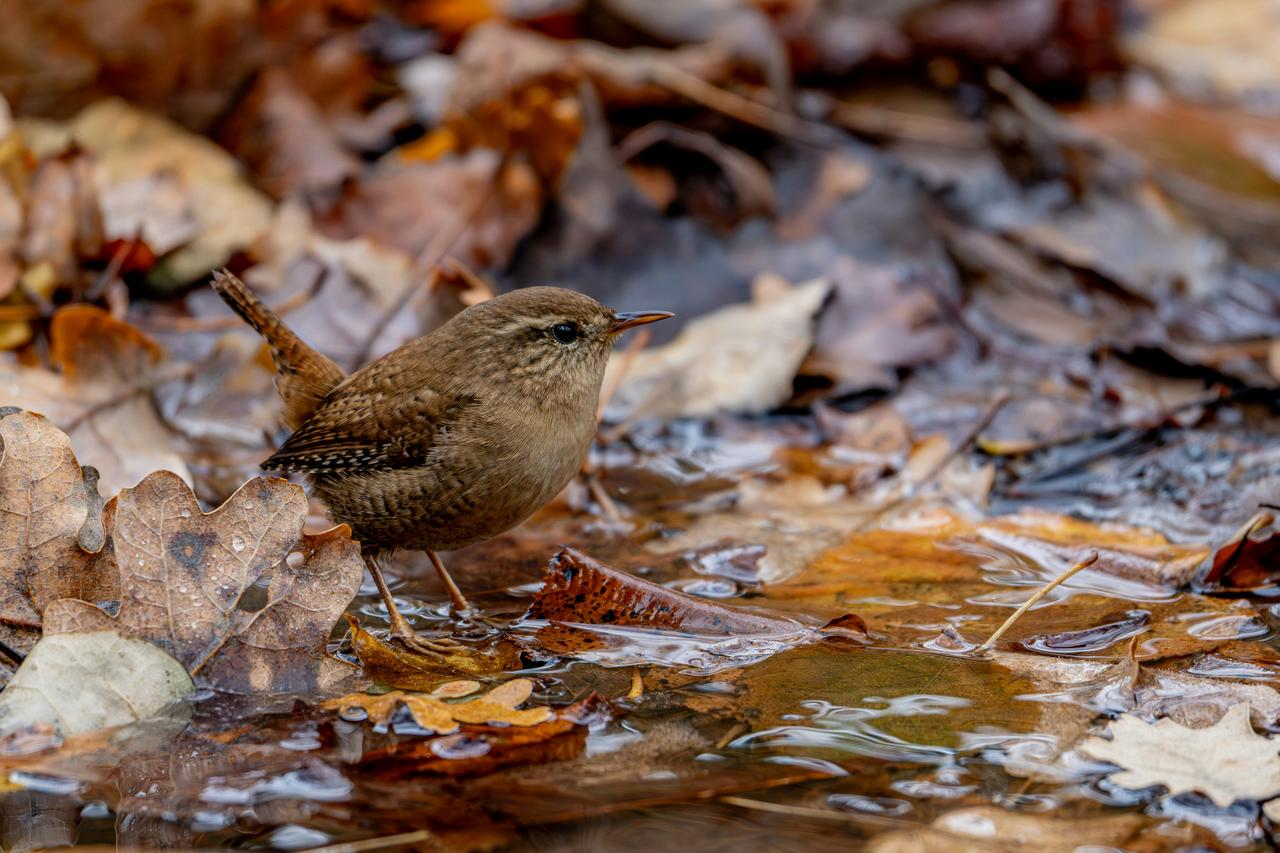
The common wren (Troglodytes troglodytes) is a songbird recognized by its small size, rounded body, and short upright tail. It is easily distinguished by its dark brown plumage with fine horizontal streaks and a prominent pale eyebrow stripe. This species, typically found in shrublands and covered areas, attracts attention through its active behavior and powerful voice.
The common wren (Troglodytes troglodytes) is a species within the order Passeriformes and belongs to the family Troglodytidae. This family includes small birds that typically inhabit dense vegetation and are known for their energetic behavior.
The common wren is a small, rounded songbird. Its most distinctive feature is its short upright tail. The plumage is generally brown, with fine horizontal streaks on a dark brown background. The underparts are lighter brown or gray, and some individuals show faint streaking in this area as well. The head matches the body in brown tones. A prominent thin eyebrow stripe is present. The eyes are dark and the small, slender bill is slightly downcurved.
The common wren has a wide geographic distribution. It is widespread across much of Europe and western and central Asia. In Türkiye, it is a resident species in most regions and a winter migrant in large parts of Central Anatolia, Eastern Anatolia and Southeastern Anatolia.
Its habitat is highly varied. It inhabits forests, shrublands, thickets, parks, woodlands and gardens. In villages and rural areas, climbing plants on fences, especially blackberries, provide suitable shelter, nesting and foraging sites.
It typically builds its nest in tree cavities and wall crevices. It generally avoids open areas and prefers covered environments with dense vegetation.
The common wren is described as a highly active and energetic species. It moves rapidly through dense vegetation and shrubbery near the ground. Its behavior is characterized by abrupt, quick movements, which can make observation challenging.
One of its most distinctive behavioral traits is its song. Despite its small size, it produces a remarkably loud and striking vocalization. These songs typically consist of high-pitched, rapid and melodic sequences. Due to its conspicuous song, the bird is often heard more than seen.
Its flight is short-distance and occurs close to the ground in a straight line, with rapid wingbeats. It mostly moves at ground level, among shrubs or at the base of trees.
Some populations in Europe are resident while others are migratory. Migratory individuals can travel up to 2500 km. Birds from northern Europe may use ships crossing the Baltic Sea as resting sites during migration.
The species’ population can be affected by harsh winter conditions; severe winters cause significant mortality, while milder winters are often followed by population recovery. This recovery is attributed to its high reproductive capacity.
The common wren is primarily insectivorous. It feeds on a variety of insects, spiders, larvae and other small invertebrates found on the ground or in trees. It obtains its food mainly by probing surfaces.
During winter months, its feeding habits may change, and it may also consume small seeds.
During the breeding season, the common wren builds spherical nests. Males typically construct two to three nests, which are then presented to the female for selection. Once the female chooses a nest, she lines the interior with feathers. Breeding occurs between March and July, and the female incubates two broods during this period. The eggs have a soft shell and are white with reddish spots on a bright background.
The common wren (Troglodytes troglodytes) is listed as Least Concern (LC) on the IUCN Red List. The species has a wide distribution and current data indicate a stable overall population trend.
Liatkouski, Matsvei. “A Small Bird Stands Among Fallen Autumn Leaves.” Photograph. Unsplash. Accessed March 19, 2026. https://unsplash.com/photos/a-small-bird-stands-among-fallen-autumn-leaves-j5nEQOiHp6s
ORNİTO. "Çıtkuşu." ornito.org. Accessed March 19, 2026. https://ornito.org/Bird/Detail/138
Trakuş. "Çitkuşu." Trakus.org. Accessed March 19, 2026. https://www.trakus.org/kods_bird/uye/?fsx=2fsdl17@d&tur=%C7itku%FEu
eBird. "Eurasian Wren (Troglodytes troglodytes)." Cornell Lab. Accessed March 19, 2026. https://ebird.org/species/winwre4?siteLanguage=tr

Scientific Name(s) | Troglodytes troglodytes | ||||||||
|---|---|---|---|---|---|---|---|---|---|
Branch | Chordata | ||||||||
Weight(s) | 8-13 g | ||||||||
Size(s) | 9-11 cm | ||||||||
Family | Troglodytidae | ||||||||
Conservation Status | LC (Low risk) | ||||||||
Incubation Period | 12-20 days | ||||||||
Average Lifespan | 6 years | ||||||||
Class | Aves | ||||||||
World | Animalia | ||||||||
No Discussion Added Yet
Start discussion for "Common Wren (Troglodytes troglodytes)" article
Taxonomy
Morphological Features
Distribution and Habitat
Behavior and Ecology
Diet
Breeding
Conservation Status