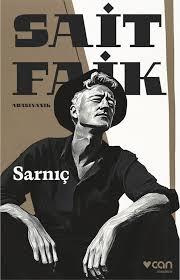
This article was automatically translated from the original Turkish version.
+1 More
Book Title | Cistern | ||||||||
|---|---|---|---|---|---|---|---|---|---|
Author(s) | Sait Faik Abasıyanık | ||||||||
Type(s) | Short Story | ||||||||
First Publication Year | 1939 | ||||||||
Publisher(s) | Can Yayınları | ||||||||
Number of Pages | 128 pages | ||||||||
Language(s) | Turkish | ||||||||
ISBN | 9789750765858 | ||||||||
Published in 1939, Sarnıç is Sait Faik Abasıyanık’s first short story collection and represents a crucial stage in the author’s transition to narrative storytelling. The book comprises sixteen short stories drawn from diverse settings and slices of life. These stories depict the everyday lives of workers, small traders, sailors, children, and individuals marginalized by society in the peripheral neighborhoods of Istanbul.
In this work, Sait Faik moves away from event-centered narration and turns his focus toward the inner states of individuals and the evocation of atmosphere. Simplicity in narration, natural descriptions, and the characters’ feelings of solitude come to the fore. For this reason, the collection is regarded as one of the earliest examples of modernist narration in Turkish short fiction.
Sarnıç consists of short stories set in impoverished neighborhoods, around the harbor, and in the lives of ordinary people. The daily struggles, small joys, disappointments, and social relationships of these individuals form the thematic framework. Particularly prominent are themes of social exclusion, the struggle for survival, loneliness, the relationship with nature, and a nomadic state of mind.
The characters in the stories are predominantly workers, fishermen, children, and clerks from the lower strata of society. Through these figures, the economic and social pressures of urban life are reflected. The author often refrains from giving names to his characters or providing clear backgrounds; this technique suggests an effort to make the invisible visible.
In Sarnıç, Sait Faik develops an observational and poetic narrative style. His descriptions intertwine nature and human experience. The stories, which avoid classical plot structures, emphasize the inner state of the individual and the surrounding atmosphere. Dialogues closely resemble everyday speech, and the narrator primarily assumes the role of an observer. Life is presented as a fragment without rigid temporal or spatial boundaries.
In some stories, a permeable boundary between reality and imagination creates an abstract atmosphere. The focus on conveying emotion and ambiance rather than events distinguishes the work from the traditional short story form.
The collection addresses themes such as urbanization, social class disparities, and individual alienation in 1930s Türkiye. The characters and settings mirror the economic and cultural conditions of the era, serving as a literary mirror to social realities. Equally explored is the individual’s relationship with nature and the search for peace found through this connection.
The living conditions of harbor workers, street vendors, and low-income individuals are depicted in detail.
The connection between humans and nature is examined through elements such as seagulls, the sea, and fishermen.
The inner states and psychological worlds of individuals excluded from society are conveyed through their introspective experiences.
In some stories, imaginative and realistic elements merge, expanding the narrative space.
Unlike the event-driven sequence of classical short stories, emphasis is placed on atmosphere and human psychology.
Sarnıç is Sait Faik’s first work in which he departs from traditional event-based storytelling and begins to explore the possibilities of the modern short story. By shifting toward the “state story,” it initiated a formal transformation in Turkish narrative fiction.
Recognized as one of the pioneering works in Turkish literature, the collection contributed significantly to the development of the short story genre through its focus on the inner world of the individual and its introduction of urban poverty into literary discourse.
Abasıyanık, Sait Faik. Sarnıç. İstanbul: Can Yayınları, 2024.
Atay, Selçuk. 2015. “Sait Faik Abasıyanık’ın ‘Sarnıç’ Adlı Hikâyesinde ‘Su’nun ‘Göstergebilimsel Serüveni’.” *Türk Bilim Araştırmaları Dergisi* 38 (Fall): 1–12. https://dergipark.org.tr/tr/download/article-file/157234.

Book Title | Cistern | ||||||||
|---|---|---|---|---|---|---|---|---|---|
Author(s) | Sait Faik Abasıyanık | ||||||||
Type(s) | Short Story | ||||||||
First Publication Year | 1939 | ||||||||
Publisher(s) | Can Yayınları | ||||||||
Number of Pages | 128 pages | ||||||||
Language(s) | Turkish | ||||||||
ISBN | 9789750765858 | ||||||||
Themes and Narrative Structure
Social Life and the Individual
Character Structure
Narrative Technique and Stylistic Features
Intellectual and Social Context
Thematic Layers
Social Class and Poverty
Human-Nature Relationship
Loneliness and Exclusion
Transition Between Reality and Imagination
Stillness in Narration
Literary Significance