This article was automatically translated from the original Turkish version.
Distance(s) | Approximately 13 million light years | ||||||||
|---|---|---|---|---|---|---|---|---|---|
Size(s) | 10.6 magnitude | ||||||||
Observation İnstrument | Hubble Space Telescope | ||||||||
Date of Discovery | 1977 | ||||||||
Object Type | Spiral galaxy | ||||||||
Location | In the third quadrant of the southern hemisphere (SQ3) | ||||||||
The Circinus Galaxy is a spiral galaxy with an active nucleus located in the Circinus constellation of the southern celestial hemisphere, approximately 13 million light years away. Due to its position very close to the plane of the Milky Way Galaxy, it has been largely obscured by foreground dust and stars, and could only be studied in detail toward the end of the 20th century. The galaxy belongs to the Type 2 Seyfert galaxies class and harbors a supermassive black hole at its center.
The Circinus Galaxy has a structurally prominent spiral disk, central regions rich in gas and dust, and an active galactic nucleus. Although its distance of approximately 13–14 million light years makes it one of the closest galaxies astronomically, it remained unnoticed for a long time due to the obscuring dust of the Milky Way. Observations in infrared wavelengths have been decisive in revealing the galaxy’s true structure and activity.
The Circinus Galaxy is classified as a Type 2 Seyfert galaxy. Seyfert galaxies are part of the broader class of Active Galactic Nuclei (AGN). In such galaxies, a significant portion of the brightness is produced by the supermassive black hole at the galactic center and its surrounding accretion disk. The AGN observed in Circinus is associated with powerful outflows that propel surrounding gas and dust at high velocities outward from the galaxy.
Surrounding the central supermassive black hole is a structure composed of dense gas and dust. This structure contains matter falling toward the black hole and partially absorbs the nucleus’s high-energy radiation, re-emitting it in infrared wavelengths.
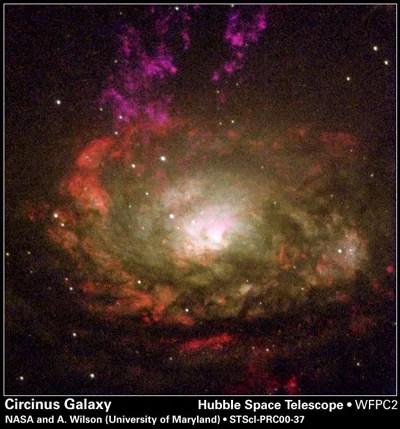
A large portion of the gas in the disk of the Circinus Galaxy is concentrated in two distinct rings. The larger outer ring has a diameter of approximately 1,300 light years and was previously observed from ground-based telescopes. The smaller inner ring, with a diameter of about 260 light years, was detailed through observations by the Hubble Space Telescope.
Both rings exhibit intense star formation activity and are therefore designated as “starburst” regions.
A V-shaped gas structure has been observed at the center of the galaxy and within the inner star formation ring. This structure is interpreted as the projection of a three-dimensional cone extending from the nucleus toward the galactic halo. Narrowband filter observations show that the gas in this conical region is heated by radiation emitted from the central black hole.
Ultraviolet and high-energy radiation emanating from the center excites the surrounding gas, causing it to glow, and this ionized gas is directed along two cones in opposite directions.
The Circinus Galaxy has been studied in detail through infrared observations. NASA’s Wide-field Infrared Survey Explorer (WISE) and the Spitzer Space Telescope have penetrated the foreground dust of the Milky Way to reveal the galaxy’s spiral arms and central brightness. In WISE images, the spiral arms of the galaxy exhibit a structure resembling a green “S” shape.
Detailed Hubble images of the Circinus Galaxy were obtained on 10 April 1999 using the Wide Field and Planetary Camera 2. A research team led by Andrew S. Wilson of the University of Maryland combined visible light data with near-infrared observations to study the galaxy’s dynamics and central activity.
Chandra X-ray Observatory. “Photo Album: Constellation Circinus.” Chandra.harvard.edu. Accessed January 26, 2026. https://chandra.harvard.edu/photo/constellations/circinus.html.
EarthSky. "Circinus: The Drawing Compass." EarthSky.org. Accessed January 26, 2026. https://earthsky.org/constellations/circinus-the-drawing-compass/.
NASA. "The Southern Constellation Circinus." NASA Science, May 7, 2008. Accessed January 26, 2026. https://science.nasa.gov/missions/hubble/nasa-the-southern-constellation-circinus/.
NOIRLab. “Circinus.” National Optical-Infrared Astronomy Research Laboratory. Accessed January 26, 2026. https://noirlab.edu/public/education/constellations/circinus/.
The Planets. "Circinus Constellation." ThePlanets.org. Accessed January 26, 2026. https://theplanets.org/constellations/circinus-constellation/.

Distance(s) | Approximately 13 million light years | ||||||||
|---|---|---|---|---|---|---|---|---|---|
Size(s) | 10.6 magnitude | ||||||||
Observation İnstrument | Hubble Space Telescope | ||||||||
Date of Discovery | 1977 | ||||||||
Object Type | Spiral galaxy | ||||||||
Location | In the third quadrant of the southern hemisphere (SQ3) | ||||||||
General Characteristics
Active Galactic Nucleus and Seyfert Classification
Star Formation Rings
Gas Flows and Conical Structures
Infrared Observations and Space Telescopes
Observation History