


This article was automatically translated from the original Turkish version.
+2 More
Church of the Serpents
Location | Göreme Open Air Museum Nevşehir Türkiye | ||||||||
|---|---|---|---|---|---|---|---|---|---|
History | 11th century | ||||||||
Plan | Free Greek Cross Plan | ||||||||
Entrance Facade | North | ||||||||
Sections | Narthex, main space, burial chapel, arms of the cross, apse | ||||||||
Prominent Features | Scene of the woman punished by snakes, Scene of Saint George and the dragon, Depiction of Saint Onuphrius | ||||||||
Frescoes | Scenes from the Old and New Testament, saints and martyrs, Deesis | ||||||||
Construction Technique | Rock carving | ||||||||
Conservation Status | Protected within the Göreme Open Air Museum | ||||||||
Church of the Serpents is located within the Göreme Open Air Museum in the village of Göreme, in the province of Nevşehir, Türkiye. Situated near the Chapel of Saint Barbara and the Nuns’ Monastery, the church derives its name from the scene of serpents depicted on its entrance wall. Dating to the 11th century, this structure holds a significant place among the rock-cut churches of the Cappadocia region.
The church has a free-standing Greek cross plan. Access is through the north facade. A vestibule on the south leads into a barrel-vaulted narthex. To the north of the narthex lies a rectangular burial chapel. The narthex and the main church are connected by a large arch. The church follows a triconch plan consisting of a central space with one main and two side arms. The ceiling of the central area is decorated with a raised cross and is surrounded by narrow arms to the north, south, and east. The eastern apse is bounded by simple parapet panels and contains an altar.
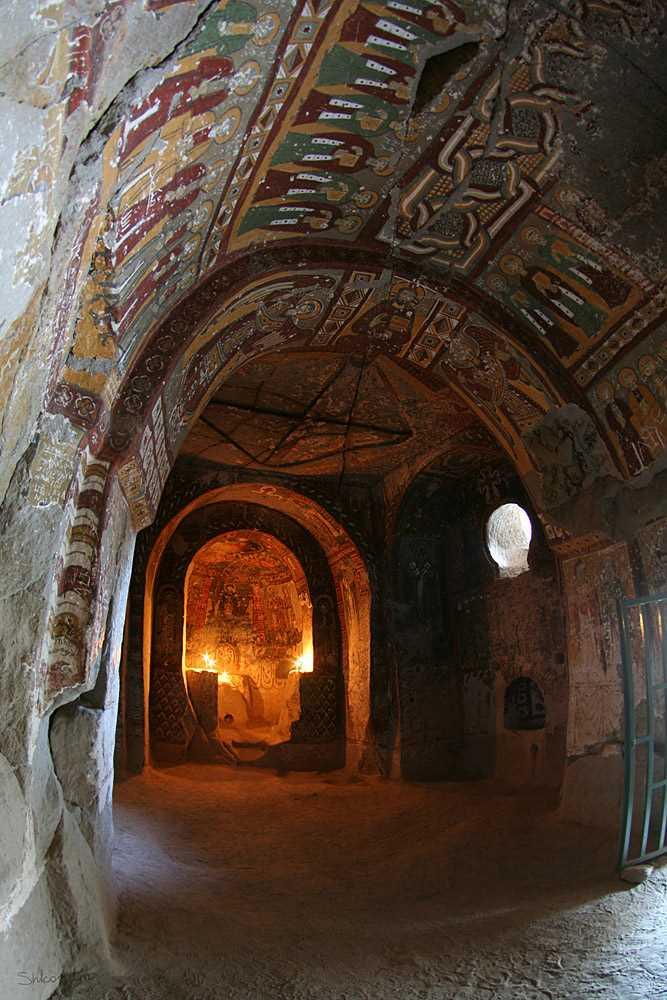
Yılanlı Kilise İç Mekan (Türkiye Kültür Portalı)
The frescoes in the church are notable for their iconographic richness and pictorial depth. They are estimated to date from either the 9th century or the first half of the 11th century to the 12th century. This fresco program encompasses scenes from both the Old and New Testaments.
Narthex Frescoes: The scene of the Last Judgment is depicted on the vault and west wall of the narthex. Scenes such as the Raising of Lazarus and the Entry into Jerusalem have been identified on the north wall.
Eastern Cross Arm: On the vault: the Annunciation to the Virgin and the Visitation; below: figures of John the Forerunner and John Chrysostom; on the triumphal arch: depictions of Stephen, Gamaliel, Solomon, Elijah, David, and Enoch.
Apse Dome: The Ascension of Christ; in the lower band: the Virgin and Child seated on a throne, surrounded by Simeon, Thomas, John, Luke, Paul, Peter, Matthew, Mark, Bartholomew, James, and Philip.
Northern Cross Arm: On the vault: Basil and Gregory; on the walls: the Last Supper in the lower register and the Crucifixion of Christ in the upper register.
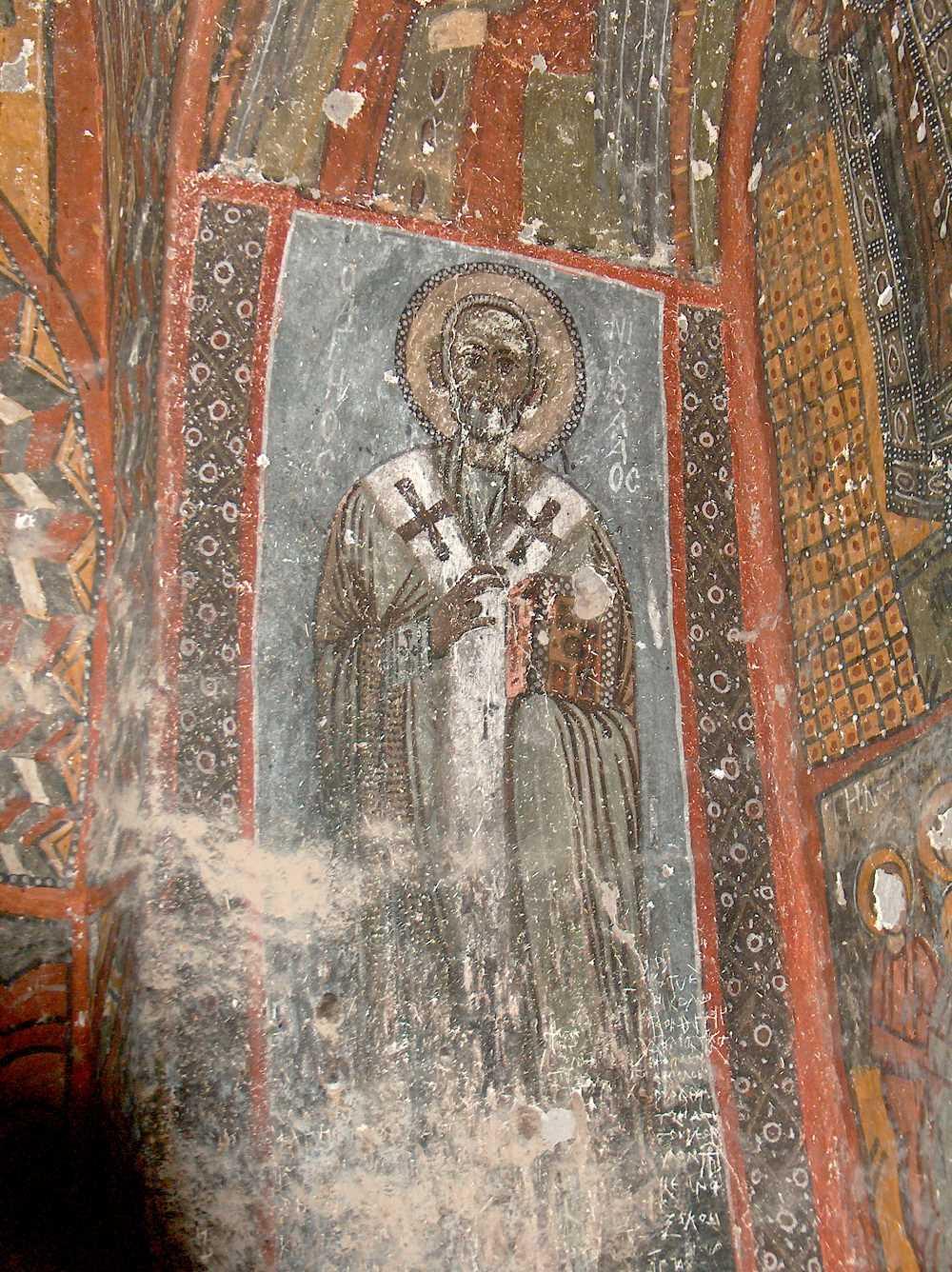
Southern Cross Arm: On the vault: Athenogenes, Nicholas, Michael, and Gabriel; on the walls: the Koimesis (Dormition of the Virgin) and scenes of Constantine and Helena.
Burial Chapel: Depictions of the Deesis have been identified within the arcosolium.

Freskler (Türkiye Kültür Portalı)
The Church of the Serpents derives its name from four female figures depicted on the west wall who are punished by serpents. The scene illustrates:
These scenes are interpreted as symbolic elements teaching Christian moral values.
On the left side of the entrance wall, the legend of Saint George fighting the dragon is depicted. According to the legend, when the daughter of the king of Libya was to be sacrificed to the dragon, Saint George arrived on horseback from the sea, pierced the dragon with his lance, and killed it. The scene is rendered with ancient costumes and intricate decorative details.
On the western part of the vault, a depiction of Saint Onuphrius is shown. He withdrew to the desert in the 4th century after leaving the Monastery of Hermopolis in Egypt. The figure, portrayed barefoot and with long hair before a palm tree, is regarded in Christianity as a symbol of mastery over the flesh.
Additional figures on the ceiling and walls of the church include depictions of John the Baptist and the Virgin with Christ, the portrayal of Saint Thomas making the sign of consecration, and figures of Saint Basil and Saint Onesimus. The scene on the eastern side showing Constantine and his mother Helena holding a cross is also noteworthy.
The Church of the Serpents is one of the most significant religious structures in the Cappadocia region due to its architectural plan, the richness of its fresco program, and its symbolic narrative. The didactic content of the frescoes presents moral messages alongside various elements of Christian iconography. In both archaeological and artistic terms, the Church of the Serpents is regarded as a historical heritage site.
Karacaoglu, Sıla. “Yılanlı Kilise.” In *Online Türkiye Turizm Ansiklopedisi*, edited by N. Kozak. Accessed May 16, 2025.https://turkiyeturizmansiklopedisi.com/yilanli-kilise
T.C. Kültür ve Turizm Bakanlığı. "Yılanlı Kilise." Kültür Portalı. Accessed May 16, 2025.https://www.kulturportali.gov.tr/turkiye/aksaray/gezilecekyer/yilanli-klse.

Church of the Serpents
Location | Göreme Open Air Museum Nevşehir Türkiye | ||||||||
|---|---|---|---|---|---|---|---|---|---|
History | 11th century | ||||||||
Plan | Free Greek Cross Plan | ||||||||
Entrance Facade | North | ||||||||
Sections | Narthex, main space, burial chapel, arms of the cross, apse | ||||||||
Prominent Features | Scene of the woman punished by snakes, Scene of Saint George and the dragon, Depiction of Saint Onuphrius | ||||||||
Frescoes | Scenes from the Old and New Testament, saints and martyrs, Deesis | ||||||||
Construction Technique | Rock carving | ||||||||
Conservation Status | Protected within the Göreme Open Air Museum | ||||||||
No Discussion Added Yet
Start discussion for "Church of the Serpents" article
Architectural Structure
Fresco Program
The Serpent Scene and the Naming Element of the Church
Saint George and the Serpent Scene
Depiction of Saint Onuphrius
Other Depictions