badge icon

This article was automatically translated from the original Turkish version.

Article

Electricity cable colors play a crucial role in ensuring safety, functionality, and order in electrical systems. Cable colors are used to determine the direction of electric current, the purpose of each cable, and the necessary safety measures. Each color serves a specific function. It is essential to pay attention to these color codes to correctly identify and connect cables in electrical installations and devices. Now, let us examine in detail the meanings and applications of colors in electrical cables.
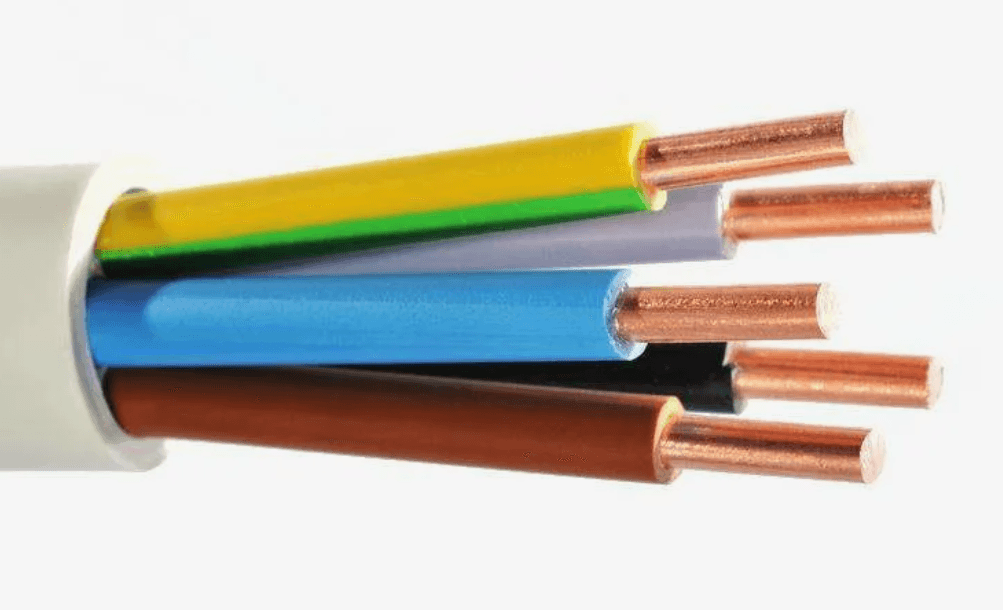

Electrical Cable (Source: )

Basic Color Meanings of Electrical Cables

Brown / Black (Live Wire):

  • Live Wire: The cable that carries electric current. In AC (alternating current) circuits, it typically supplies power from the source to electrical devices.
  • Brown: Used as the first phase (L1) wire in Europe.
  • Black: Commonly used as the second phase (L2) wire.
  • Red: Often denotes the second phase in many AC applications, especially in three-phase systems.
  • Orange: Sometimes used to indicate the third phase in industrial and commercial systems.

Blue (Neutral Wire):

  • Neutral Wire: Provides the return path for electric current, carrying the current back from the live wire to complete the circuit. These wires typically function as conductors for negative charge.
  • Application: Ensures the safe return of energy within the electrical circuit.

Green / Yellow (Earth Ground Wire):

  • Earth Ground Wire: Used to safely direct dangerous electricity to the ground during leakage or short-circuit conditions.
  • Green and Yellow: The standard colors used for grounding. They are defined as a dual-colored cable and ensure the safe discharge of electricity from devices or systems.
  • Application: Connected to metal parts of devices to prevent electric shocks and ensure safety.

Gray:

  • Gray Wire: May be used as a neutral wire or second phase, particularly in Europe. However, this varies depending on the country and system.

Differences in Color Codes Between AC and DC Cables


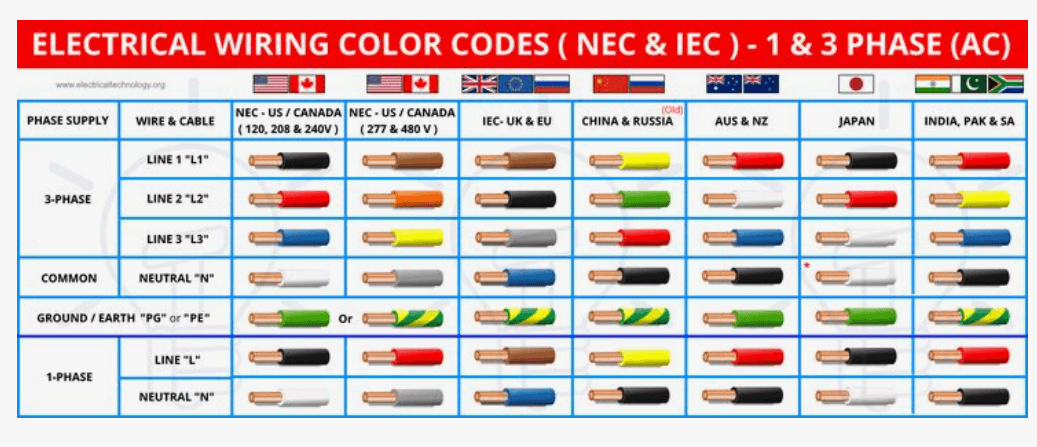
Electrical Cable Colors (Source:

1. AC (Alternating Current) Cable Colors:

Single-Phase AC System:

  • Live: Brown
  • Neutral: Blue
  • Earth Ground: Green / Yellow

Three-Phase AC System:

  • Phase 1: Brown
  • Phase 2: Black
  • Phase 3: Gray
  • Neutral: Blue
  • Earth Ground: Green / Yellow

2. DC (Direct Current) Cable Colors:

Two-Wire Ungrounded DC System:

  • Positive: Brown
  • Negative: Gray
  • Earth Ground: Green / Yellow

Two-Wire Negative-Grounded DC System:

  • Positive: Brown
  • Negative: Blue
  • Earth Ground: Green / Yellow

Two-Wire Positive-Grounded DC System:

  • Positive: Blue
  • Negative: Gray
  • Earth Ground: Green / Yellow

Three-Wire Grounded DC System:

  • Positive: Brown
  • Midwire: Blue
  • Negative: Gray
  • Earth Ground: Green / Yellow


Purpose and Importance of Cable Colors

The colors of electrical cables play a vital role in both functional and safety aspects. Failure to use cable colors correctly can lead to serious electrical accidents, fires, and even fatalities. The advantages provided by color coding include:

  1. Safety: Electricians and technicians can identify the function of each cable through color codes and prevent incorrect connections.
  2. Quick Identification: During maintenance and repair of electrical circuits, accurate identification of cables enables faster and safer work.
  3. Risk Reduction: Incorrect cable connections or cuts can cause major disruptions and property damage. Colored cables help prevent such errors.
  4. International Standards: While different countries may use varying color codes, certain colors are widely recognized globally. For example, brown is used for live wires in AC circuits in Europe, while black is used in the United States.

Safety Measures According to Electrical Cable Color Codes

Before performing any work on electrical systems, it is essential to confirm that the main power source has been disconnected. Additionally, seeking assistance from a qualified and experienced electrician is always safer for any electrical work.

Bibliographies

Adesa Kablo. (n.d.). *Elektrik Kablosu Renkleri ve Anlamları*. Adesa Kablo. Accessed [insert date]. https://adesakablo.com.tr/elektrik-kablosu-renkleri-ve-anlamlari/

Aydem Perakende. (n.d.). *Elektrik Kablosu Renkleri ve Anlamları*. Aydem Perakende. Accessed https://www.aydemperakende.com.tr/blog/elektrik-kablosu-renkleri-ve-anlamlari.

Connector Tips. "What standards apply to heavy-duty connectors?". Accessed https://www.connectortips.com/wp-content/uploads/2023/10/What-standards-apply-to-heavy-duty-connectors-Figure-1.jpg..

EnCazip. (n.d.). *Elektrik Kablosu Renkleri ve Anlamları*. EnCazip. Accessed https://www.encazip.com/bilgi/enerji/elektrik-kablosu-renkleri-anlamlari.

Author Information

Avatar
AuthorLütfiye ErsoyDecember 25, 2025 at 10:06 AM

Tags

Discussions

No Discussion Added Yet

Start discussion for "Cable Colors" article

View Discussions

Contents

  • Basic Color Meanings of Electrical Cables

  • Differences in Color Codes Between AC and DC Cables

    • 1. AC (Alternating Current) Cable Colors:

    • 2. DC (Direct Current) Cable Colors:

  • Purpose and Importance of Cable Colors

  • Safety Measures According to Electrical Cable Color Codes

Ask to Küre