


This article was automatically translated from the original Turkish version.
Boston Tea Party was a political protest carried out by American colonists on December 16, 1773, in Boston Harbor, Massachusetts. During the action, a group of protesters disguised as Mohawk Native Americans dumped 342 chests of tea from three ships in the harbor to protest the British East India Company’s monopoly on the American tea trade and the tax imposed on tea.
The protest occurred within the context of an ongoing dispute between the British Parliament and the thirteen colonies in North America over Parliament’s authority to tax the colonies without their representation. The colonists viewed direct taxation without parliamentary representation as a violation of their constitutional rights.
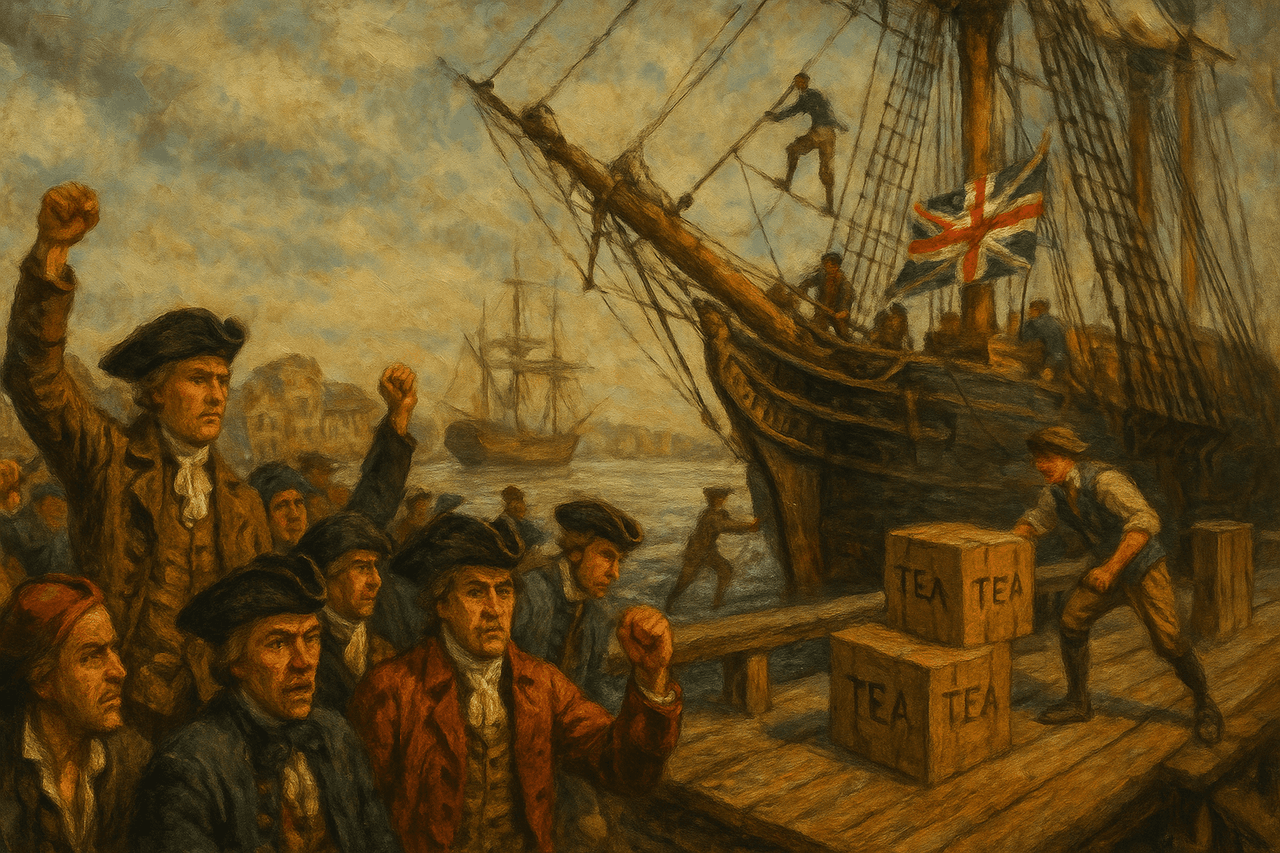
Çay Sandıklarının İndirilmesinin Engellediği Protesto Anı (Yapay Zeka ile Oluşturulmuştur.)
The background to the event was the Tea Act, passed by the British Parliament in May 1773, which granted the financially troubled East India Company a monopoly on tea sales in the American market. The colonists interpreted this law as an extension of Britain’s efforts to increase control over the colonies and resolved to prevent the tea from being unloaded at the ports.
Following the Boston Tea Party, the British Parliament enacted a series of harsh measures in early 1774 to punish Boston, known as the “Intolerable Acts” (Eng. Intolerable Acts). These developments became one of the direct causes of the American Revolutionary War, which lasted from 1775 to 1783.
The Boston Tea Party is among the most symbolic events of the American Revolution, which unfolded between 1765 and 1789.
In the mid-1760s, the British Parliament sought new sources of revenue to cover the financial burden of the recently concluded Seven Years’ War (1756–1763). Since the war had been partly fought to defend the American colonies, the London government considered it legitimate for the colonies to bear some of the financial responsibility. The Stamp Act of March 1765 imposed taxes on all paper products in the American colonies, including newspapers, legal documents, calendars, and playing cards. However, the colonists strongly protested the act, arguing that taxation without representation in Parliament violated their rights as British subjects.
Colonial legislative bodies such as the Virginia House of Burgesses passed resolutions asserting that only their own assemblies had the authority to levy taxes. Protests quickly spread to the streets; American merchants imposed boycotts on British goods while crowds occasionally resorted to violence. For example, on August 14, 1765, a mob in Boston hanged effigies of tax collectors and then ransacked their homes. On August 26, the home of Massachusetts Lieutenant Governor Thomas Hutchinson was attacked and his family forced to flee. These events contributed to the formation of the secret organization known as the Sons of Liberty.
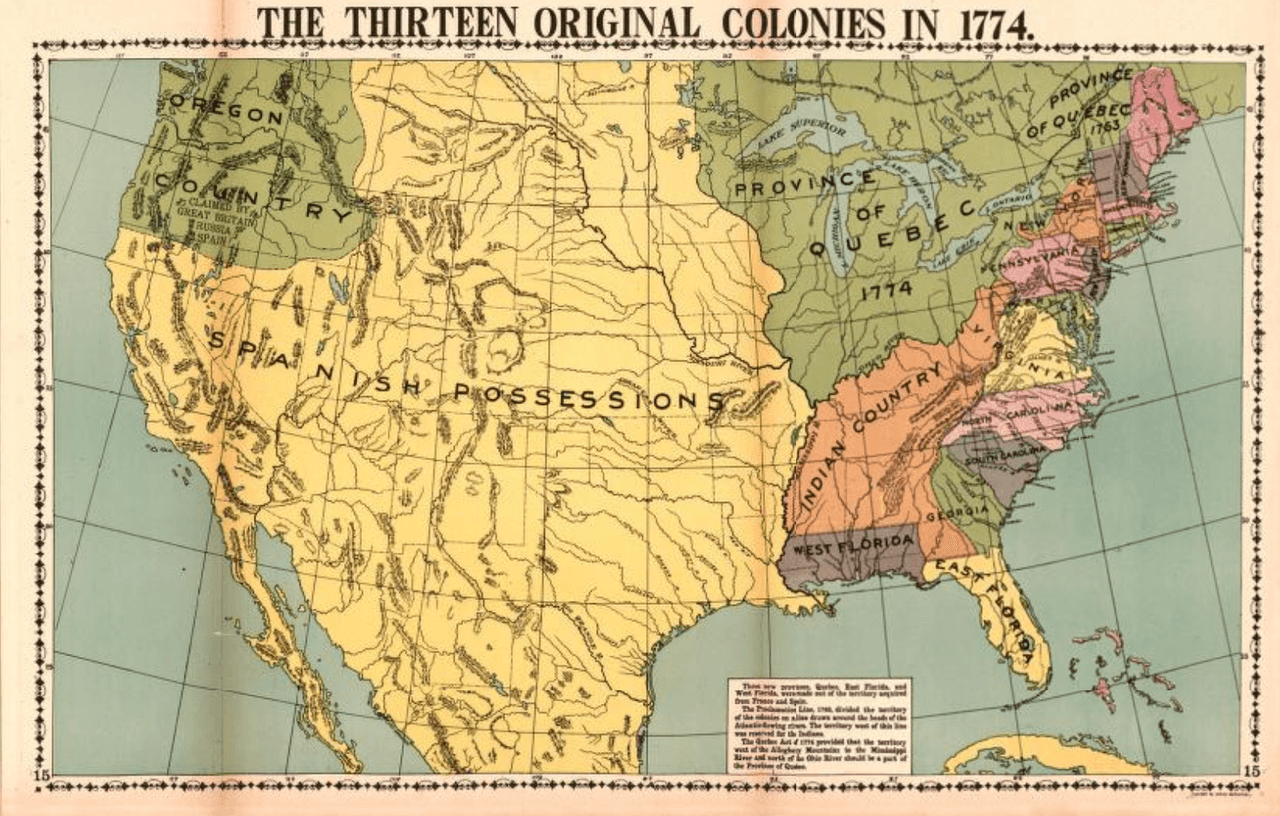
1774 Kuzey Amerika Siyasi Haritası (Library of Congress)
In response to these fierce reactions, Parliament was forced to repeal the Stamp Act in early 1766. However, this brief period of relief did not last long; in 1767–1768, a new package of taxes and regulations known as the Townshend Acts came into effect. The colonies responded with renewed resistance; the Massachusetts Assembly urged other colonial assemblies to send petitions to the king. Merchants once again boycotted British goods, and resistance in Boston occasionally turned violent.
As tensions escalated, General Thomas Gage, commander-in-chief of all British forces in North America, dispatched 2,000 troops to Boston in October 1768. The tension reached its peak with the Boston Massacre on March 5, 1770, when nine British soldiers fired into a crowd throwing stones, killing five civilians.
In the aftermath of the Boston Massacre, Parliament repealed most of the Townshend Acts to ease tensions. However, Prime Minister Lord North retained the tax on tea for two reasons: first, to assert Parliament’s right to tax the colonies; and second, to use the revenue to pay the salaries of colonial officials, making them directly dependent on London rather than on local assemblies.
Enacted by Parliament on May 10, 1773, the Tea Act was not designed to target the colonies directly but to rescue the financially troubled East India Company. The company held large quantities of unsold tea, and the American market was seen as a viable outlet for clearing this surplus. The company was granted exclusive rights and tax breaks for tea sales in the American colonies, but the three-penny tax remained in force.
The colonists perceived this law not as an economic measure but as a political threat. Leading resistance figures such as Samuel Adams argued that accepting cheaper tea would amount to tacit acceptance of Britain’s right to tax them. As a result, the political climate, which had been relatively calm for three years, was once again swept up in a wave of anger.
Of the seven ships carrying tea to America, four were bound for Boston, while the others were directed to New York, Philadelphia, and Charleston. In Philadelphia and New York, colonists pressured the East India Company’s agents to resign, and the tea was returned without being unloaded. In Charleston, the tea was seized by customs officials and stored in warehouses because the import duties could not be paid. However, the situation in Boston unfolded differently.
Massachusetts Governor Thomas Hutchinson opposed the agents’ resignations because two of them were his own sons. On November 28, 1773, the ship Dartmouth arrived in Boston Harbor. Under the law, the ship had 20 days to unload its tea; otherwise, the cargo would be confiscated. Samuel Adams and his allies mobilized public opinion to prevent the tea from being unloaded. Large public meetings attended by 5,000 people were held, and the crowd demanded that the tea be sent back. However, Governor Hutchinson refused to allow the ship to leave the harbor.
On the decisive day of December 16, 1773, a large public meeting was convened at the Old South Meeting House in Boston in the morning, at Samuel Adams’s urging. Thousands of Bostonians attended and debated how to prevent the tea from being unloaded. At the meeting, Francis Rotch, owner of the Dartmouth, was sent to Governor Thomas Hutchinson to make one final request for permission to leave the harbor.
That evening around 6:00 PM, Rotch returned to the meeting and announced that Hutchinson had refused his request. Immediately afterward, Samuel Adams rose and declared, “This meeting can do nothing more to save the country,” effectively ending the gathering.
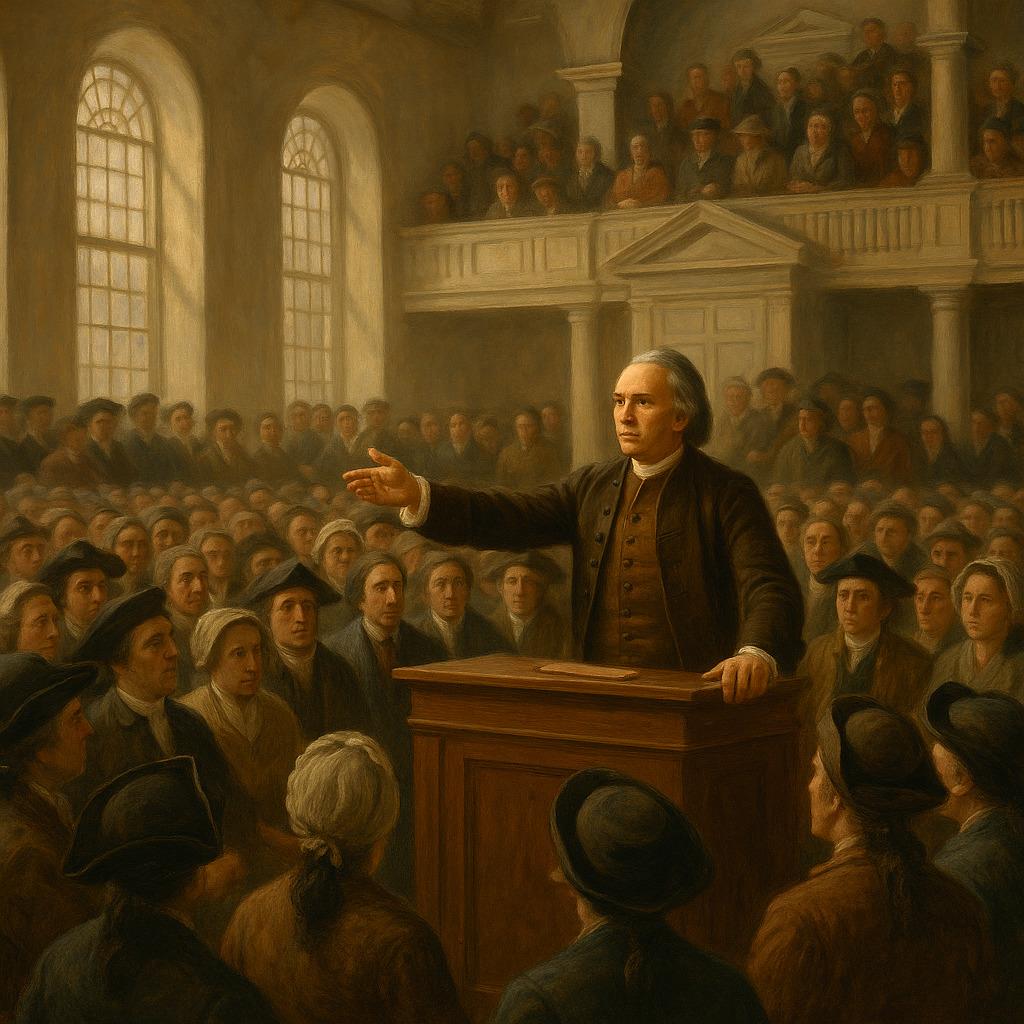
People Listening to Samuel Adams (Generated by Artificial Intelligence.)
Between 6:15 and 6:30 PM, sounds of pipes and Native American war cries were heard from outside. Some attendees left the meeting. Shortly after darkness fell, between 30 and 130 men dressed as Mohawk Indians boarded the three ships—Dartmouth, Eleanor, and Beaver—removed 342 chests of tea from their holds, and dumped them into Boston Harbor. The total weight of the tea was approximately 92,000 pounds, valued at around £10,000. The participants concealed their identities among the crowd, and none were ever officially identified.
Immediately after the event, Samuel Adams began efforts to legitimize the action, presenting it not as a spontaneous riot but as a deliberate political protest. While some leading Patriots were uneasy about the destruction of private property, they generally endorsed the act. In March 1774, tea from the East India Company stored in a Boston warehouse was similarly destroyed. In October, the tea-laden ship Peggy Stewart in Annapolis was set on fire.
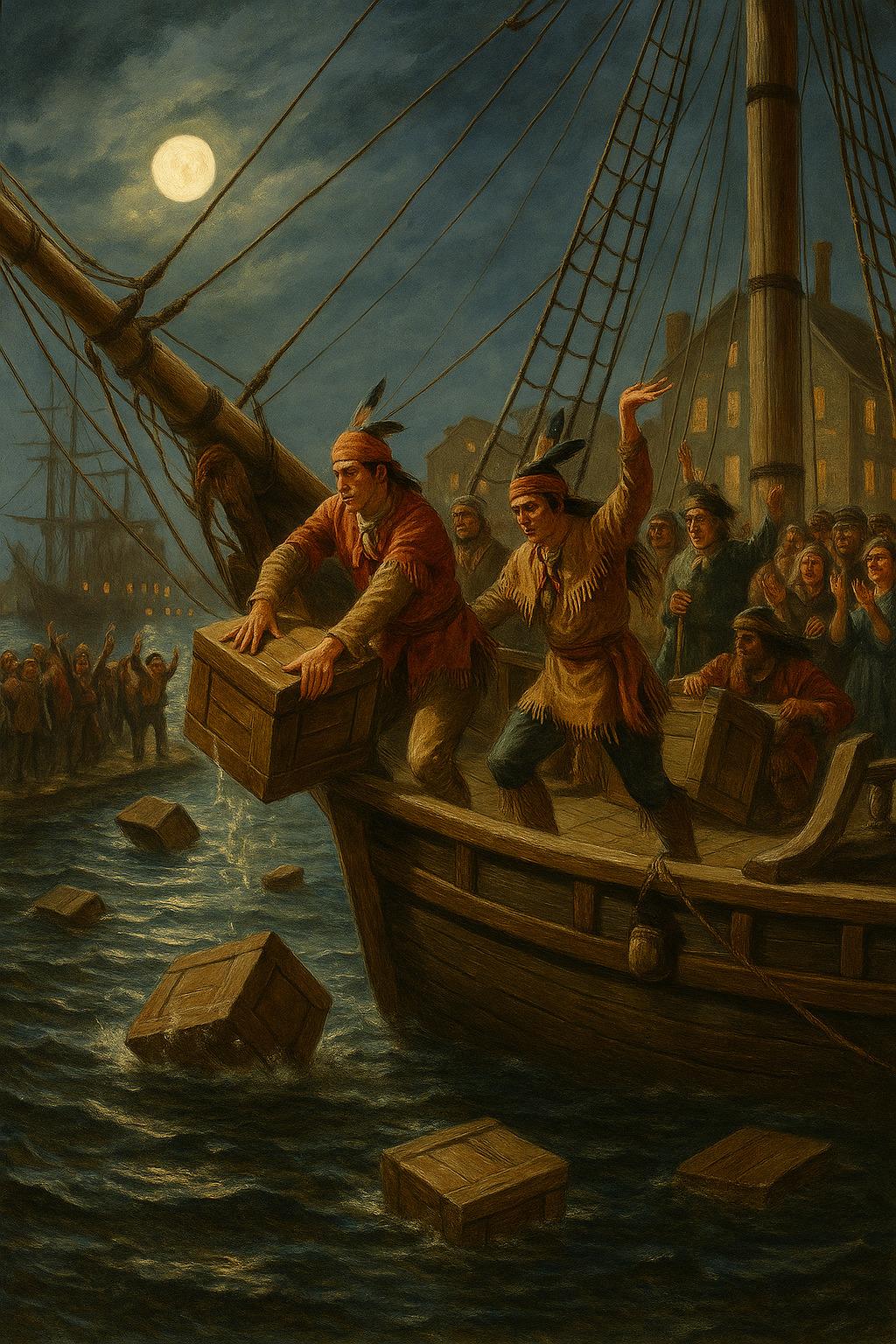
Mohawk Kılığına Girmiş Adamlar, Çay Sandıklarını Denize Dökerken (Yapay Zeka ile oluşturulmuştur.)
The Boston Tea Party was viewed by the British Empire as a direct challenge to its authority. In response, Parliament under Lord North enacted a series of punitive laws in 1774 that closed Boston Harbor and restricted local self-government. These measures, known in the colonies as the “Intolerable Acts,” strengthened political unity across the continent and led to the convening of the First Continental Congress.
The Boston Tea Party is regarded as one of the key events that triggered the American Revolution. It radicalized American public opinion and accelerated British efforts to reassert control over the colonies. The political and social preconditions for the American Revolutionary War, which began in 1775, became clearly evident in its aftermath. Today, the Boston Tea Party remains a symbol of liberty and civil disobedience in American political culture.
American Battlefield Trust. "Boston Tea Party." Accessed May 2, 2025.https://www.battlefields.org/learn/articles/boston-tea-party.
Bill of Rights Institute. “The Boston Tea Party.” Accessed May 3, 2025.https://billofrightsinstitute.org/essays/the-boston-tea-party/.
Güven, Mustafa Harun. “Boston Çay Partisi.” İktibas Dergisi, March 15, 2018. Accessed May 2, 2025.https://iktibasdergisi.com/2018/03/15/boston-cay-partisi/
Mark, Harrison W. “Boston Tea Party.” *World History Encyclopedia*, 24 November 2023. Accessed May 2, 2025.https://www.worldhistory.org/Boston_Tea_Party/.
McConnell Map Co, and James McConnell. McConnell's historical maps of the United States. [Chicago, Ill.: McConnell Map Co, 1919] Map. https://www.loc.gov/item/2009581130/.

Historical Background
The Tea Act and Colonial Response
The Chests Tossed into the Sea
Consequences
Significance