This article was automatically translated from the original Turkish version.
Registration Number | 1341 | ||||||||
|---|---|---|---|---|---|---|---|---|---|
Registration Date | 24.02.2023 | ||||||||
Application Number | C2021/000306 | ||||||||
Application Date | 09.08.2021 | ||||||||
Name of the Geographical Indication | Bolvadin Fırın Eti | ||||||||
Product / Product Group(s) | Food / Meals and Soups | ||||||||
Type of Geographical Indication | Mahreç mark | ||||||||
Applicant/Registrant(s) | Bolvadin Chamber of Commerce and Industry | ||||||||
Address of the Registrant | Şazi Mah. Eski Demirciler içi Sok. Bolvadin AFYONKARAHİSAR | ||||||||
Geographical Boundary | Bolvadin district Afyonkarahisar province | ||||||||
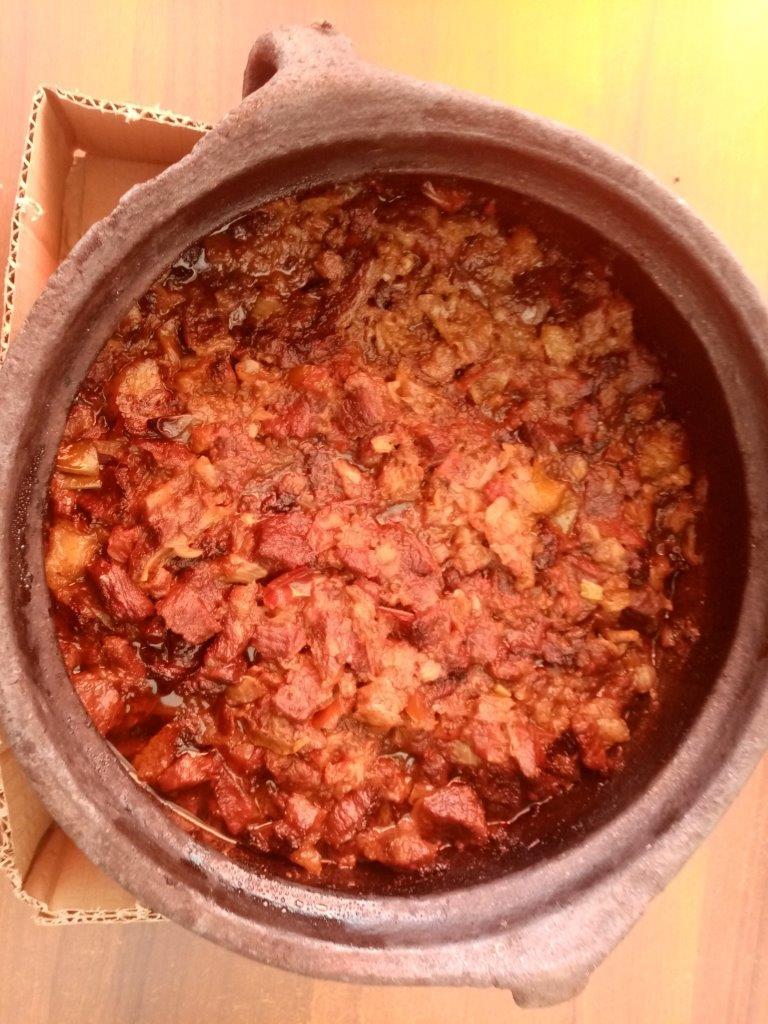
Bolvadin oven meat is a traditional meat dish specific to the Bolvadin district of Afyonkarahisar. It is prepared by cutting beef or veal into bite-sized pieces, placing them in clay pots along with onion, garlic, tomato, and pepper, and cooking them for approximately 5 to 6 hours in stone ovens heated to 280–300°C using oak wood, without adding any water. The meat, sourced from the neck and rib sections, is low in fat and cleaned of tendons; by the end of cooking, it achieves a very tender texture. Optionally, locally dried kokurdak pepper may be added.
Bolvadin oven meat is a dish made by placing low-fat, tendon-free bite-sized pieces of beef or veal from the neck and rib areas, together with onion, garlic, tomato, and pointed pepper or the local kokurdak pepper (Capsicum annuum), into clay pots and cooking them in stone ovens. The total cooking time is 5 to 6 hours, with no addition of water. As a result of this prolonged, waterless cooking process, the meat becomes exceptionally tender.
The dish is prepared in stone ovens heated to 280–300°C using oak wood. These ovens are constructed from fire bricks and have insulated floors. The internal height of the oven is approximately 11.5 meters and semi-circular in shape. Oak wood embers are arranged to occupy about 50% of the oven’s internal volume. The clay pots are then placed in the remaining space, arranged so they do not touch each other. This configuration ensures even heat distribution and uniform cooking of the dish.
Bolvadin oven meat is prepared by local households, who bring their prepared mixtures to communal stone ovens for cooking. This method is especially common during Ramadan and on special occasions. This traditional mode of production and consumption reinforces the product’s strong geographical and cultural association.
The following ingredients are used to prepare Bolvadin oven meat for five people:
During preparation, the meat is cut into 1.5–2 cm bite-sized pieces and placed in clay pots. Onion and garlic, cut to the same size, along with coarsely chopped peppers, are added to the pots. After adding salt, the pots are placed in a preheated stone oven and cooked for 4 to 5 hours. At the end of this period, coarsely chopped tomatoes are placed on top of the pots and the cooking continues for an additional hour. Before serving, the dish is allowed to rest for about 30 minutes and is then served hot in the same clay pot in which it was cooked.
Bolvadin oven meat can be stored in a refrigerator at 4–6°C for up to 7 days and may be reheated before consumption.
The production of Bolvadin oven meat historically relies on traditional methods specific to the Bolvadin district. This dish holds an important place in the social life of the region and is frequently consumed during Ramadan and holidays. The practice of preparing the mixture at home and transporting it to communal stone ovens for cooking preserves the dish’s role in collective memory. This demonstrates that the product is not only physically but also culturally bound to its geographical origin.
Monitoring activities for the geographical indication protection of Bolvadin oven meat are coordinated by the Bolvadin Chamber of Commerce and Industry. The monitoring board consists of three members, each representing the Bolvadin Chamber of Commerce and Industry, the Bolvadin Commodity Exchange, and the Bolvadin District Directorate of Agriculture and Forestry. This board conducts at least one regular inspection per year and carries out additional investigations when necessary or in response to complaints.
The monitoring process includes criteria such as the suitability of ingredients, the technical specifications of the stone ovens, and compliance with the production method. It also verifies whether the designation “Bolvadin Fırın Eti” and its official geographical indication emblem appear on the product or packaging. If the designation cannot be directly applied to the product or packaging during production, it must be prominently displayed within the production facility where it is easily visible.
Turk Patent and Trademark Office. "Bolvadin Fırın Eti." Accessed August 16, 2025. https://ci.turkpatent.gov.tr/Files/GeographicalSigns/c51ec81b-c0f2-4a80-a663-8f9e1345b62a.pdf
Türk Patent ve Marka Kurumu. "Bolvadin Fırın Eti." Türk Patent ve Marka Kurumu. Accessed August 16, 2025. https://ci.turkpatent.gov.tr/cografi-isaretler/detay/4786

Registration Number | 1341 | ||||||||
|---|---|---|---|---|---|---|---|---|---|
Registration Date | 24.02.2023 | ||||||||
Application Number | C2021/000306 | ||||||||
Application Date | 09.08.2021 | ||||||||
Name of the Geographical Indication | Bolvadin Fırın Eti | ||||||||
Product / Product Group(s) | Food / Meals and Soups | ||||||||
Type of Geographical Indication | Mahreç mark | ||||||||
Applicant/Registrant(s) | Bolvadin Chamber of Commerce and Industry | ||||||||
Address of the Registrant | Şazi Mah. Eski Demirciler içi Sok. Bolvadin AFYONKARAHİSAR | ||||||||
Geographical Boundary | Bolvadin district Afyonkarahisar province | ||||||||
Distinctive Characteristics
Recipe/Production Method
Geographical Boundary and Reputation Link
Monitoring and Registration Process