


This article was automatically translated from the original Turkish version.
+1 More
Bosphorus Lüfer
Registration Number | 1520 | ||||||||
|---|---|---|---|---|---|---|---|---|---|
Registration Date | 10.01.2024 | ||||||||
Application Number | C2021/000085 | ||||||||
Application Date | 26.02.2021 | ||||||||
Name of the Geographical Indication | Boğaziçi Lüferi | ||||||||
Product / Product Group(s) | Balıketi / Other | ||||||||
Type of Geographical Indication | Mahreç İşareti | ||||||||
Applicant/Registrant(s) | Istanbul Chamber of Commerce | ||||||||
Address of the Registrant | Reşadiye Cad. 34112 Eminönü ISTANBUL | ||||||||
Geographical Boundary | The waters between the lines connecting the Türkeli Lighthouse (Rumeli) in the north and the Anadolu Lighthouse in the north and the Ahırkapı Lighthouse and the Kadıköy İnciburnu Mendirek Lighthouse in the south | ||||||||
Boğaziçi Lüferi is a fish species belonging to the genus Pomatomus saltatrix of the family Pomatomidae, which grows and is caught in the waters between Turkisheli and Anatolia Lighthouse to the north, and Ahırkapı and Kadıköy İnciburnu Mendirek Lighthouse to the south of the Bosphorus Strait in Istanbul. It has a double dorsal fin, yellowish fins, green-gray back and sides, and a silvery-white belly; its gill covers are scaled, its head is scaleless, and it has a strong jaw with teeth. This species, protected under geographical indication registration, is fished only when individuals exceed 18 cm in length and is typically caught between October and January. Freshly consumed Boğaziçi Lüferi is an integral part of the region’s maritime, culinary, and economic culture, and is prepared by grilling, steaming, pilaki, or frying.
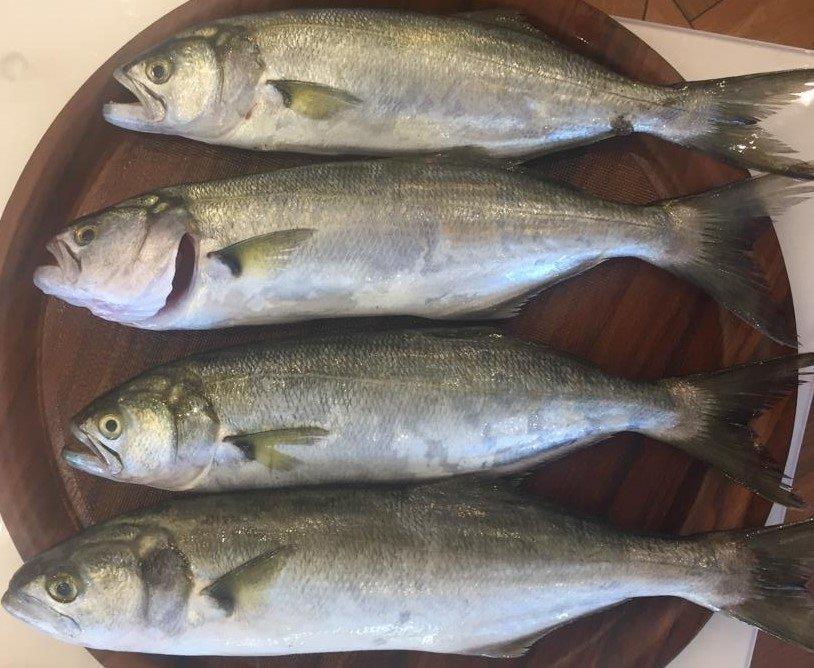
Boğaziçi Lüferi (Turkish Patent)
The Boğaziçi Lüferi is a fish species of the genus Pomatomus saltatrix in the family Pomatomidae. It has a double dorsal fin, yellowish fins, a laterally compressed body, green-gray back and sides, and a silvery-white belly. Its gill covers are scaled, while its head is scaleless. The jaw is strong and contains teeth on the palate.
This species thrives and is fished in the waters of the Bosphorus Strait between Turkisheli Lighthouse (Rumeli) and Anatolia Lighthouse to the north, and Ahırkapı Lighthouse and Kadıköy İnciburnu Mendirek Lighthouse to the south. The Boğaziçi Lüferi lives at depths of 10 to 200 meters within this geographical boundary.
The Boğaziçi Lüferi is intensively fished between October and January. The minimum legal size for capture is 18 cm, with a minimum weight of 150 grams per individual. Its primary food sources include small fish such as fresh anchovy, mackerel, and sprat. Spawning occurs at the end of spring and beginning of summer, during which each individual releases approximately 60,000 to 80,000 eggs. The species undergoes a wintering period from mid-summer to autumn and shows increased fat content between October and May.
The Boğaziçi Lüferi holds a significant place in the maritime, culinary, and economic culture of the Bosphorus Strait, with a history extending back to the Ottoman period. The region’s maritime heritage and fishing culture are closely linked to the Boğaziçi Lüferi. This connection enables a bond to be established between the product’s reputation and its geographical origin.
The Boğaziçi Lüferi is a fish species of the genus Pomatomus saltatrix in the family Pomatomidae that grows and is caught within the defined geographical boundaries of the Bosphorus Strait. Various regional methods are used to catch this fish.
Baited Hook Method: In this method, suspended rigs and bottom tackle with mushroom weights are preferred. Suspended rigs are especially used for night fishing from boats, while bottom tackle is generally used for near-shore fishing. During migration periods, daytime fishing is guided by a lookout on board who observes underwater movements using a glass panel mounted beneath the boat (known among fishermen as a “mirror”). Once a school is detected, the net is quickly deployed and encircled. Noise is then created to direct the fish into the net, and the net is retrieved using a hydraulic winch.
Night Fishing: A lookout positioned at the front of the boat observes fish schools by watching for bioluminescence using a lamp. Once a school is identified, the net is rapidly deployed into the water to form a circle. Fish are then guided into the net by turning lights on and off or producing sound.
Fishing with Natural Baits: In this method, fish such as anchovy, sprat, sardine, mackerel, horse mackerel, sprat, mullet, and mackerel are used whole or in fillet form. Sprat is one of the most preferred baits and is cleaned of scales before use. Other bait fish must be fresh.
Suspended Rig Fishing: This method, typically practiced from a skiff, is applied at night using light. The fishing location is predetermined, the skiff is anchored, and it is secured with mooring lines to prevent drift caused by currents or wind. The rig, after being baited, is lowered to the bottom and then raised about one meter to wait for a bite. If no fish appears after a long time, the skiff is moved back and forth along the mooring lines to test different depths.
Spoon Fishing: A spoon lure with a shiny surface is lowered into the water from a moving skiff at a speed of 3–5 km/h. After an average of 20 fathoms of line have been deployed, the spoon is retrieved by hand. Spoon sizes are typically number 1 or 2 and should not exceed the size of a willow leaf.
Jigging: This method is applied from boats or skiffs, especially during November–December, when the fish migrate toward the Black Sea. The jig, used without bait, operates by repeatedly lifting and lowering the line. This method is generally preferred during daytime, in rainy or choppy seas. The thickness of the fishing line varies according to the size of the fish (between 0.50 and 0.60 mm).
Fishing with Nets and Traps: This method resembles spoon fishing. The rod used is of appropriate capacity for the weight of the net or trap and measures 2.7–3 meters in length. It can be used with bait; in such cases, filleted bait fish are attached to the net. Fishing with this method occurs during daytime and late afternoon when fish approach the shore.
The caught Boğaziçi Lüferi is sold fresh. It can be stored in freezers at –18 °C for 6 to 8 months. Common consumption methods include grilling, steaming, pilaki, and frying. When filleting, some flesh is left on the central bone, which is then fried in a pan to prepare a fish cutlet.
The Boğaziçi Lüferi was registered as a geographical indication on 10 January 2024 (Registration No: 1520). The application was submitted by the Istanbul Chamber of Commerce (Application No: C2021/000085, Application Date: 26 February 2021). The geographical indication emblem and the term “Boğaziçi Lüferi” must appear on the product or its packaging; if this is not feasible, they must be displayed prominently within the business premises.
The Boğaziçi Lüferi must be cultivated and fished exclusively within the defined geographical boundaries of the Bosphorus Strait. This region has a historical legacy dating back to the Ottoman period and holds importance in terms of maritime activity, culinary tradition, and economic operations. The link between the product’s reputation and its geographical origin requires that this fish be caught and produced only within the specified coordinates.
Inspection of the Boğaziçi Lüferi is conducted under the coordination of the Istanbul Chamber of Commerce. The inspection team consists of six experts, one each from the Istanbul Provincial Directorate of Agriculture and Forestry, Istanbul Provincial Directorate of Trade, S.S. Aquatic Products Cooperatives Central Union, S.S. Fatih Aquatic Products Cooperative, S.S. Yeşilköy Aquatic Products Cooperative, and the Istanbul Chamber of Commerce.
Inspections are carried out annually between October and January, and may also be conducted at any time upon request or in response to complaints. Criteria considered during inspections include the conformity of the product’s physical and, where necessary, chemical properties; compliance with established size and method regulations for fishing; and the correct use of the term “Boğaziçi Lüferi,” its logo, and the geographical indication emblem.
The inspection authority may seek support or procure services from experts employed by public or private institutions as needed. The entity that registered the product is responsible for protecting its rights and managing legal proceedings.

Boğaziçi Lüferi (generated by artificial intelligence.)
Turk Patent and Trademark Office. "Boğaziçi Lüferi." Geographical Indications. Accessed May 26, 2025. https://ci.turkpatent.gov.tr/cografi-isaretler/detay/3422.
İstanbul Ticaret Odası. *Boğaziçi Lüferi Coğrafi İşaret Tescil Belgesi*. Türk Patent ve Marka Kurumu. Accessed May 26, 2025. https://ci.turkpatent.gov.tr/Files/GeographicalSigns/d062a8f8-f561-4c51-9e85-0049fe20c969.pdf.

Bosphorus Lüfer
Registration Number | 1520 | ||||||||
|---|---|---|---|---|---|---|---|---|---|
Registration Date | 10.01.2024 | ||||||||
Application Number | C2021/000085 | ||||||||
Application Date | 26.02.2021 | ||||||||
Name of the Geographical Indication | Boğaziçi Lüferi | ||||||||
Product / Product Group(s) | Balıketi / Other | ||||||||
Type of Geographical Indication | Mahreç İşareti | ||||||||
Applicant/Registrant(s) | Istanbul Chamber of Commerce | ||||||||
Address of the Registrant | Reşadiye Cad. 34112 Eminönü ISTANBUL | ||||||||
Geographical Boundary | The waters between the lines connecting the Türkeli Lighthouse (Rumeli) in the north and the Anadolu Lighthouse in the north and the Ahırkapı Lighthouse and the Kadıköy İnciburnu Mendirek Lighthouse in the south | ||||||||
Species Characteristics
Physical and Chemical Properties
Properties
Amino Acid Composition (mg / 100 g)
Fatty Acid Composition (%)
Life Cycle and Feeding
Geographical and Cultural Connection
Production Methods
Registration and Protection
Geographical Boundary
Inspection Process