

+1 More

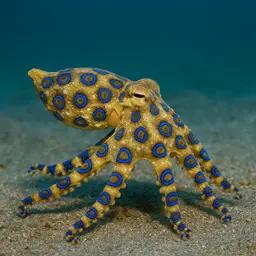
Generated by Artificial Intelligence
Blue-Ringed Octopus
Scientific Name(s) | Hapalochlaena species | ||||||||
|---|---|---|---|---|---|---|---|---|---|
Family | Octopodid (Octopuses) | ||||||||
Size(s) | 12–20 cm (including arms) | ||||||||
Skin Colors | Yellowish base tone; blue rings become prominent when threatened | ||||||||
Habitat | Indo-Pacific coastline reef and tidal zones | ||||||||
Food Sources | Small crustaceans, shrimp and fish | ||||||||
Venom | Tetrodotoxin (TTX) – inhibits nerve transmission | ||||||||
Effect on Humans | Respiratory paralysis; no antidote; only supportive treatment | ||||||||
Reproductive Traits | Reproduces once; female carries eggs for 6 weeks | ||||||||
Lifespan | Average 1–2 years | ||||||||
Blue-ringed octopuses are small cephalopod species classified under the genus Hapalochlaena, known among marine creatures for carrying a deadly toxin. Four species have been identified in this genus: Hapalochlaena lunulata, H. maculosa, H. fasciata, and the rare H. nierstraszi. Each is recognized by the characteristic blue rings on their bodies. These rings become prominent when they feel threatened, serving as a warning to predators.
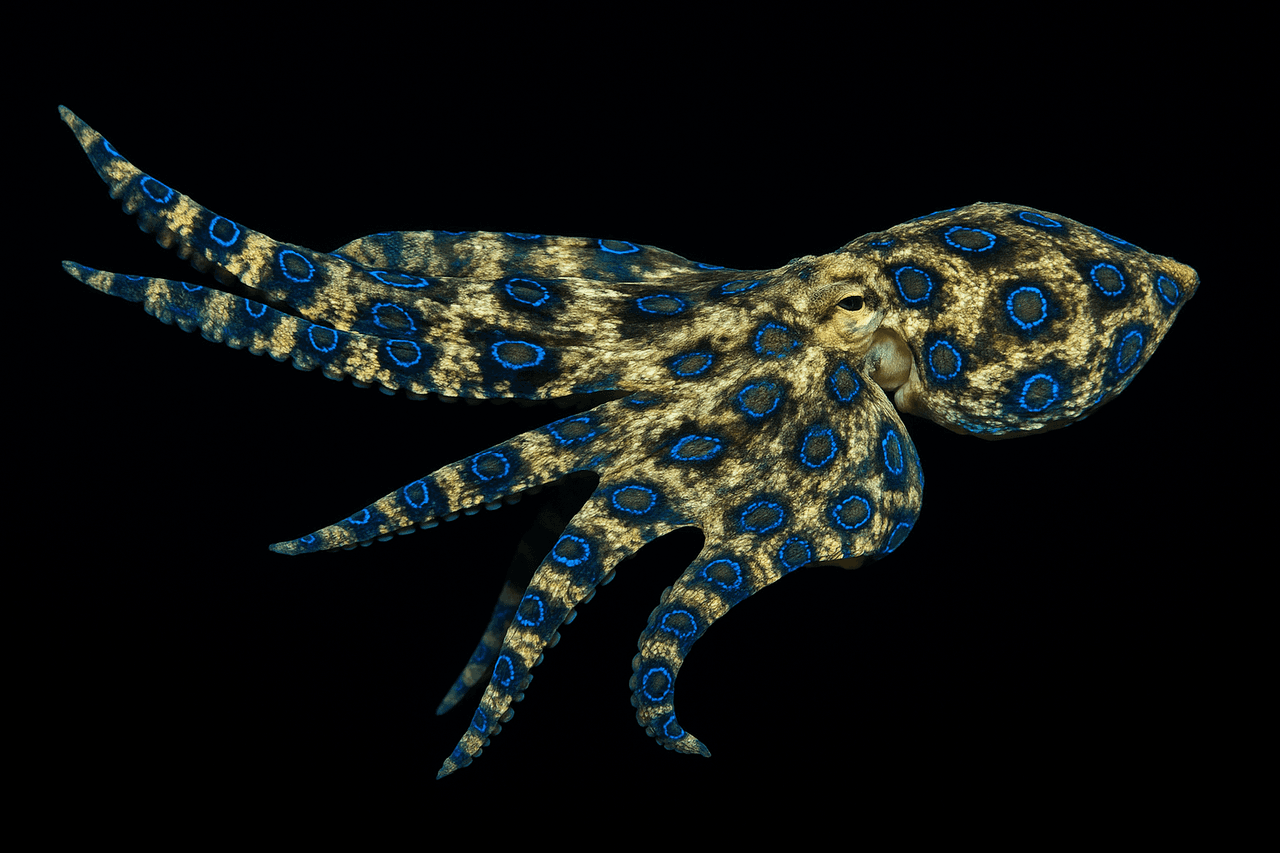
Blue-Ringed Octopus (Generated by Artificial Intelligence)
The body length of blue-ringed octopuses, including their arms, ranges from 12 to 20 cm. Their skin, normally yellowish-brown, rapidly becomes patterned with blue rings when in danger. This color change is achieved by the coordinated action of special cells called iridophores and chromatophores. Thanks to this system, they can change their body pattern within seconds.
With short and thick arms, this species is highly agile and can perform rapid maneuvers underwater. As their bodies are soft, they can easily pass through narrow crevices and hide in rocky areas.
Blue-ringed octopuses are distributed in the Indo-Pacific Ocean, especially around the coasts of Australia, the Philippines, Indonesia, and Japan. They prefer to live in shallow coastal areas, coral reefs, seagrass beds, and tidal pools. They generally hide during the day and actively hunt at night. They are known for approaching their prey by remaining still and motionless or by using color camouflage.
Their diet largely consists of small crustaceans (crabs, shrimp) and occasionally small fish. Approaching its prey stealthily, the blue-ringed octopus grasps its prey with its arms and pierces its skin with a hard, beak-like structure. During this process, it injects a powerful neurotoxin called tetrodotoxin (TTX). The poisoned prey is quickly incapacitated. This method is an evolutionary trait of the species, serving more as an offensive strategy than a defensive one.
Blue-ringed octopuses secrete tetrodotoxin (TTX), one of the deadliest toxins known in nature. This toxin blocks nerve transmission in the central nervous system, leading to respiratory paralysis. The venom is generally concentrated in the salivary glands but can also be found in body tissues.
In human encounters, the bite is usually painless and difficult to notice. Symptoms appear within minutes: numbness around the mouth, dizziness, difficulty breathing, and paralysis. As there is no known antidote for such cases, respiratory support and intensive medical intervention are vital. Due to the lethal effect of the venom on humans, direct contact with these creatures is not recommended.
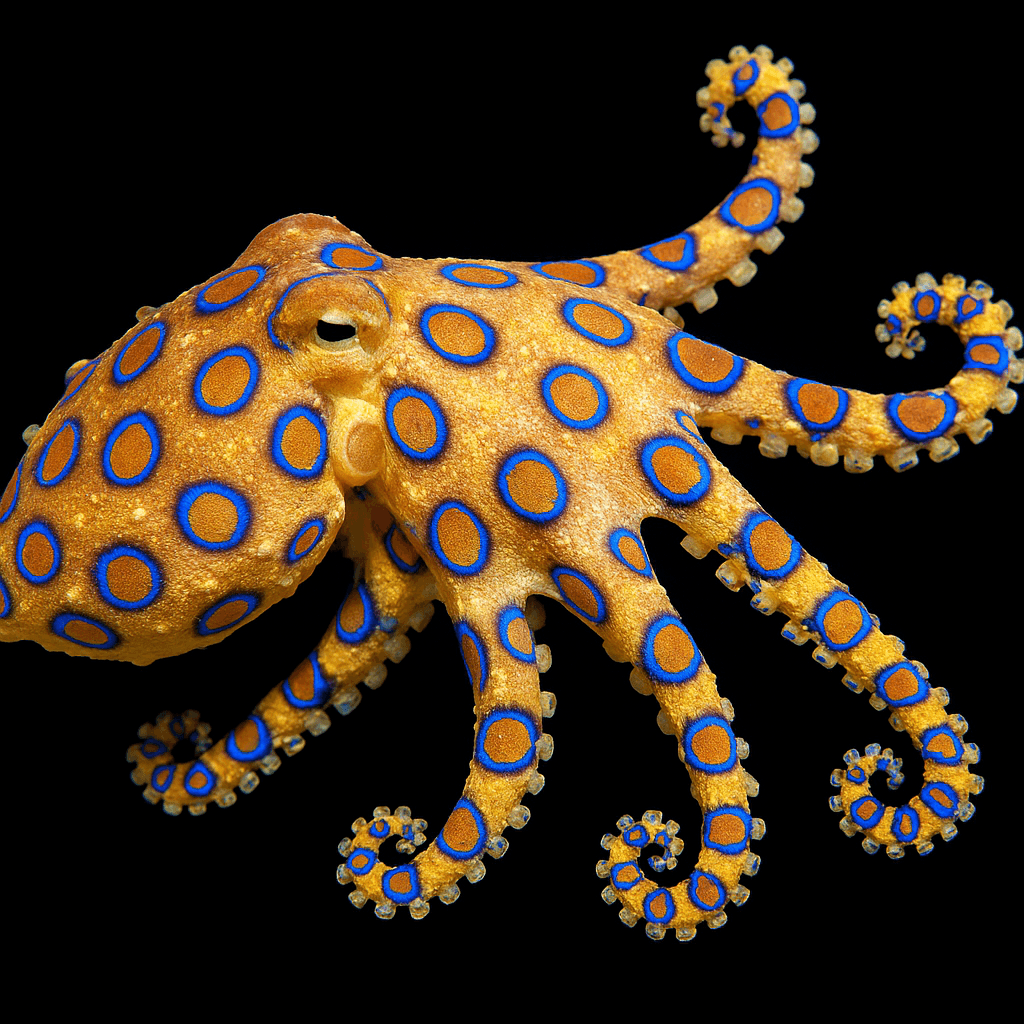
Blue-Ringed Octopus (Generated by Artificial Intelligence)
Blue-ringed octopuses are short-lived species; their lifespan typically ranges from 1 to 2 years. Female individuals reproduce only once. After laying eggs, the female carries approximately 50–100 eggs under her body and protects them without feeding during the incubation period. After about 6 weeks, the hatchlings are released. The female individual usually dies after this process. The juveniles begin hunting independently within a short time.
As important predators in their natural environment, blue-ringed octopuses play a role in balancing the populations of small invertebrates and fish in the ecosystem. They themselves are preyed upon by very few predators, as their venom is a highly effective deterrent against predators.
Most human interaction occurs in coastal areas. Careless contact by individuals collecting seashells or by divers can lead to poisoning cases. Therefore, some countries implement informative signs and public education campaigns. Particularly in nature documentaries, the biological characteristics and potential danger of this species are frequently covered.
Marinebio. "Blue-ringed Octopuses." Accessed July 13, 2025. https://www.marinebio.org/species/blue-ringed-octopuses/hapalochlaena-maculosa/
Natural History Museum. "The blue-ringed octopus: small, vibrant and exceptionally deadly." Accessed July 13, 2025. https://www.nhm.ac.uk/discover/blue-ringed-octopus-small-vibrant-deadly.html
Gözcelioğlu, Bülent. “Blue-Ringed Octopus.” TÜBİTAK Science and Technology. (2021) Accessed July 13, 2025. https://e-dergi.tubitak.gov.tr/edergi/yazi.pdf?dergiKodu=4&cilt=54&sayi=1086&sayfa=82&yaziid=45095
TRT Haber. "A poisonous blue-ringed octopus bit a woman on the beach in Australia." Accessed July 13, 2025. https://www.trthaber.com/haber/dunya/avustralyada-bir-kadini-plajda-zehirli-mavi-halkali-ahtapot-isirdi-753583.html

Generated by Artificial Intelligence
Blue-Ringed Octopus
Scientific Name(s) | Hapalochlaena species | ||||||||
|---|---|---|---|---|---|---|---|---|---|
Family | Octopodid (Octopuses) | ||||||||
Size(s) | 12–20 cm (including arms) | ||||||||
Skin Colors | Yellowish base tone; blue rings become prominent when threatened | ||||||||
Habitat | Indo-Pacific coastline reef and tidal zones | ||||||||
Food Sources | Small crustaceans, shrimp and fish | ||||||||
Venom | Tetrodotoxin (TTX) – inhibits nerve transmission | ||||||||
Effect on Humans | Respiratory paralysis; no antidote; only supportive treatment | ||||||||
Reproductive Traits | Reproduces once; female carries eggs for 6 weeks | ||||||||
Lifespan | Average 1–2 years | ||||||||
No Discussion Added Yet
Start discussion for "Blue-Ringed Octopus" article
Morphology and Behavioral Characteristics
Habitat and Geographical Distribution
Feeding and Hunting
Toxin Structure and Its Effect on Human Health
Reproduction and Life Cycle
Ecological Role and Human Interaction
This article was created with the support of artificial intelligence.