


This article was automatically translated from the original Turkish version.
+1 More
Bloom's Taxonomy
Purpose | Systematize learning objectives Plan teaching processes and structure assessment | ||||||||
|---|---|---|---|---|---|---|---|---|---|
Field of Use | Writing learning objectives, lesson planning, activity design, measurement and evaluation | ||||||||
Features | It has a hierarchical structure, includes cognitive steps from lower to higher, and serves as a guide for educators and curriculum developers | ||||||||
Bloom’s Taxonomy is a hierarchical model developed to classify learning objectives. It was created in 1956 by a committee of educational experts under the leadership of American educational psychologist Benjamin Bloom. The taxonomy provides a systematic ordering of objectives in the cognitive, affective, and psychomotor domains that learners are expected to achieve during the educational process.
Bloom’s Taxonomy was initially developed to classify the cognitive domain; it was later expanded in 1964 to include the affective domain and in 1972 to include the psychomotor domain. In 2001, the cognitive domain was restructured and revised with contributions from David Krathwohl and Anderson, former students of Bloom.

Benjamin Samuel Bloom (Matematiksel)
The original Bloom’s Taxonomy consists of six cognitive levels: Knowledge, Comprehension, Application, Analysis, Synthesis, and Evaluation. These levels assume that individuals progress through mental processes from simple to complex.
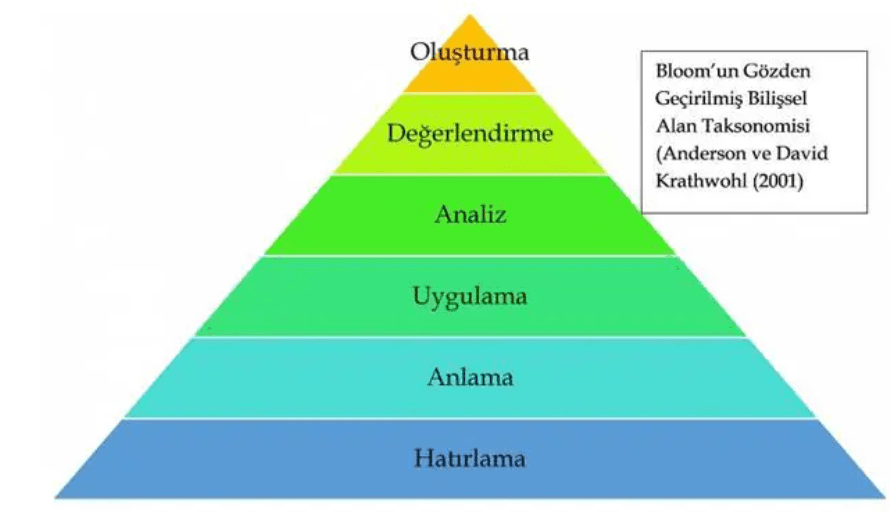
The 2001 revision introduced changes to the structure and terminology of the taxonomy to better align it with contemporary educational practices. In this revision, the level names were changed from nouns to action verbs, and the level of Synthesis was elevated to the highest level and renamed “Creating.” The new hierarchy is as follows:
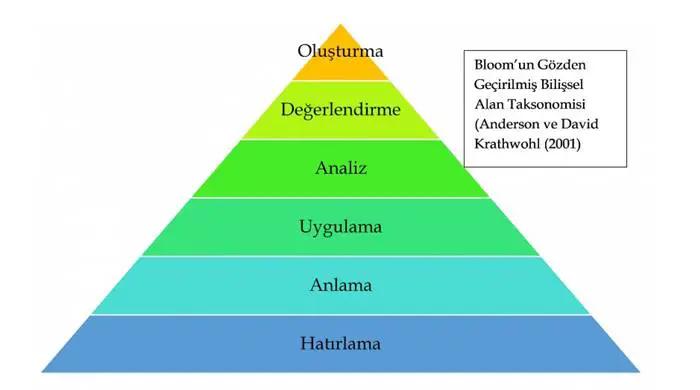
Bloom Taksonomisi (Matematiksel)
The revised taxonomy has adopted a two-dimensional structure: Cognitive Processes and Types of Knowledge. Types of knowledge include factual knowledge, conceptual knowledge, procedural knowledge, and metacognitive knowledge. This structure enables a more detailed examination of learning objectives in terms of both content and process.
Affective Domain: Classifies students’ attitudes, values, emotions, and emotional responses. It consists of five levels: Receiving, Responding, Valuing, Organizing, and Characterizing.
Psychomotor Domain: Encompasses physical movements, motor skills, and coordination. Skill development is described through processes such as observation, imitation, practice, and automation.
Bloom’s Taxonomy is used in setting educational goals, planning instructional activities, and designing assessment processes. Teachers, when defining lesson objectives, can use the levels of thinking in the taxonomy to ensure that students not only recall information but also understand, apply, analyze, evaluate, and create original products.
It also serves as a guide for determining the types of questions teachers use in classroom activities, writing learning outcomes, and planning independent learning processes. Verb lists aligned with each level help educators articulate learning objectives clearly and measurably.
Although Bloom’s Taxonomy has gained widespread acceptance in education, it has also faced criticism. One major critique is that dividing the learning process into hierarchical levels fails to fully reflect the complex and holistic nature of learning. Additionally, the hierarchical relationship between evaluation and creating has been questioned as unclear. In response, circular and integrated models have been proposed.
Bloom’s Taxonomy (Sprouts Türkiye)
Bloom’s Taxonomy is an important and effective framework for classifying learning objectives in education. It provides a systematic approach that educators can use when planning instructional activities, defining lesson goals, and structuring assessment processes. Both the original and revised versions continue to be relevant in contemporary educational practices.
Birgin, Osman. 2016. “Bloom Taksonomisi.” In *Matematik Eğitiminde Teoriler*, edited by E. Bingölbali, S. Arslan, and İ. Ö. Zembat, 839–860. Ankara: Pegem Akademi. Accessed May 14, 2025.
Istanbul Kent University. "Eğitimde Bloom Taksonomisi." PDF. Accessed May 14, 2025.
Matematiksel. "Bloom Taksonomisi Nedir?" Matematiksel.org. Accessed May 14, 2025.https://www.matematiksel.org/bloom-taksonomisi-nedir/
Mathematical. "Bloom Taksonomisi Schema - 1." Visual.https://www.matematiksel.org/wp-content/uploads/2023/09/Screenshot_1-1.jpg?ezimgfmt=ng:webp/ngcb228. Accessed May 14, 2025.
Mathematical. "Bloom Taksonomisi Schema - 2." Visual.https://www.matematiksel.org/wp-content/uploads/2023/09/bloom.jpg?ezimgfmt=ng:webp/ngcb228. Accessed May 14, 2025.
Teaching Training Together. “Bloom's Taxonomy.” *TeachingTrainingTogether.org*. Accessed May 14, 2025.
YouTube. "Bloom Taksonomisi - Eğitimde Kullanımı ve Aşamaları." YouTube Video, 6:13. Accessed May 14, 2025.https://www.youtube.com/watch?v=AjneKqqEeTM&t=1s
Bloom's Taxonomy
Purpose | Systematize learning objectives Plan teaching processes and structure assessment | ||||||||
|---|---|---|---|---|---|---|---|---|---|
Field of Use | Writing learning objectives, lesson planning, activity design, measurement and evaluation | ||||||||
Features | It has a hierarchical structure, includes cognitive steps from lower to higher, and serves as a guide for educators and curriculum developers | ||||||||
Original Bloom’s Taxonomy
Revised Bloom’s Taxonomy
Other Learning Domains
Use and Importance in Education
Critiques and Alternative Approaches