


This article was automatically translated from the original Turkish version.
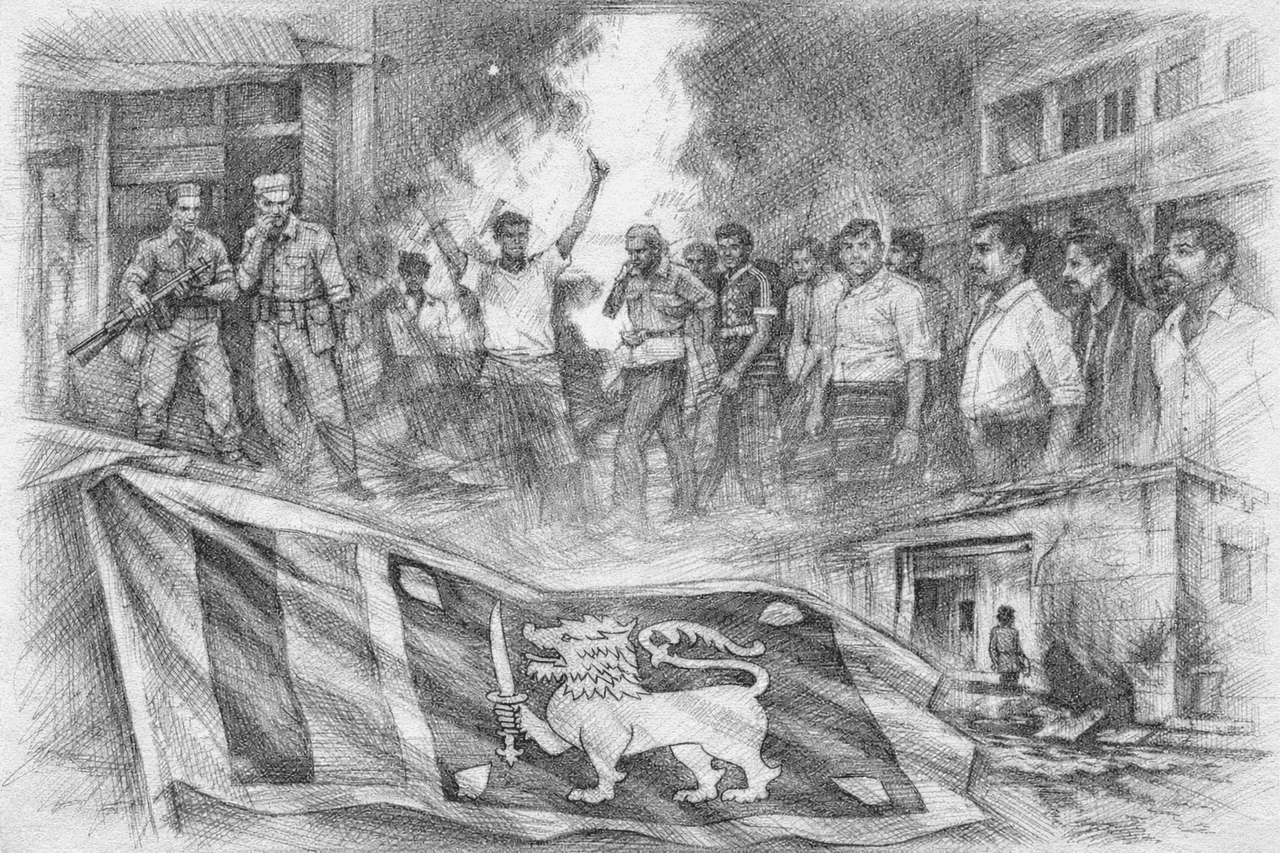
(Generated by Artificial Intelligence)
Black July
Location | Sri Lanka generally | ||||||||
|---|---|---|---|---|---|---|---|---|---|
Official Apology | In 2004 by President Chandrika Kumaratunga | ||||||||
Destroyed Businesses | Approximately 5,000 | ||||||||
Destroyed Homes | Approximately 18,000 | ||||||||
Displaced Persons | Approximately 150,000 people | ||||||||
Number of Deaths | 3,000+ Tamil civilians | ||||||||
Triggering Event | Tinneveli Pususu | ||||||||
Perpetrator Actors | Sinhala extreme nationalist groups | ||||||||
Target Group | Tamil ethnic minority | ||||||||
Event Type | Ethnic pogrom | ||||||||
End Date | 30 July 1983 | ||||||||
Start Date | 23 July 1983 | ||||||||
Black July (English: Black July), was an organized massacre targeting the Tamil minority in Sri Lanka between 23 and 30 July 1983.【1】 The violence began in the capital Colombo on 23 July and rapidly spread across different regions of the country, evolving into widespread and simultaneous acts of brutality. While official authorities reported hundreds of deaths, independent reports and human rights sources state that over 3,000 Tamil civilians lost their lives. During the violence approximately 18,000 homes and 5,000 businesses were destroyed and nearly 150,000 people were forcibly displaced.【2】 Black July is regarded not only by its scale and intensity but also by its political and social consequences as a decisive turning point and is widely recognized as the de facto beginning of the 26-year civil war in Sri Lanka.
The historical roots of ethnic conflict in Sri Lanka are directly linked to the political and institutional structures established after the country gained independence from Britain in 1948. Following independence, state governance came largely under the control of the Sinhala majority, creating conditions that systematically excluded the Tamil minority from political representation public employment and access to public resources. The new state’s nation-building process adopted a majoritarian approach that prevented the emergence of an inclusive political framework and established a persistent line of tension between Sinhala and Tamil communities.
This tension acquired an institutional character over time through legal and administrative measures. The 1948 Citizenship Act rendered a significant portion of Indian-origin Tamils stateless by excluding them from citizenship status. Subsequently the “Sinhala Only” (Sinhala Only) law enacted in 1956 which designated Sinhala as the sole official language of the country provoked strong opposition from Tamils who demanded official recognition of Tamil in public administration education and the judiciary.
Ethnic tensions were not confined to political and legal spheres but also manifested in cultural domains. In this context the burning of the Jaffna Public Library in 1981 is recorded as one of the attacks on Tamil cultural heritage. As a result of the attack more than 95,000 rare manuscripts archival documents and historical artifacts were destroyed.【3】 This event was interpreted as an assault on Tamil cultural heritage and demonstrated that cultural targets were also incorporated into the scope of violence during the ethnic conflict.
Under these conditions the long-standing efforts of the Tamil community to seek rights through protests and parliamentary politics frequently produced no concrete results. Among some sections of the Tamil population disillusioned by unmet demands there emerged a shift toward armed organization.【4】 Various armed groups emerged during this period and over time the Liberation Tigers of Tamil Eelam (LTTE) became the most effective among them.【5】 Thus the accumulated political legal and cultural tensions since independence created the structural foundation for the escalation into armed conflict.
The Thirunelveli Ambush on 23 July 1983 in the Thirunelveli region near Jaffna in northern Sri Lanka is recorded as the military incident that triggered the pogrom known as Black July. The attack was carried out by militants of the Liberation Tigers of Tamil Eelam (LTTE) using a landmine against a military patrol unit of the Sri Lanka Light Infantry. During the ambush a total of 13 Sinhala soldiers including several recruits who had just joined the unit were killed.【6】 This attack is widely regarded as one of the first incidents in which long-standing ethnic tensions in Sri Lanka clearly escalated into armed conflict.
Sources offer differing assessments regarding the background of the attack. Some studies argue that the Thirunelveli Ambush should be understood within the context of military operations and human rights violations targeting Tamil civilians in Jaffna shortly before the incident.【7】 In particular some narratives highlight that security operations involving sexual violence against civilians and the deaths of children fueled growing anger and insecurity within the Tamil community.【8】 Conversely some academic reports and human rights organizations question whether the military attack on 23 July 1983 alone triggered the Black July pogrom pointing out that state-sanctioned or tolerated violence was already escalating systematically prior to the event.【9】 Within this framework the Thirunelveli Ambush is viewed not as an abrupt beginning of ethnic conflict but as a visible turning point revealing existing tensions.【10】
Following the attack the bodies of the slain soldiers were transported to the Borella Cemetery in Colombo a critical turning point in the course of events. The failure of security forces to effectively control the large crowd gathered for the funeral ceremony quickly created conditions for the outbreak of mass violence. In the aftermath Tamil civilians their homes businesses and places of worship became targets and the violence spread beyond Colombo to other regions of the country. These developments granted the Thirunelveli Ambush historical significance not merely as a military attack but as the actual catalyst of the Black July pogrom.
The violent events of Black July are not described in many sources as spontaneous outbreaks of social unrest but rather as a coordinated and organized series of attacks. These sources indicate that predetermined lists were used to select targets rather than random selection. Sinhala groups are reported to have used official data sources such as voter registration records to identify Tamil-owned homes and businesses which were then attacked in Colombo and other cities.【11】
Some accounts indicate that state-owned vehicles were used to transport attackers and that military and police forces either failed to intervene or limited their involvement in many areas.【12】 This situation sparked debate over the role of security forces during the violence.
It is also reported that during the same period the government intensified its control over the media imposing restrictions on local and international press and suspending the operations of Tamil media outlets.【13】 These measures directly affected how information about Black July was communicated to the public.
One of the most striking examples of violence during Black July occurred at the high-security Welikada Prison in Colombo. On 25 and 27 July 1983 inmates held in the prison mostly Tamil prisoners were attacked by Sinhala inmates using iron bars and cutting tools resulting in the deaths of 53 people.【14】 Various sources suggest that the attacks occurred with the knowledge of prison authorities and that security personnel did not intervene.【15】
The violence was not confined to prisons but extended to civilian areas. Some records indicate that Tamil homes and businesses were targeted vehicles were set on fire and identities were determined through linguistic markers such as language use.
The violence spread beyond Colombo to areas with significant Tamil populations including Kandy Matale Nuwara Eliya Badulla and Trincomalee. The events in these regions demonstrate that Black July was characterized by synchronized acts of violence across the country.
What Were the Black July Events That Triggered the 26-Year Sri Lankan Civil War? (Al Jazeera English)
Following the Black July events senior political representatives of the Sri Lankan government issued various public statements. In his initial remarks following the violence President J.R. Jayewardene made no direct reference to the attacks on Tamil civilians; his statements were primarily framed around public order national unity and security.【16】
In the period following the events a series of constitutional and legal amendments were enacted. The Sixth Amendment to the Constitution criminalized activities deemed contrary to Sri Lanka’s territorial integrity and demands for a separate state. As a result members of the Tamil United Liberation Front (TULF) who refused to comply with the amendment lost their parliamentary seats and were effectively excluded from the legislature.【17】
During the same period the Prevention of Terrorism Act (PTA)(Prevention of Terrorism Act – PTA) enacted in 1979 as a temporary security measure was made permanent. The law granted security forces broad powers including extended detention periods detention without judicial oversight and interrogation without legal safeguards. This legal framework became one of the legal bases for subsequent security operations.
The Black July pogrom is regarded as a turning point associated with long-term demographic and political changes in Sri Lanka. It is estimated that between 500,000 and one million Tamils fled the country in the aftermath due to deteriorating security conditions and public uncertainty.【18】 As a result of this migration a large Tamil diaspora emerged primarily in Canada the United Kingdom Germany France and Australia as well as across North America Europe and Oceania.
One of the domestic consequences of the migration was a decline in skilled human capital. A significant proportion of those who left included professionals such as doctors lawyers engineers and academics and this exodus has been linked to shortages of personnel in health care law and technical sectors.【19】 This situation produced long-term consequences for the capacity and institutional functioning of public services.
Politically it was observed that armed Tamil organizations gained greater social visibility after 1983. In this context it is assessed that the Liberation Tigers of Tamil Eelam (LTTE) expanded its organizational capacity and established a more central position within the Tamil community following the pogrom.【20】 In subsequent years armed struggle became a dominant form of political representation within the Tamil movement. 【21】
One of the most enduring consequences of Black July has been the absence of an effective accountability mechanism for the events. No comprehensive judicial process was initiated against individuals or institutions involved in planning executing or spreading the pogrom and the vast majority of perpetrators remained unpunished. In 2004 then President Chandrika Kumaratunga issued an official apology for the Black July events.【22】 However this apology was not supported by independent investigative commissions judicial proceedings or comprehensive reparations for victims. Consequently the apology had a positive but limited impact on social reconciliation and the establishment of justice.
Today various reports indicate that military units and security institutions continue to maintain a presence in northern and eastern Sri Lanka particularly in areas with concentrated Tamil populations.【23】 The security regulations and administrative oversight mechanisms implemented in these regions have persisted even after the end of the civil war. In this context the Black July events are recognized as one of the primary turning points in the historical background of ethnic relations and security policies in Sri Lanka.
Akilan, Ambihai, and Archana Ravichandradeva. "For Sri Lankan Tamils, the Black July Pogroms Live On 40 Years Later." Al Jazeera, July 29, 2023. Accessed February 8, 2026. https://www.aljazeera.com/opinions/2023/7/29/for-sri-lankan-tamils-the-black-july-pogroms-live-on-40-years-later.
Al Jazeera English. "What Are Black July Massacres That Triggered Sri Lanka’s 26-Year Civil War?" YouTube. July 23, 2023. Accessed February 8, 2026. https://www.youtube.com/watch?v=c5axEyhfd-k.
Al Jazeera. "What Are ‘Black July’ Massacres That Triggered Sri Lanka’s 26-Year Civil War?" July 27, 2023. Accessed February 8, 2026. https://www.aljazeera.com/news/2023/7/27/what-are-black-july-massacres-that-triggered-sri-lankas-26-year-civil-war.
Ananthavinyayan, Thamil. "The Lasting Legacy of Sri Lanka’s Black July Pogroms." *JURIST News*, August 14, 2023. Accessed February 8, 2026. https://www.jurist.org/commentary/2023/08/black-july-part-1/.
BBC News Türkçe. "Sri Lanka’da İç Savaşın İzleri: Kara Temmuz'u Hatırlamak." July 23, 2013. Accessed February 8, 2026. https://www.bbc.com/turkce/haberler/2013/07/130723_srilanka.
Dizman, Mücahit. "Sri Lanka ve Türkiye’deki Çözüm Süreçlerinin Karşılaştırmalı Analizi." *Akdeniz İİBF Dergisi* 25, no. 2 (2025): 86–100. Accessed February 8, 2026. https://dergipark.org.tr/en/download/article-file/4487432.
Harrison, Frances. "Black July - Riots That Led to War." *Ilankai Tamil Sangam*, July 23, 2003. Accessed February 8, 2026. https://sangam.org/black-july-riots-that-led-to-war/.
PEARL. "Black July: A Tamil Genocide." Accessed February 8, 2026. https://pearlaction.org/black-july-a-tamil-genocide/.
Pavey, Eleanor. "The Massacres in Sri Lanka During the Black July Riots of 1983." *Sciences Po - Mass Violence and Resistance - Research Network*, January 20, 2016. Accessed February 8, 2026. https://www.sciencespo.fr/mass-violence-war-massacre-resistance/en/document/massacres-sri-lanka-during-black-july-riots-1983.html.
Perera, J.K.J.P., and W.S.G. Wickramathilake. "The Cultural Legacy of Sri Lanka’s Black July Pogroms." *JURIST News*, August 16, 2023. Accessed February 8, 2026. https://www.jurist.org/commentary/2023/08/the-cultural-legacy-of-sri-lankas-black-july-pogroms/.
Satkunanathan, Ambika. "Black July: The Unspoken and the Unspeakable." *Groundviews*, July 29, 2020. Accessed February 8, 2026. https://groundviews.org/2020/07/29/black-july-the-unspoken-and-the-unspeakable/.
Satyendra, Nadesan. "Indictment Against Sri Lanka - Black July 1983: The Charge is Genocide...." *Tamilnation.org*. Accessed February 8, 2026. https://tamilnation.org/indictment/genocide83/.
Socialist Party. "Black July: Sri Lanka 1983 and the Beginning of Civil War." July 17, 2013. Accessed February 8, 2026. https://www.socialistparty.org.uk/articles/17112/17-07-2013/black-july-sri-lanka-1983-and-the-beginning-of-civil-war/.
Tamil Guardian. "Remembering Black July 41 Years On." July 23, 2024. Accessed February 8, 2026. https://www.tamilguardian.com/content/remembering-black-july-41-years.
Tamilnation.org. "Indictment Against Sri Lanka - Black July 1983: The Charge is Genocide." Accessed February 8, 2026. https://tamilnation.org/indictment/genocide83/gen04.
Yalçın, Emrullah. "Terör ve Terörizmle Mücadelede Bir İç Savaşın Analizi: Sri Lanka ve Tamil Kaplanları Örneği." *Toros Üniversitesi İİSBF Sosyal Bilimler Dergisi* 3, no. 5 (July 2016): 143–183. Accessed February 8, 2026. https://dergipark.org.tr/tr/download/article-file/225639.
[1]
“Black July: Sri Lanka 1983 and the Beginning of Civil War,” Socialist Party, 17 July 2013, https://www.socialistparty.org.uk/articles/17112/17-07-2013/black-july-sri-lanka-1983-and-the-beginning-of-civil-war/.
[2]
“Black July: A Tamil Genocide,” PEARL, accessed 27 January 2026, https://pearlaction.org/black-july-a-tamil-genocide/.
[3]
Ambihai Akilan and Archana Ravichandradeva “For Sri Lankan Tamils the Black July Pogroms Live On 40 Years Later,” Al Jazeera, 29 July 2023 https://www.aljazeera.com/opinions/2023/7/29/for-sri-lankan-tamils-the-black-july-pogroms-live-on-40-years-later.
[4]
“Sri Lanka’da İç Savaşın İzleri: Kara Temmuz'u Hatırlamak,” BBC News Türkçe, 23 July 2013 https://www.bbc.com/turkce/haberler/2013/07/130723_srilanka.
[5]
Pavey Eleanor “The Massacres in Sri Lanka During the Black July Riots of 1983,” Sciences Po - Mass Violence and Resistance - Research Network, 20 January 2016 https://www.sciencespo.fr/mass-violence-war-massacre-resistance/en/document/massacres-sri-lanka-during-black-july-riots-1983.html.
[6]
Pavey Eleanor “The Massacres in Sri Lanka During the Black July Riots of 1983,” Sciences Po - Mass Violence and Resistance - Research Network, 20 January 2016 https://www.sciencespo.fr/mass-violence-war-massacre-resistance/en/document/massacres-sri-lanka-during-black-july-riots-1983.html
[7]
Pavey Eleanor “The Massacres in Sri Lanka During the Black July Riots of 1983,” Sciences Po - Mass Violence and Resistance - Research Network, 20 January 2016 https://www.sciencespo.fr/mass-violence-war-massacre-resistance/en/document/massacres-sri-lanka-during-black-july-riots-1983.html
[8]
Ambihai Akilan and Archana Ravichandradeva “For Sri Lankan Tamils the Black July Pogroms Live On 40 Years Later,” Al Jazeera, 29 July 2023 https://www.aljazeera.com/opinions/2023/7/29/for-sri-lankan-tamils-the-black-july-pogroms-live-on-40-years-later.
[9]
Frances Harrison “Black July - Riots That Led to War,” Ilankai Tamil Sangam, 23 July 2003 https://sangam.org/black-july-riots-that-led-to-war/.
[10]
“Remembering Black July 41 Years On,” Tamil Guardian, 23 July 2024 https://www.tamilguardian.com/content/remembering-black-july-41-years.
[11]
“Remembering Black July 41 Years On,” Tamil Guardian, 23 July 2024 https://www.tamilguardian.com/content/remembering-black-july-41-years.
[12]
Pavey Eleanor “The Massacres in Sri Lanka During the Black July Riots of 1983,” Sciences Po - Mass Violence and Resistance - Research Network, 20 January 2016 https://www.sciencespo.fr/mass-violence-war-massacre-resistance/en/document/massacres-sri-lanka-during-black-july-riots-1983.html.
[13]
Pavey Eleanor “The Massacres in Sri Lanka During the Black July Riots of 1983,” Sciences Po - Mass Violence and Resistance - Research Network, 20 January 2016 https://www.sciencespo.fr/mass-violence-war-massacre-resistance/en/document/massacres-sri-lanka-during-black-july-riots-1983.html.
[14]
“Sri Lanka’da İç Savaşın İzleri: Kara Temmuz'u Hatırlamak,” BBC News Türkçe, 23 July 2013 https://www.bbc.com/turkce/haberler/2013/07/130723_srilanka.
[15]
“Remembering Black July 41 Years On,” Tamil Guardian, 23 July 2024 https://www.tamilguardian.com/content/remembering-black-july-41-years.
[16]
“Sri Lanka’da İç Savaşın İzleri: Kara Temmuz'u Hatırlamak,” BBC News Türkçe, 23 July 2013 https://www.bbc.com/turkce/haberler/2013/07/130723_srilanka.
[17]
Pavey Eleanor “The Massacres in Sri Lanka During the Black July Riots of 1983,” Sciences Po - Mass Violence and Resistance - Research Network, 20 January 2016 https://www.sciencespo.fr/mass-violence-war-massacre-resistance/en/document/massacres-sri-lanka-during-black-july-riots-1983.html.
[18]
“Sri Lanka’da İç Savaşın İzleri: Kara Temmuz'u Hatırlamak,” BBC News Türkçe, 23 July 2013 https://www.bbc.com/turkce/haberler/2013/07/130723_srilanka.
[19]
Pavey Eleanor “The Massacres in Sri Lanka During the Black July Riots of 1983,” Sciences Po - Mass Violence and Resistance - Research Network, 20 January 2016 https://www.sciencespo.fr/mass-violence-war-massacre-resistance/en/document/massacres-sri-lanka-during-black-july-riots-1983.html.
[20]
Pavey Eleanor “The Massacres in Sri Lanka During the Black July Riots of 1983,” Sciences Po - Mass Violence and Resistance - Research Network, 20 January 2016 https://www.sciencespo.fr/mass-violence-war-massacre-resistance/en/document/massacres-sri-lanka-during-black-july-riots-1983.html.
[21]
“Sri Lanka’da İç Savaşın İzleri: Kara Temmuz'u Hatırlamak,” BBC News Türkçe, 23 July 2013 https://www.bbc.com/turkce/haberler/2013/07/130723_srilanka.
[22]
Pavey Eleanor “The Massacres in Sri Lanka During the Black July Riots of 1983,” Sciences Po - Mass Violence and Resistance - Research Network, 20 January 2016 https://www.sciencespo.fr/mass-violence-war-massacre-resistance/en/document/massacres-sri-lanka-during-black-july-riots-1983.html.
[23]
“Black July: A Tamil Genocide,” PEARL accessed 27 January 2026 https://pearlaction.org/black-july-a-tamil-genocide/.

(Generated by Artificial Intelligence)
Black July
Location | Sri Lanka generally | ||||||||
|---|---|---|---|---|---|---|---|---|---|
Official Apology | In 2004 by President Chandrika Kumaratunga | ||||||||
Destroyed Businesses | Approximately 5,000 | ||||||||
Destroyed Homes | Approximately 18,000 | ||||||||
Displaced Persons | Approximately 150,000 people | ||||||||
Number of Deaths | 3,000+ Tamil civilians | ||||||||
Triggering Event | Tinneveli Pususu | ||||||||
Perpetrator Actors | Sinhala extreme nationalist groups | ||||||||
Target Group | Tamil ethnic minority | ||||||||
Event Type | Ethnic pogrom | ||||||||
End Date | 30 July 1983 | ||||||||
Start Date | 23 July 1983 | ||||||||
Historical Background and Origins of the Conflict
Triggering Event: The Thirunelveli Ambush
Implementation and Spread of the Pogrom
Key Violent Incidents and Geographic Spread
Political Responses and Legislative Measures
Long-Term Social and Political Effects
Accountability and Current Situation