


This article was automatically translated from the original Turkish version.
In software system quality assurance processes, testing activities constitute an integral and critical component of the software development life cycle (SDLC). Testing processes enable verification and validation that the developed software functions in accordance with both functional and non-functional requirements. In particular, black box testing refers to testing conducted solely based on observable inputs and outputs, without any knowledge of the software’s internal structure such as code, algorithms, or data flow.
Black box testing is also known as functional testing or specification-based testing, and it evaluates whether the software produces the expected output by simulating how users interact with the system. In this context, test scenarios are typically designed based on the system’s requirement documents, user needs, and use cases.
Although the primary goal of software testing may appear to be proving that the system is error-free, a more accurate definition views software testing as a process of finding defects. In other words, the fundamental assumption of the testing process is that the system is not flawless. This implies that test engineers applying black box testing can uncover errors by comparing actual outputs with expected outputs for specific inputs, even without knowledge of the system’s internal structure. The effort allocated to software testing can reach up to 30% of the total software development process, highlighting the critical impact of testing activities on software quality.
Because black box testing focuses on the system’s external behavior, it is developer-independent and generally aligns with the perspective of customers or end users. For this reason, it is widely used in test types aimed at verifying the overall system behavior, such as system testing, acceptance testing, and regression testing. For example, experimental studies on open-source software have demonstrated that black box testing achieves high success in defect detection and that different testing techniques contribute to understanding system behavior at varying levels.
Black box testing is a testing approach that evaluates a software system solely based on its inputs and outputs, without any knowledge of its internal workings.
In this approach, the software is treated as a “black box”; that is, its internal components are not examined, and only the inputs provided from outside and the resulting outputs are assessed. Test scenarios are designed based on the system’s functional requirements and the behaviors presented to the user, not on the source code.
The structural properties of black box testing are the fundamental elements that distinguish it from other testing types. Based on literature, the following key characteristics are highlighted:
Despite its strengths, black box testing has certain limitations noted in the literature:
Black box testing is a testing method designed to evaluate the functional correctness of software systems, their ability to meet user needs, and their compliance with specifications. Although the process is carried out without knowledge of the software’s internal structure, it aims to observe system behavior through comprehensive and carefully planned scenarios.
In this context, the objectives of black box testing can be summarized under five main headings:
Black box tests primarily aim to verify whether the software’s externally observable behavior aligns with the functional requirements defined in the specifications. Does the software produce the correct output for a given set of inputs? Does it respond appropriately to undefined inputs? These are the questions addressed during black box testing.
Black box tests are specification-driven and aim to confirm whether the system performs its defined tasks according to user expectations. In this context, correct functionality is essential for both user satisfaction and determining whether the software is ready for deployment.
Software testing is often less about proving the absence of errors and more about uncovering existing ones. Black box tests are used not only for verification but also to detect observable deviations in system behavior. For example, techniques such as equivalence partitioning and boundary value analysis systematically scan data fields with high potential for errors.
Black box tests often aim to assess how the software behaves from the user’s perspective. Since the testing process is based on real user scenarios, usability of user interfaces, adequacy of error messages, system consistency, and user responses can be observed through these tests.
This enables determination of whether the system is not only technically functional but also satisfactory from a usability standpoint. In particular, practical testing in open-source projects has shown that black box testing conducted at the user level directly influences overall system acceptance.
Black box tests can reveal not only errors but also missing or conflicting requirements. When a tester designing a test scenario cannot identify the expected system behavior for certain inputs, this exposes gaps in the requirements analysis.
The use of techniques such as decision tables and cause-effect graphs helps clarify complex business logic and prompts a review of requirements. In this way, black box testing also serves as a feedback and improvement tool.
One of the goals of black box testing is to improve system testability and measure reliability. Test scenarios developed through this method can be reused in future versions as regression tests. Additionally, techniques such as fuzz testing evaluate the system’s responses to invalid inputs, thereby measuring the software’s robustness and error tolerance.
Such tests are particularly important in security-critical systems, as they help detect potential system failures caused by user-induced errors before they occur.
Black box testing enables testing based solely on external behavior (inputs and outputs) without knowledge of the software’s internal structure. Numerous techniques have been developed for this testing type, each suited to specific test scenarios. The commonly used black box testing techniques in the literature are detailed below:
Equivalence partitioning divides the input domain into logically meaningful subsets (equivalence classes) and allows testing with only one representative from each class. This approach reduces the number of test cases while maintaining sufficient potential for error detection.
Example: If an application accepts only numbers between 1 and 100, the test classes might be as follows:
This technique is used to achieve significant impact with small test data sets that represent both valid and invalid conditions.
Boundary value analysis is based on the assumption that errors most frequently occur at the boundaries of input values and focuses testing on these critical points.
Application area: Numeric range-based controls (e.g., age, temperature, balance inputs).
Test examples: If the valid value range is 1–100, the following tests can be applied:
Decision table testing analyzes how different combinations of conditions lead to specific actions and generates test scenarios accordingly.
This technique is preferred in systems involving business logic, such as bank credit approval, shopping cart rules, or user permissions.
Cause-effect graphing is a technique for creating test scenarios by graphically representing input conditions (“causes”) and their resulting outcomes (“effects”).
Purpose: To detect inconsistencies and omissions in systems with complex logical conditions.
Steps:
This technique is widely applied in control systems where cause-effect relationships are critical.
All-pairs testing or orthogonal array testing is a powerful technique for covering combinations of multiple variables with the minimum number of tests.
Core principle: Every possible pair of values from any two variables must appear in at least one test case.
Application area: Scenarios requiring testing of multiple configuration combinations such as username, password, language, browser, and device.
Advantage: Significantly reduces the number of tests while maintaining a high probability of defect detection.
Random testing tests system behavior using randomly generated inputs. No specific system is followed; the goal is to observe whether unexpected inputs trigger errors in the system.
Purpose: To evaluate system robustness in situations where errors are difficult to predict.
Limitation: Lacks systematic coverage and risks missing important test cases.
Fuzz testing involves feeding the system corrupt, incomplete, unexpected, or random inputs, particularly in security-critical systems, to observe how the software responds to them.
Purpose: To detect undesirable responses such as crashes, freezes, or error message generation.
Advantage: Helps detect user errors, malicious inputs, or system vulnerabilities early.
Constraint: It is not possible to predict in advance which types of errors will be detected, and the test coverage is not clearly defined.
Fuzz tests are typically used alongside more technical testing processes and are effective in evaluating the software’s “robustness” level.
The black box testing process is a systematic evaluation aimed at determining whether a software system functions correctly according to its functional requirements. Because this process focuses exclusively on external behavior, test scenarios must be carefully structured. According to established literature, the black box testing process consists of the following steps: requirement analysis, test case definition, test data generation, execution, and evaluation.
1. Requirement Analysis: The first step of the testing process is to analyze the software’s functional requirements. In this step, it is determined how the software should behave under specific conditions, and rules are established to form the foundation of test scenarios.
2. Test Case Design: A test case is a structured test unit designed to evaluate the expected output of a software system under a specific condition. A test case includes the following elements:
3. Test Data Generation: The data selected for testing must represent the broadest possible set of system behaviors. Techniques such as equivalence partitioning and boundary value analysis are frequently used in this step. Additionally, studies on open-source software have shown that techniques like pairwise testing can produce effective results with fewer data points.
4. Test Execution: Test data is applied to the system and the resulting outputs are recorded. This phase can be manual or automated. The fact that black box tests are performed at the user interface level provides a significant advantage for automation.
5. Result Evaluation: Actual outputs are compared with the expected outputs specified in the test case. Discrepancies are recorded as defects.
Techniques used in black box testing assist in the systematic development of test cases. These include:
For example, for a software that “compares two integers and returns the larger one,” the following test cases could be designed:
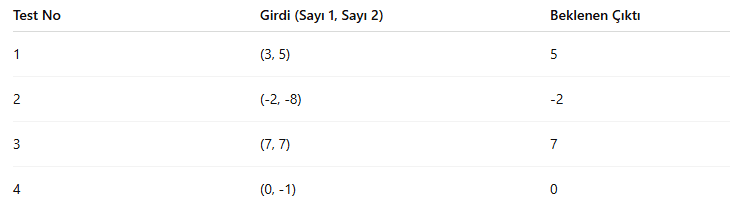
Generated with artificial intelligence.
This example demonstrates a basic application of equivalence partitioning and boundary testing techniques.
A collection of test cases forms a test suite. Each test case is an element of this suite. Literature indicates that a good test suite should have the following characteristics:
Black box testing is a powerful approach that evaluates software based on its external behavior, enabling assessment of functional correctness and user alignment. While this method facilitates certain aspects of the testing process, it can also be limiting in some contexts.
Software testing methods are generally divided into two main categories: black box and white box. Both approaches aim to improve software quality but differ significantly in perspective, application method, and scope. Understanding these differences is crucial for determining appropriate testing strategies. Below is a systematic comparison of these two approaches based on available resources.
Black box testing focuses on the relationship between inputs and outputs. The internal structure, algorithms, or data flow of the tested component are unknown. Test scenarios are developed based on user requirements or system specifications.
White box testing requires direct access to the software’s source code. Tests are designed based on internal structures such as control flow, loops, decision structures, and code coverage. The goal is to ensure that every part of the code is executed at least once.
Situations where black box testing is preferred:
Situations where white box testing is preferred:
Chen, T. Y., and P. L. Poon. “Experience with Teaching Black-Box Testing in a Computer Science/Software Engineering Curriculum.” *IEEE Transactions on Education* 47, no. 1 (2004): 42–50.Accessed Adresi.
Dashti, Mohammad Torabi, and David Basin. *A Theory of Black-Box Tests*. arXiv preprint arXiv:2006.10387, 2020.Accessed Adresi.
Golian, Nataliia,Viktoriia Golіan, and Iryna Afanasieva. “Black and White-Box Unit Testing for Web Applications.” *Bulletin of National Technical University "KhPI". Series: System Analysis, Control and Information Technologies*, no. 1(7) (2022): 79–83.Accessed Adresi.
Guidotti, Riccardo, Anna Monreale, Salvatore Ruggieri, Franco Turini, Fosca Giannotti, and Dino Pedreschi. “A Survey of Methods for Explaining Black Box Models.” *ACM Computing Surveys (CSUR)* 51, no. 5 (2018): 1–42.Accessed Adresi.
Jacob, Pramod M., and M. Prasanna. “A Comparative Analysis on Black Box Testing Strategies.” In *2016 International Conference on Information Science (ICIS)*, 1–6. Piscataway, NJ: IEEE, August 2016.Accessed Adresi.
Khan, Mohd. Ehmer, and Farheen Khan. “A Comparative Study of White Box, Black Box and Grey Box Testing Techniques.” *International Journal of Advanced Computer Science and Applications* 3, no. 6 (2012).Accessed Adresi.
Khan, Mohd. Ehmer. “Different Approaches to Black Box Testing Technique for Finding Errors.” *International Journal of Software Engineering & Applications* 2, no. 4 (2011): 31–38.Accessed Adresi.
Khan, Mumtaz Ahmad, and Mohd. Sadiq. “Analysis of Black Box Software Testing Techniques: A Case Study.” In *The 2011 International Conference and Workshop on Current Trends in Information Technology (CTIT 11)*, 1–5. Piscataway, NJ: IEEE, October 2011.Accessed Adresi.
Kumar, Manish, Santosh Kumar Singh, and R. K. Dwivedi. “A Comparative Study of Black Box Testing and White Box Testing Techniques.” *International Journal of Advance Research in Computer Science and Management Studies* 3, no. 10 (2015): 32–44.Accessed Adresi.
Nidhra, Srinivas, and Jonnalagedda Dondeti. “Black Box and White Box Testing Techniques—A Literature Review.” *International Journal of Embedded Systems and Applications (IJESA)* 2, no. 2 (2012): 29–50.Accessed Adresi.
Verma, Arvind, Abhishek Khatana, and Shivani Chaudhary. “A Comparative Study of Black Box Testing and White Box Testing.” *International Journal of Computer Sciences and Engineering* 5, no. 12 (2017): 301–304.Accessed Adresi.
Xu, Shaochun, Lichao Chen, Chunning Wang, and Oleksandr Rud. “A Comparative Study on Black-Box Testing with Open Source Applications.” In *2016 17th IEEE/ACIS International Conference on Software Engineering, Artificial Intelligence, Networking and Parallel/Distributed Computing (SNPD)*, 527–532. Piscataway, NJ: IEEE, May 2016.Accessed Adresi.

Key Characteristics of Black Box Testing
Limitations of Black Box Testing
Objectives of Black Box Testing
Evaluate Conformance to Functional Requirements
Identify Errors and Behavioral Inconsistencies
Measure User Experience and Usability
Reveal Deficiencies in Specifications
Enhance Testability and System Reliability
Common Black Box Testing Techniques
Equivalence Partitioning
Boundary Value Analysis
Decision Table Testing
Cause-Effect Graphing
All-Pairs Testing (Orthogonal Array Testing)
Random Testing
Fuzz Testing
Testing Process and Test Scenario Development
Stages of the Testing Process
Test Case Development Approaches
Test Suite Definition
Advantages and Disadvantages of Black Box Testing
Advantages
Disadvantages
Comparison of Black Box and White Box Testing
Definitional Distinction
Key Differences Table
When to Use Which Test?