


This article was automatically translated from the original Turkish version.
+1 More
Ecballium elaterium (L.) A. Rich. is a perennial herbaceous plant native to the Mediterranean region, notable for its toxic and medicinal properties. Known locally by names such as "acı düvelek," "eşek hıyarı," and "cırtatan," this plant is particularly recognized for its ability to eject seeds at high pressure upon fruit maturation. Its chemical composition includes cucurbitacins as the primary constituents, along with sterols, phenolic compounds, amino acids, and volatile oils. These compounds have shaped its medicinal applications through anti-inflammatory, cytotoxic, and purgative effects. However, due to the plant’s high toxicity, its use requires caution.
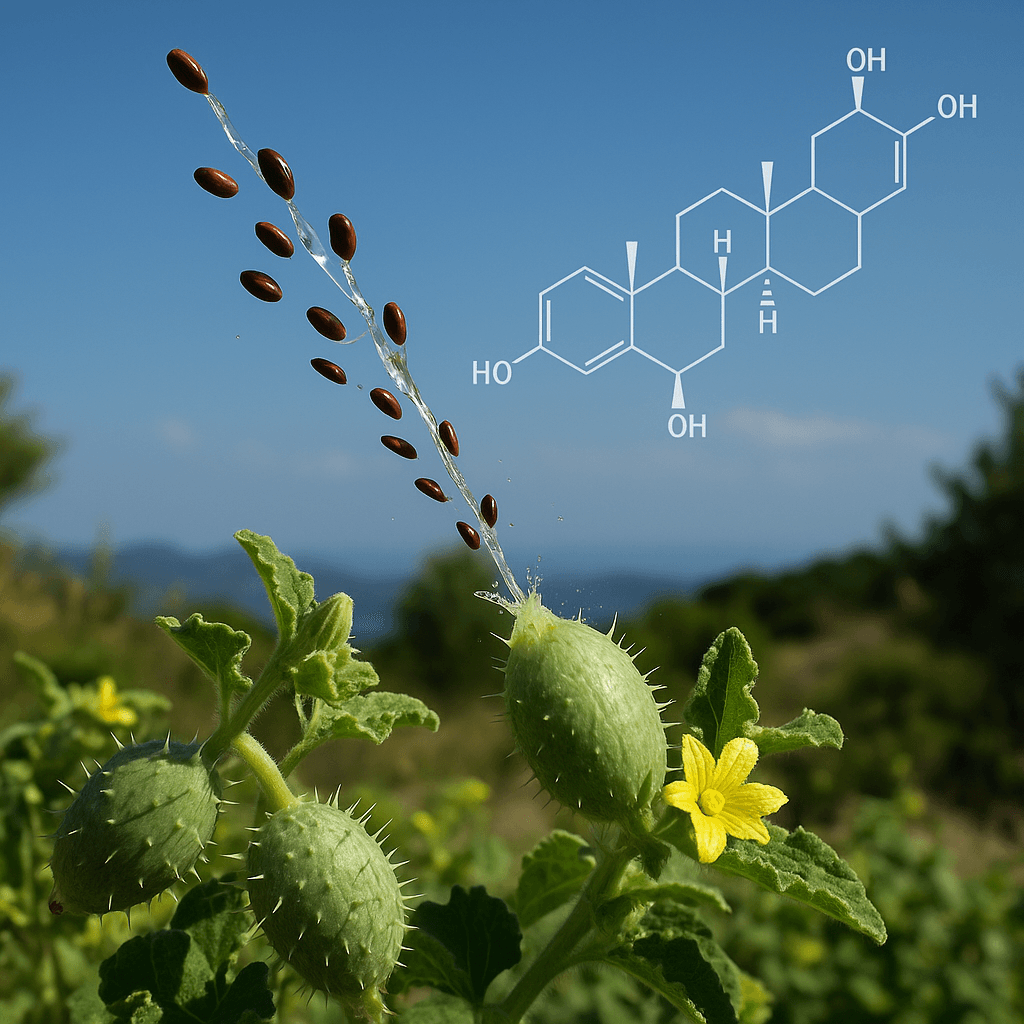
Image of Acı Düvelek (generated by artificial intelligence)
Ecballium elaterium is a herbaceous plant that grows widely in Mediterranean climate zones and exhibits invasive characteristics. It is naturally distributed in Türkiye, Greece, Italy, and North African countries. The specific epithet "elaterium" is derived from the Greek word meaning "to eject," referring to the fruit’s mechanism of forcibly expelling seeds under internal pressure. The plant flowers between April and November at elevations ranging from 0 to 600 meters.
Acı düvelek is distinguished by its hairy leaves, yellowish flowers, and oval, spiny fruits that change color from green to yellow upon maturation. The fruit measures 4–5 cm in length and can develop internal pressures of up to 27 atm. The seeds are dark brown and egg-shaped.
The biological activity of the plant is primarily attributed to cucurbitacins, which are triterpenoid structures serving as part of its defense mechanism.
The sap of E. elaterium can cause severe toxicity in a dose-dependent manner. Oral ingestion may lead to rapid pulse, respiratory distress, nausea, diarrhea, loss of consciousness, and in extreme cases, convulsions and death. Even topical or nasal application has been associated with mucosal edema, dyspnea, and conjunctivitis.
In Türkiye, it is naturally found in provinces such as Istanbul, İzmir, Hatay, and Muğla. Its adaptable structure enables it to thrive across a wide ecological range, from nutrient-rich to poor soils.
Ecballium elaterium is a plant of significant chemical diversity, studied for its potential therapeutic applications in both traditional and modern medicine. However, its high toxicity necessitates careful use. Pharmaceutical research into controlled dosages to evaluate its efficacy remains critically important.
Anadolu Ajansı. “Canını Seven Acı Kavuna Dikkat Etsin.” Accessed April 27, 2025. https://www.aa.com.tr/tr/saglik/canini-seven-aci-kavuna-dikkat-etsin/96017
Anzano, Attilio, Bruna de Falco, Laura Grauso, and Virginia Lanzotti. 2024. “Squirting Cucumber, Ecballium elaterium (L.) A. Ritch: An Update of Its Chemical and Pharmacological Profile.” Molecules 29, no. 18: 4377. https://doi.org/10.3390/molecules29184377
Güllü, İ. B., and N. Öcal. 2016. “Tıbbi Bir Bitki Olarak Ecballium elaterium (L.)’un Tedavi Alanlarının Araştırılması.” BAUN Fen Bilimleri Enstitüsü Dergisi 18, no. 1: 49–57. https://dergipark.org.tr/tr/download/article-file/259517
Health Aktüel. "Acı Kavun Nedir? Faydaları Nelerdir?" Accessed April 27, 2025. https://www.saglikaktuel.com/bitki-ansiklopedisi-aci-kavun-nedir-faydalari-nelerdir-1461.htm
Memişoğlu, M., and G. Toker. 2002. “Ecballium elaterium (L.) Bitkisinin Kimyasal Bileşimi.” FABAD Journal of Pharmaceutical Sciences 27: 19–25. https://dergi.fabad.org.tr/pdf/volum27/Issue1/4.pdf

No Discussion Added Yet
Start discussion for "Bitter Cucumber (Ecballium elaterium)" article
Morphological Characteristics
Chemical Composition
Pharmacological Effects
Toxicological Effects
Ecological and Biogeographical Distribution