


This article was automatically translated from the original Turkish version.
Image processing is one of the foundational pillars of modern technology and is an integral part of many applications we use daily, from photo editing software to artificial intelligence. One of the most commonly used methods in this field, bicubic interpolation, delivers high-quality results when resizing images or estimating missing pixels.
Bicubic interpolation is a method used to calculate new pixel values when resizing an image—for example, during scaling up or down. Known in Turkish as "çift kübik interpolasyon," this method derives its name from cubic (third-degree polynomial) mathematical functions and operates on a two-dimensional plane (x and y axes). Unlike simpler methods such as nearest-neighbor and bilinear interpolation, bicubic interpolation considers 16 surrounding pixels (a 4x4 matrix) when calculating a pixel’s value. This results in smoother and more natural-looking outcomes.
According to Cloudinary, "Bicubic interpolation is a method that calculates a pixel’s value based on its neighboring pixels." 【1】 This method is preferred in situations requiring high image quality because it excels at preserving detail and reducing artifacts such as pixelation or blurriness.
In image processing, interpolation is typically used to change an image’s resolution or fill in missing data points. For instance, when enlarging a photograph, new pixels must be generated between the original ones. The values of these new pixels are estimated using interpolation algorithms. Bicubic interpolation performs these estimations in a more sophisticated manner, better preserving sharp edges and fine details.
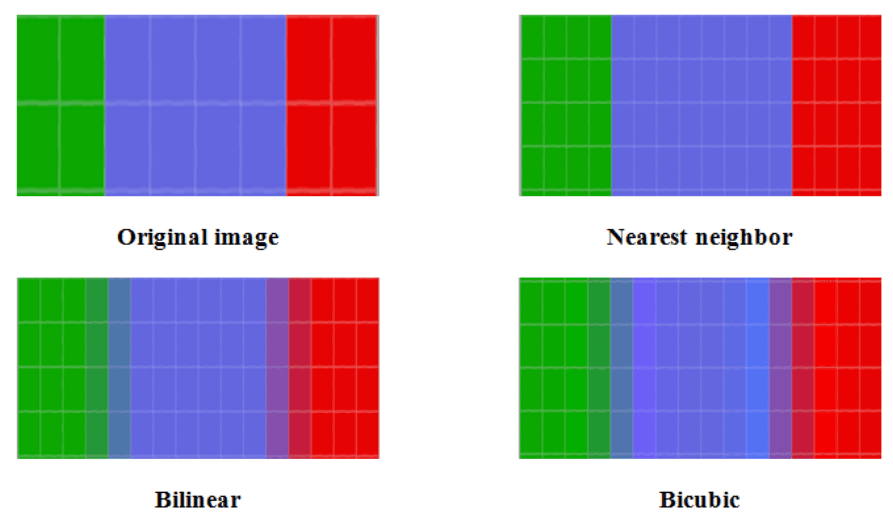
Original image, differences in pixels produced by nearest-neighbor, bilinear, and bicubic interpolation (Credit: )
The foundation of bicubic interpolation lies in cubic polynomials. This method does not only consider nearby pixels but also their gradients (rates of change). Mathematically, this process occurs in two stages: first interpolation along the x-axis, followed by interpolation along the y-axis.
Bicubic interpolation employs a cubic spline function, typically defined as:
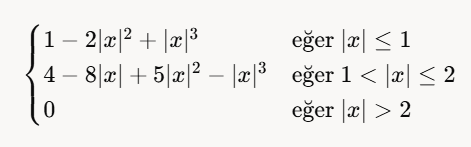
This function assigns a weight to each surrounding pixel based on its distance. Wu et al. explained in their study: "Cubic interpolation provides a smoother transition by considering the derivatives of a continuous function."
To calculate a pixel’s value, a 4x4 pixel matrix surrounding the target pixel is selected. This matrix includes both horizontal and vertical neighbors. Each pixel’s value is then combined using cubic weighting. The mathematical expression can be summarized as:
Here, aij are coefficients derived from the values and gradients of the 16 neighboring pixels. Although this process is computationally intensive, it significantly enhances result quality.
The key difference between bicubic and bilinear interpolation is that bicubic interpolation accounts not only for pixel values but also for their derivatives (gradients). This plays a critical role in preserving edges and details. Rowe et al. emphasized this in their presentation: "Gradients improve the accuracy of interpolation and reduce artifacts."
The step-by-step working mechanism of bicubic interpolation is as follows:
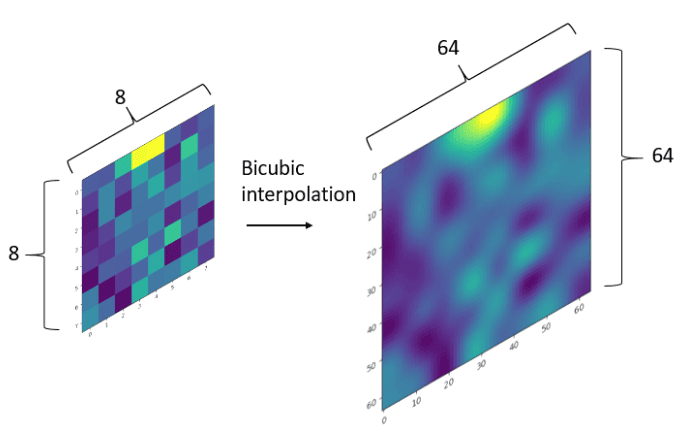
Bicubic interpolation (Credit: )
Like any method, bicubic interpolation has its strengths and weaknesses.
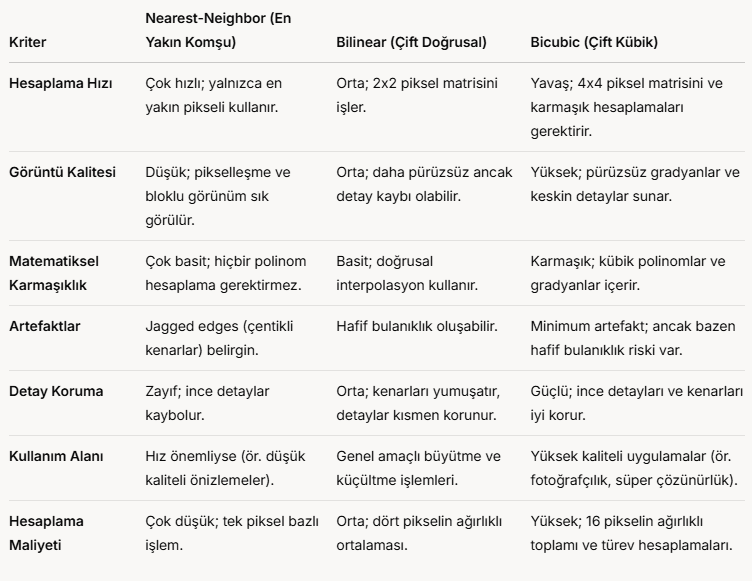
Comparison of Interpolation Methods (Generated by artificial intelligence.)
Bicubic interpolation is not merely a theoretical concept but a widely used practical method.
In languages such as Python, this method can be implemented as follows:
Example pseudocode:
Detailed Code:

(1) Original image; (2) Image obtained by downsampling the original image at 4x scale using bicubic interpolation; (3) Image obtained by upsampling the downsampled image at 4x scale using bicubic interpolation. (Prepared and edited by Beyza Nur Türkü)
Bhatt, P., Patel, S., and Pandit, R. (2013). Comparative analysis of interpolation and texture synthesis method for enhancing image. International Journal of Innovative Research in Science, Engineering and Technology, 2(1).
Cloudinary. "Bicubic Interpolation." Cloudinary Website. Accessed March 18, 2025.Accessed Adresi.
Diaz, G., Tan, B., Sobron, I., Eizmendi, I., Landa, I., and Velez, M. (2024). Cross-Domain Human Activity Recognition Using Low-Resolution Infrared Sensors. Sensors, 24(19), 6388.
GitHub. "Bicubic-interpolation for images (Python)." GitHub Website. Accessed March 18, 2025.Accessed Adresi.
Khaledyan, D., Amirany, A., Jafari, K., Moaiyeri, M. H., Khuzani, A. Z., and Mashhadi, N. (2020, October). Low-cost implementation of bilinear and bicubic image interpolation for real-time image super-resolution. In 2020 IEEE Global Humanitarian Technology Conference (GHTC) (pp. 1-5). IEEE.
Marquette University. (2018). "Bilinear, Bicubic and In Between Spline Interpolation". Department of Mathematics, Statistics and Computer Science. Accessed March 18, 2025.Accessed Adresi.
McMaster University. (2014). "Bicubic Interpolation". Electrical and Computer Engineering. Accessed March 18, 2025.Accessed Adresi.
TheAILearner. "Image Processing - Bicubic Interpolation." Mastering Artificial Intelligence. Accessed March 18, 2025.Accessed Adresi.
[1]
Cloudinary, "Bicubic Interpolation", Cloudinary Web Sitesi, Son erişim: 18 Mart 2025, Erişim Adresi.

No Discussion Added Yet
Start discussion for "Bicubic Interpolation" article
Bicubic Interpolation
The Primary Goal of Interpolation
Mathematical Foundations of Bicubic Interpolation
The Role of Cubic Polynomials
Use of the 4x4 Matrix
The Importance of Gradients
How Bicubic Interpolation Works
Advantages and Disadvantages of Bicubic Interpolation
Advantages
Disadvantages
Applications of Bicubic Interpolation
Implementation of Bicubic Interpolation in Code