


This article was automatically translated from the original Turkish version.

Imagine you are interviewing a child. You ask them, “What do you want to be when you grow up?” The answer you might receive could be a profession that stretches the limits of imagination—teacher, doctor, pilot. But in Gaza, the response is entirely different: “Brother, we Palestinian children cannot grow up. We can be shot at any moment. We can die while walking down the street. This is what life is like in Palestine.”
These words are in fact the most striking summary of how the innocence, joy, and hope of childhood can be erased overnight. In this article, I will examine what it means to be a child in the Gaza Strip and under occupation in the West Bank, the fundamental human rights violations experienced under Israeli military occupation, and how this reality profoundly affects every aspect of a child’s life.
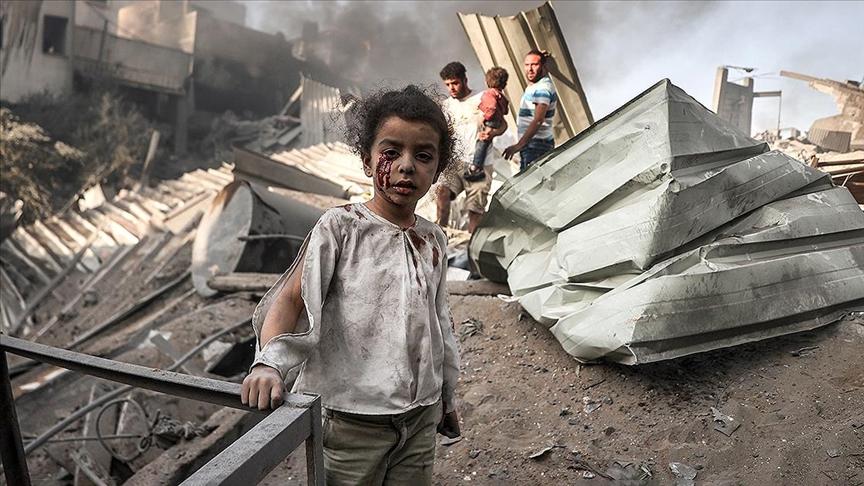
A young child injured in Gaza (Anadolu Agency)
Unfortunately, being a child does not carry the same innocence everywhere in the world. Today in Gaza, according to official figures, tens of thousands of people have lost their lives, more than half of whom are women and children. The actual numbers are believed to be far higher.Israel’s attacks on Gaza have transformed from war into a deliberate, systematic massacre, even a genocide. Hospitals, schools, refugee camps, and places of worship are targeted—every aspect of life is being bombed.
At this point, the stance of Western countries and the United States is truly disturbing. They show no sensitivity to the deaths of children in Gaza that they demonstrated for civilian casualties in the Ukraine-Russia war. Instead, they attempt to justify this massacre with callous statements such as, “This is war; unfortunately these things happen.” It seems that in their world, “some children are more childlike” than others.
The United Nations Convention on the Rights of the Child guarantees every child the right to special care and assistance. But what about Palestinian children living under occupation? For them, this convention holds no meaning.
Each year, between 500 and 700 Palestinian children, some as young as 12, are arrested and brought before Israeli military courts. According to a report by the United Nations Children’s Fund (UNICEF), mistreatment of children within this detention system has become widespread, systematic, and institutionalized. Research shows that three-quarters of detained children have suffered physical violence, two-thirds were not informed of their rights, and nearly all were interrogated without a parent or guardian present. It is also known that children are often denied access to food, water, and toilets for extended periods and are subjected to threats and torture to extract confessions.
Education and health are among the most fundamental rights of every child. Yet for Palestinian children, accessing these rights is nearly impossible. Checkpoints, the separation barrier, and settler attacks in the West Bank prevent children from reaching their schools. Israeli military operations near schools create an extremely stressful and dangerous environment for children.
The same applies to healthcare. Targeting medical facilities, restrictions on the movement of personnel and supplies, and long delays at checkpoints make it nearly impossible for a child with an urgent medical condition to receive timely treatment.
All these experiences reveal not merely the stolen life of a child, but the stolen future of an entire generation. Israel’s policies aim to create a generation without hope, stripped of freedom, and denied even basic necessities. Once regarded by the world as victims of genocide under the Nazis, today the same genocidal violence is being inflicted with the utmost cruelty on children, women, and civilians. They will now be remembered in the conscience of humanity solely for their brutality and the massacre of children.
The story of children who cannot grow up is also a symbol of hope. Because even amid such immense suffering and oppression, the ability to say, “No matter what happens today, every child who survives is a hope for tomorrow,” may be the only way to cling to life.
And we must not forget: today, being a child in Palestine means far more than simply living in a place—it means being part of an unending resistance, an inexhaustible hope, and an unwavering joy for life.
Büyükaslan, Ali. "Gazze'de Çocuk Olmak." Türkiye Araştırmaları Vakfı. Accessed April 12, 2026. https://www.turkiyearastirmalari.org/2023/11/14/fokus-tr/gazzede-cocuk-olmak/
Quzmar, Khaled. "GÖRÜŞ-Bir bakış: Filistin'de çocuk olmak." Anadolu Ajansı. Accessed April 12, 2026. https://www.aa.com.tr/tr/analiz/gorus-bir-bakis-filistinde-cocuk-olmak/3061242