


This article was automatically translated from the original Turkish version.
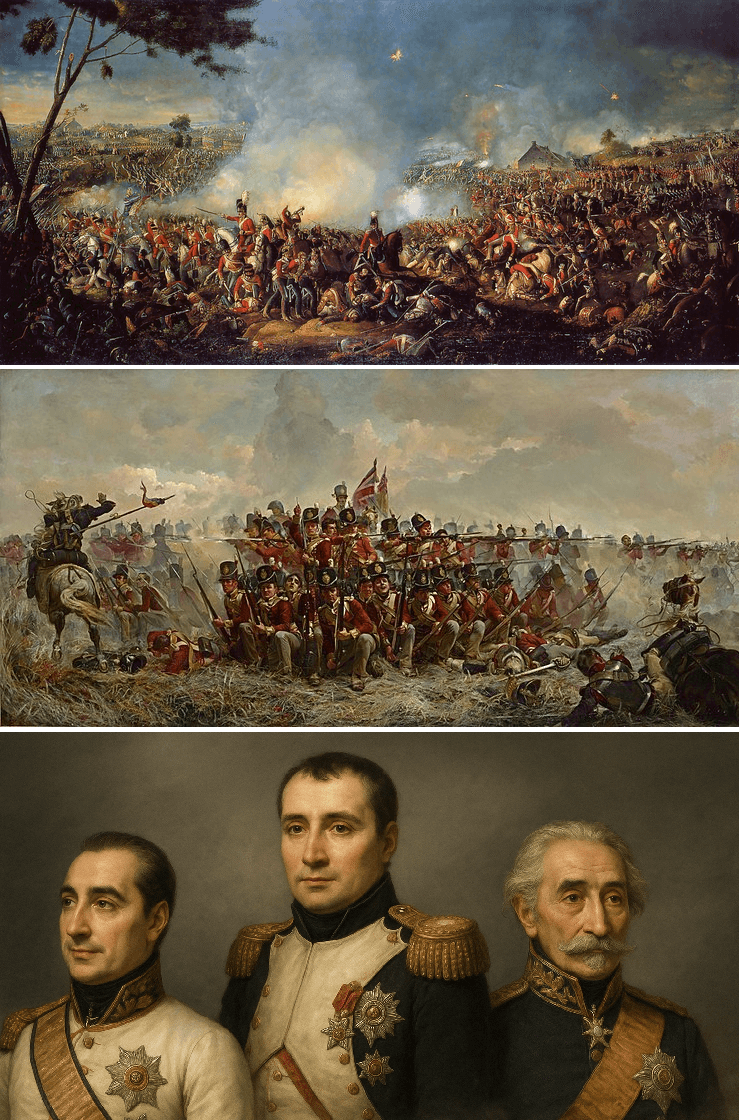
Battle of Waterloo
History | 1815-06-18 | ||||||||
|---|---|---|---|---|---|---|---|---|---|
Region | Belgium Waterloo | ||||||||
Result | Decisive Coalition Victory | ||||||||
Side | France Prussia United Kingdom of the Netherlands United Kingdom Seventh Coalition: Nassau Hanover Duchy of Brunswick | ||||||||
Battle of Waterloo, fought on 18 June 1815, was the final major battle of the Napoleonic Wars (1803–1815) between the French army under Napoleon Bonaparte and the Seventh Coalition forces composed of Britain, Prussia, the Netherlands, and other European powers. The battle took place near the town of Waterloo in present-day Belgium, accelerated the collapse of the French Empire, and definitively ended Napoleon’s political career.
Napoleon returned from exile on the island of Elba on 1 March 1815, launching a brief but critical period of rule known as the Hundred Days. The major powers of Europe viewed this development as a threat, declared Napoleon an enemy of peace, and united once again to remove him permanently. Napoleon’s strategy was to defeat the British army before it could link up with the Prussians, thereby breaking the Coalition and securing victory.
Muharebe Alanı (Yapay zeka ile oluşturulmuştur.)
The opposing forces at Waterloo consisted of the Anglo-Dutch army under the command of the Duke of Wellington and the Prussian forces under General Prince Blücher. The French army came very close to success during critical moments of the battle, particularly in the fighting around the La Haye Sainte farm, where they pressured the Coalition lines. However, the timely arrival of Prussian troops and the failure of the French Imperial Guard’s final assault turned the tide of the battle.
Four days after his defeat at Waterloo, Napoleon abdicated for the second time and was exiled to the island of Saint Helena in the Atlantic Ocean. This battle not only marked the end of Napoleon but also opened the door to a prolonged period of relative peace in Europe. The Battle of Waterloo is regarded as one of the turning points in modern European history.
Napoleon Bonaparte abdicated on 6 April 1814 following the Sixth Coalition Wars and was exiled to the island of Elba. However, on 1 March 1815, he escaped from Elba with only a few hundred soldiers and landed near Cannes in southern France. This event, combined with rapid popular and military support in France, enabled Napoleon to reach the capital Paris in just 20 days and reclaim power on 20 March 1815. This period is known in history as the Hundred Days (Les Cent-Jours).
Napoleon’s return caused alarm across Europe. On 13 March 1815, even before Napoleon reached Paris, the Congress of Vienna declared him an enemy of the people, and all European states agreed on armed intervention to remove him. The Seventh Coalition, formed on 25 March 1815, included the United Kingdom, Prussia, Austria, and Russia. Their plan was for five separate armies to invade France simultaneously and disperse Napoleon’s military capacity without a single major battle. However, implementation of this plan took time. By June 1815, only two Coalition armies—the Anglo-Dutch-German force under Wellington and the Prussian army under Prince Blücher—were deployed in Belgium. The Austrian and Russian armies had not yet reached their operational positions. This situation gave Napoleon a significant strategic advantage: his goal was to defeat each Coalition army separately before they could unite.
Üç Komutan: Wellington Dükü Arthur Wellesley- Napolyon Bonapart - Prens Blücher (Yapay zeka ile oluşturulmuştur.)
On 6 June 1815, Napoleon began assembling a force of approximately 125,000 men under the name “Armée du Nord” (Army of the North). This army consisted of about 89,000 infantry, 22,000 cavalry, and 11,000 artillerymen. Within a week, units arriving from Lille, Metz, and Paris were moved to the Charleroi line, positioned to cut the communication route between the Prussian and British armies. On the morning of 15 June, French troops crossed the border into Belgian territory, initiating the sequence of engagements that led to the Battle of Waterloo, beginning with the battles of Ligny and Quatre-Bras.
Napoleon’s operational plan aimed to defeat the Prussian army under General Blücher first, then the Anglo-Dutch forces under the Duke of Wellington, thereby dismantling the Coalition. However, logistical problems and the faster-than-expected organization of the Coalition armies prevented the plan from being executed. Despite all these developments, Napoleon launched a decisive offensive at Waterloo on the morning of 18 June 1815.
The Battle of Waterloo took place on the morning of 18 June 1815 between the French army under Napoleon Bonaparte, the British and allied forces under the Duke of Wellington, and the Prussian army under Marshal Blücher. Napoleon deployed a large force, including the Imperial Guard. In the course of the battle, British and Prussian forces achieved superiority through coordinated action against the French army. This combined offensive broke the French lines and inflicted a heavy defeat on Napoleon. The Battle of Waterloo is recorded as the final major land engagement of the French Empire and marked the end of Napoleon’s political and military career.
The Battle of Waterloo began on the morning of 18 June 1815 with an intense artillery bombardment launched by the French army under General Reille. This bombardment aimed to weaken the Allied defenses and create a breach in their lines. During the same hours, Napoleon’s brother Jérôme Bonaparte obtained intelligence from a conversation between two British officers that Marshal Blücher planned to reinforce the Duke of Wellington. This information initiated an important intelligence flow in the first minutes of the battle. However, Napoleon did not take this information seriously enough and made no changes to his battle plan. The Emperor continued to underestimate the Duke of Wellington, and this strategic complacency led to critical errors in the following hours.
In the early hours of the battle, Napoleon’s artillery batteries and cavalry units launched several major attacks against the Allied lines. However, these initial moves failed to achieve significant success. The French aimed to identify weak points in the enemy defenses by committing General d’Erlon’s I Corps to the front. Nevertheless, French advances encountered heavy artillery fire and determined British resistance, resulting in heavy casualties.
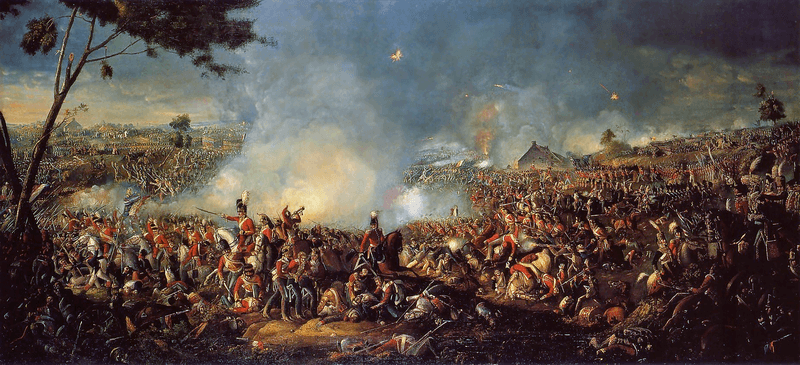
The Battle of Waterloo, oil painting on canvas by William Sadler, 1815 (World History)
The Allied defense effectively utilized the natural advantages of the terrain. British units, mostly positioned on elevated and hilly ground, made French assaults more difficult. Napoleon’s cavalry units encountered spear defenses and were forced to retreat. Meanwhile, French divisions under General d’Erlon suffered heavy losses and were repulsed.
Hougoumont Farm played a critical role in Napoleon’s offensive plan. Located near the right flank of the Duke of Wellington’s defensive line, it was considered a strategic objective by the French command. French units under Prince Jerome Bonaparte began surrounding the farm in the early morning. However, the Hanoverian and Nassau divisions stationed in the area put up stronger resistance than expected.
This resistance thwarted the French plan to capture the farm quickly and caused delays in Napoleon’s overall attack strategy. Intense fighting continued around the farm throughout the day; despite repeated assaults, the French failed to break the defense of Hougoumont. Holding the farm became one of the most important factors in maintaining the stability of the British defensive line.
By midday, French artillery sought to break the Allied line through concentrated fire. However, heavy rain since the morning had softened the ground, preventing cannonballs from ricocheting and reducing the explosive impact. French infantry struggled to advance across the muddy terrain, leaving their attack formations disorganized and ineffective against the Allied defenses.
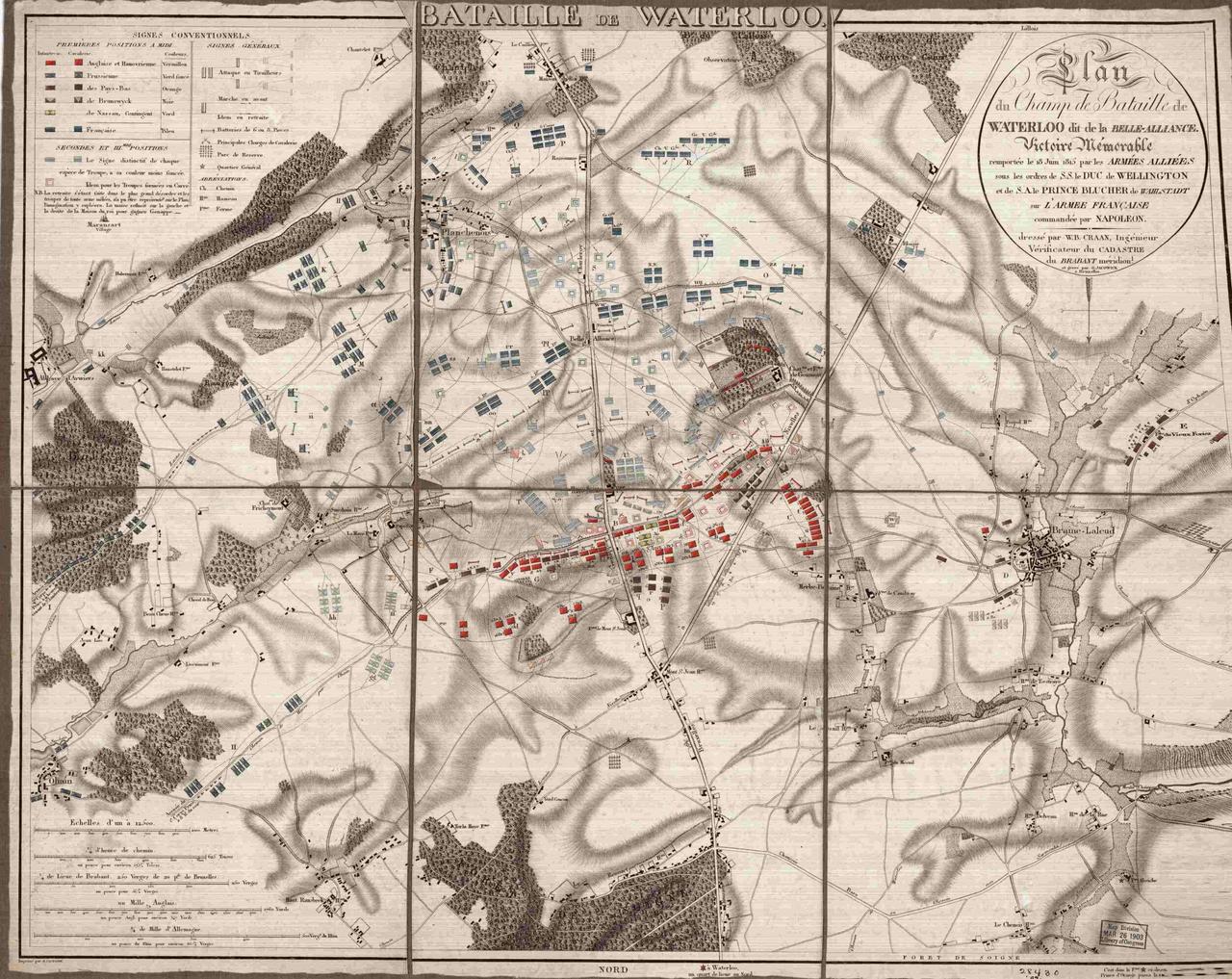
Muharebe Planını Gösteren Harita, 1816 (Library of Congress)
At around 3:00 p.m., Napoleon ordered General d’Erlon’s I Corps to attack the center of the Allied line. However, this assault failed to produce any decisive results. French divisions suffered heavy losses against British spear lines and artillery batteries and were forced to retreat. The Duke of Wellington assessed this weak French advance and launched a counterattack, successfully shifting the balance of the front in favor of the Allies.
Around 1:30 p.m. on 18 June 1815, Prussian forces under General Bülow began advancing toward the right flank of the French army. Despite being pursued by Marshal Grouchy, Marshal Blücher left one corps behind at Wavre and sent his main force of approximately 48,000 men to reinforce Wellington. As the Prussian threat became evident, Napoleon dispatched General Lobau’s force of about 7,000 men toward Plancenoit. However, as additional Prussian corps arrived in the afternoon, pressure on the French right flank intensified. These developments forced Napoleon to commit his reserve units piecemeal to the front and prevented him from focusing sufficient strength on attacks against the Anglo-Allied center.
Napoleon aimed to deliver a decisive blow to the center of the Allied lines with one final effort. In the evening of 18 June 1815, the Imperial Guard advanced with a force of 4,000 men. This attack was vital for the French; however, the complex battlefield conditions allowed the Allies to treat it as an opportunity. The French force encountered fierce resistance. The Allies succeeded in repelling Napoleon’s Imperial Guard, and the French suffered a severe morale collapse. This marked one of the turning points of the battle. With the Prussians also breaking through the French defenses, the French were forced to retreat.
As Napoleon’s Imperial Guard withdrew, the French army began its collapse, driven by a loss of morale. The combined efforts of the Prussian and British forces shattered French resistance. The French army suffered a major rout, and the Napoleonic Empire came to an end. The French lost between 25,000 and 33,000 men, while the Allies suffered approximately 24,000 casualties.
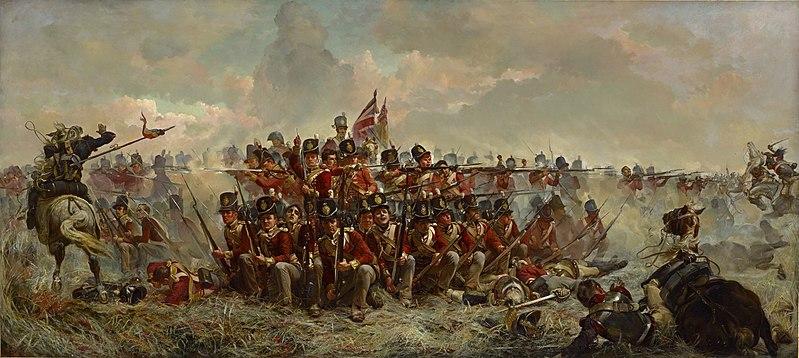
İngiliz 28. Alayı Tablosu (World History)
The Battle of Waterloo ended on 18 June 1815 with the decisive defeat of the French army under Napoleon Bonaparte by British and Prussian forces. After the battle, the French army disintegrated, suffered heavy losses, and was unable to withdraw in an orderly fashion. This defeat led to Napoleon’s second abdication, and on 22 June 1815 he relinquished the throne. He subsequently surrendered to British forces and was exiled to the island of Saint Helena in the Atlantic Ocean, where he died in 1821.
The Battle of Waterloo brought the Napoleonic Wars to an end. The Bourbon monarchy was restored in France, and political boundaries across Europe were reorganized according to the decisions of the Congress of Vienna. After the battle, a balance of power system was established among the great European powers, contributing to nearly 40 years without a major war on the continent.
Chandler, David G. The Campaigns of Napoleon. New York: Scribner, 1966.
Harrison W. Mark. “Battle of Waterloo.” *World History Encyclopedia*. Last updated: October 13, 2023. Accessed April 29, 2025.https://www.worldhistory.org/article/2303/battle-of-waterloo/
Roberts, Andrew. Napoleon: A Life. New York: Viking Press, 2014.
World History Encyclopedia. "Waterloo Muharebesi." Translated by Nizamettin Karaben. Accessed April 29, 2025.https://www.worldhistory.org/trans/tr/2-2303/waterloo-muharebesi/
“Battle of Waterloo, Oil on Canvas by William Sadler, 1815.” World History Encyclopedia. Pyms Gallery, London. Accessed April 29, 2025.https://www.worldhistory.org/image/17966/battle-of-waterloo/
“The 28th Regiment at Quatre Bras, Oil on Canvas by Elizabeth Thompson (Lady Butler), 1875.” World History Encyclopedia. Accessed April 29, 2025.https://www.worldhistory.org/image/18008/the-28th-regiment-at-quatre-bras/
“Waterloo: Selected Maps of Napoleon’s Final Battle.” Library of Congress Blogs. Accessed April 29, 2025.https://blogs.loc.gov/maps/2020/12/waterloo-selected-maps-of-napoleons-final-battle/

Battle of Waterloo
History | 1815-06-18 | ||||||||
|---|---|---|---|---|---|---|---|---|---|
Region | Belgium Waterloo | ||||||||
Result | Decisive Coalition Victory | ||||||||
Side | France Prussia United Kingdom of the Netherlands United Kingdom Seventh Coalition: Nassau Hanover Duchy of Brunswick | ||||||||
Situation Before the Battle
Course of the Battle
Preparations and Beginning
Initial Attacks
Hougoumont Farm and Initial Resistance
Weakening of French Corps and Allied Resistance
Prussian Support and the Turning Point
Napoleon’s Final Move
French Withdrawal
Outcome and Consequences