


This article was automatically translated from the original Turkish version.
History | 18–24 April 1955 | ||||||||
|---|---|---|---|---|---|---|---|---|---|
Location | Indonesia Bandung | ||||||||
Main Themes | Opposition to colonialism, Non-alignment, Peaceful coexistence, Respect for sovereignty, Non-interference in internal affairs | ||||||||
Prominent Figures | Ahmet Sukarno (President of Indonesia), Jawaharlal Nehru (Prime Minister of India), Gamal Abdel Nasser (Prime Minister of Egypt), Fatin Rüştü Zorlu (Deputy Prime Minister of Türkiye) | ||||||||
Outcome | Adoption of the Bandung Principles Joint decisions against colonialism and communism Foundation of the Non-Aligned Movement | ||||||||
Countries Participating from Asia | Afghanistan, Burma (Myanmar), People's Republic of China, Indonesia, Philippines, India, Iraq, Iran, Japan, Cambodia, Laos, Lebanon, Nepal, Pakistan, Saudi Arabia, Syria, Ceylon (Sri Lanka), Thailand, Türkiye, Vietnam (North and South represented separately), Jordan, Yemen | ||||||||
Countries Participating from Africa | Ethiopia, Ghana (not yet independent, observed as Gold Coast), Liberia, Libya, Egypt | ||||||||
Countries in Special Circumstances | Cyprus, Democratic Republic of Vietnam, Republic of South Vietnam (listed separately) | ||||||||
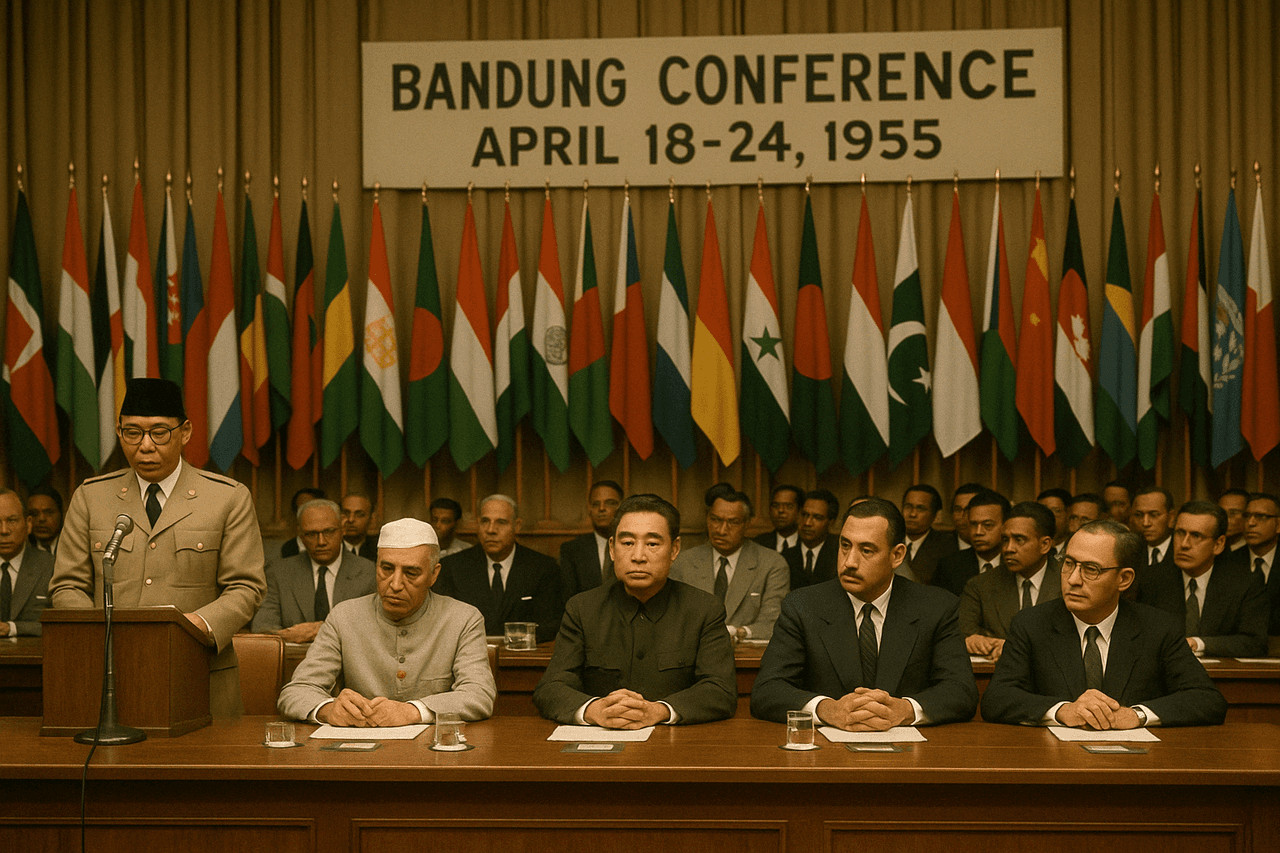
Bandung Conference (officially the Asian-African Conference) was an international meeting held in the city of Bandung, Indonesia, from 18 to 24 April 1955. It brought together representatives of 29 Asian and African countries that had either gained independence from colonialism or were in the process of doing so. This conference holds historical significance as the first major gathering of nations that sought to remain outside the Western and Eastern blocs during the Cold War.
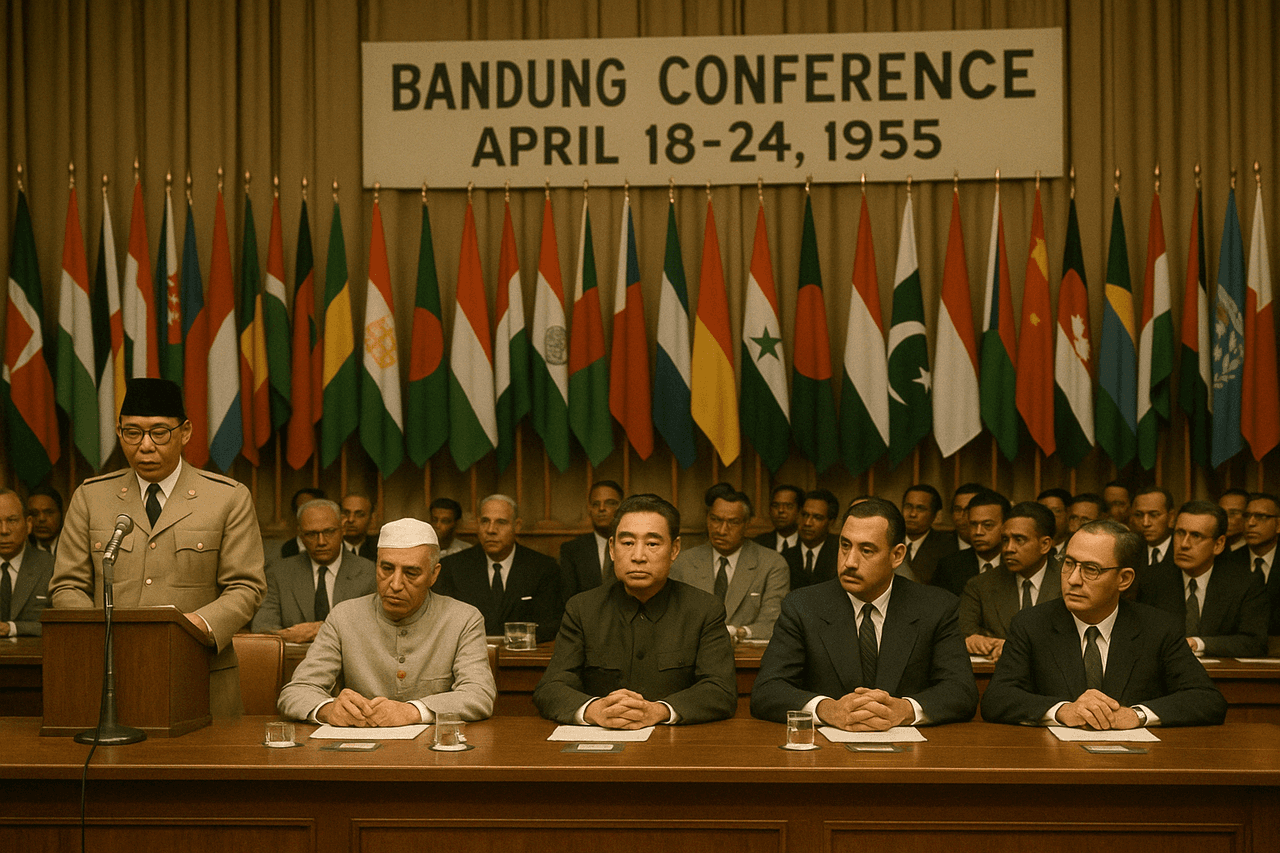
A Visual Representing the Conference (Generated by Artificial Intelligence)
The primary aim of the conference was to unite newly independent Asian and African nations in opposition to colonialism and to form a “third bloc” by maintaining neutrality in the bipolar world. Participating countries sought to determine their own political and economic futures, avoid external pressures, and promote an international system based on mutual respect.
The 29 countries represented at the conference included Afghanistan, People's Republic of China, India, Indonesia, Egypt, Türkiye, Pakistan, Iraq, Iran, Syria, Saudi Arabia, Yemen, Nepal, Laos, Vietnam (with both northern and southern delegations), Ethiopia, Libya, Liberia, Jordan and others. Israel, Taiwan, South Africa and Korea were not invited.
The leading figures of the conference were Indonesia’s host president Ahmed Sukarno, India’s prime minister Jawaharlal Nehru, Egypt’s prime minister Gamal Abdel Nasser and the head of the Chinese delegation Zhou Enlai. Türkiye was represented by a delegation led by Deputy Prime Minister Fatin Rüştü Zorlu.
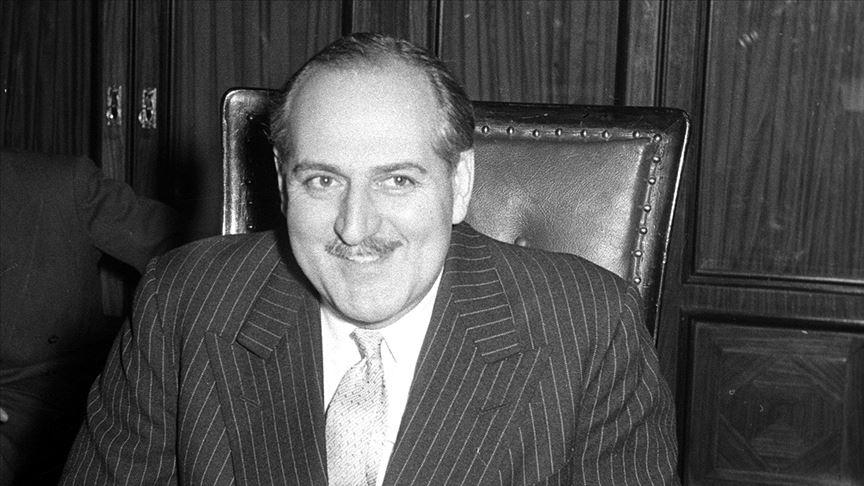
Fatin Rüştü Zorlu (Anadolu Ajansı)
The conference adopted a ten-point resolution known as the “Bandung Principles.” These principles included fundamental tenets such as respect for sovereignty, non-interference in internal affairs, peaceful coexistence, and opposition to racism and colonialism. Additional concrete decisions were made regarding the peaceful use of nuclear energy and the adoption of a unified stance against Israel on the Palestinian issue.
Türkiye was one of the few NATO member states invited to the conference, but it maintained a close alignment with the Western Bloc. Fatin Rüştü Zorlu argued during the conference that the idea of neutrality could harm newly independent nations and viewed communist expansionism as equally dangerous as colonialism. His position was included in the conference document. Türkiye’s stance was criticized by countries such as India, Egypt and China as acting as a spokesperson for the West.
The Bandung Conference laid the foundation for the Non-Aligned Movement, which served as a balancing force between the Eastern and Western blocs throughout the Cold War. The conference gave voice to the “Third World” in international relations and played a major role in establishing universal human rights and decolonization as accepted global concepts.
The conference provided moral and strategic support to independence movements across Africa, accelerating the continent’s decolonization process. It also opened the way for African nations to project their voices on international platforms.
Despite its active participation, Türkiye’s relations with non-aligned countries gradually weakened due to Cold War policies. Diplomatic tensions arose, particularly over the Cyprus issue, with several African and Asian countries. This situation prevented Türkiye from developing a fully consistent foreign policy with the Non-Aligned Movement in the long term.
The Bandung Conference was a pivotal moment in the reshaping of global power relations during the second half of the 20th century. It marked the first serious challenge to the Western-dominated world order by the “Global South,” and its echoes continue to be felt today.
Anadolu Ajansı. "Dış politikanın cesur devlet adamı: Fatin Rüştü Zorlu" Accessed April 17, 2025.
Aydın, Mehmet Korkud. “Bandung Konferansı ve Türk Basınına Yansımaları.” Turkish Studies - History, vol. 13, no. 24, 2018, pp. 33-60. https://doi.org/10.7827/TurkishStudies.14640.
Murat, Turgay. "Bandung Konferansı ve Türkiye." Fırat Üniversitesi Sosyal Bilimler Dergisi, vol. 28, no. 2, July 2018, pp. 363–379.
Çıngır, Ömer Faruk. "Soğuk Savaş Dönemindeki Çift Kutuplu Dünya’ya Bir Alternatif Arayışı: Bağlantısızlar Hareketi, Bandung Konferansı ve Türk Dış Politikası." Soğuk Savaş Dönemindeki Çift Kutuplu Dünya, 2023.

History | 18–24 April 1955 | ||||||||
|---|---|---|---|---|---|---|---|---|---|
Location | Indonesia Bandung | ||||||||
Main Themes | Opposition to colonialism, Non-alignment, Peaceful coexistence, Respect for sovereignty, Non-interference in internal affairs | ||||||||
Prominent Figures | Ahmet Sukarno (President of Indonesia), Jawaharlal Nehru (Prime Minister of India), Gamal Abdel Nasser (Prime Minister of Egypt), Fatin Rüştü Zorlu (Deputy Prime Minister of Türkiye) | ||||||||
Outcome | Adoption of the Bandung Principles Joint decisions against colonialism and communism Foundation of the Non-Aligned Movement | ||||||||
Countries Participating from Asia | Afghanistan, Burma (Myanmar), People's Republic of China, Indonesia, Philippines, India, Iraq, Iran, Japan, Cambodia, Laos, Lebanon, Nepal, Pakistan, Saudi Arabia, Syria, Ceylon (Sri Lanka), Thailand, Türkiye, Vietnam (North and South represented separately), Jordan, Yemen | ||||||||
Countries Participating from Africa | Ethiopia, Ghana (not yet independent, observed as Gold Coast), Liberia, Libya, Egypt | ||||||||
Countries in Special Circumstances | Cyprus, Democratic Republic of Vietnam, Republic of South Vietnam (listed separately) | ||||||||
Purpose and Causes of the Meeting
Participants
Prominent Figures
Decisions Made
Türkiye’s Position
Impact of the Bandung Conference
Impact on World Politics
Impact on Africa
Impact on Türkiye