


This article was automatically translated from the original Turkish version.
+2 More
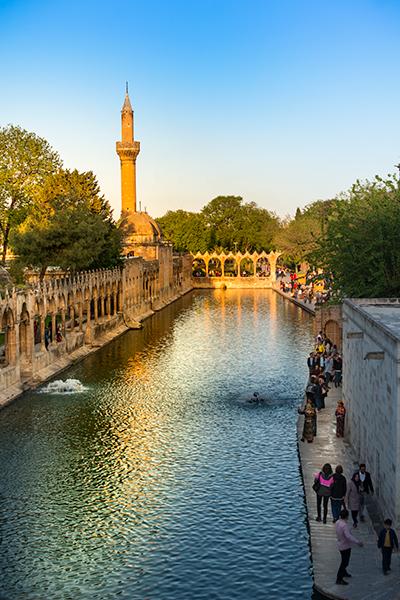
Şanlıurfa Balıklıgöl
Location | Şanlıurfa Türkiye | ||||||||
|---|---|---|---|---|---|---|---|---|---|
FormationType | Karstic Spring | ||||||||
SurroundingStructures | Halil-ül Rahman Camii, Rizvaniye Camii, Mevlid-i Halil Mağarası | ||||||||
HistoricalConnections | It is known as the place where Hz. İbrahim was thrown into the fire. | ||||||||
Balıklıgöl is a lake complex and surrounding area located in the center of Şanlıurfa, recognized as one of the city’s most significant spatial focal points due to its historical, religious, cultural, and natural characteristics. The area consists of two main water bodies: Halilü’r-Rahman Lake and Ayn-ı Zeliha Lake. Together with the sacred sites, historical structures, open spaces, and landscape arrangements around them, these lakes form a cohesive cultural landscape. Balıklıgöl has been shaped primarily within the framework of beliefs attributed to Prophet Ibrahim; over centuries, it has acquired the status of a sacred site according to these narratives.
Balıklıgöl and its immediate surroundings possess a multi-layered character not only within the context of religious beliefs but also in terms of Şanlıurfa’s historical development, architectural continuity, urban identity, and ecological structure. The coexistence of traces from different historical periods in the same location has made Balıklıgöl an essential part of a long-term settlement and usage process extending from prehistoric times to the present.
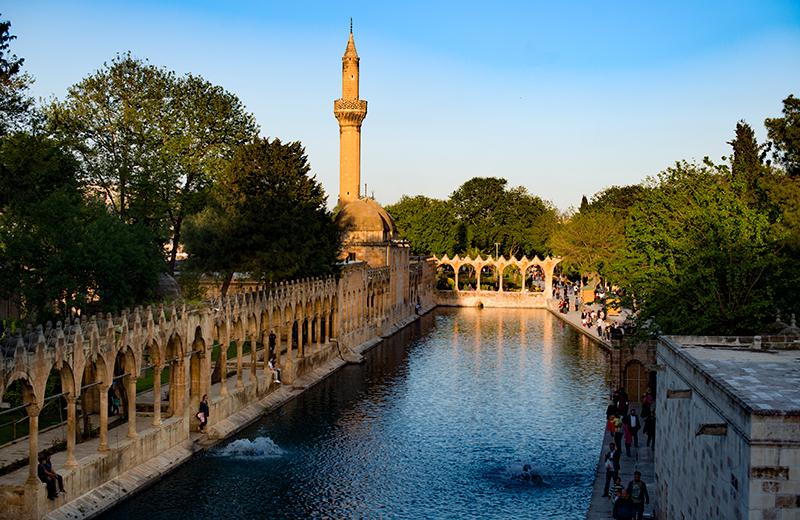
Balıklıgöl (Şanlıurfa Governorship)
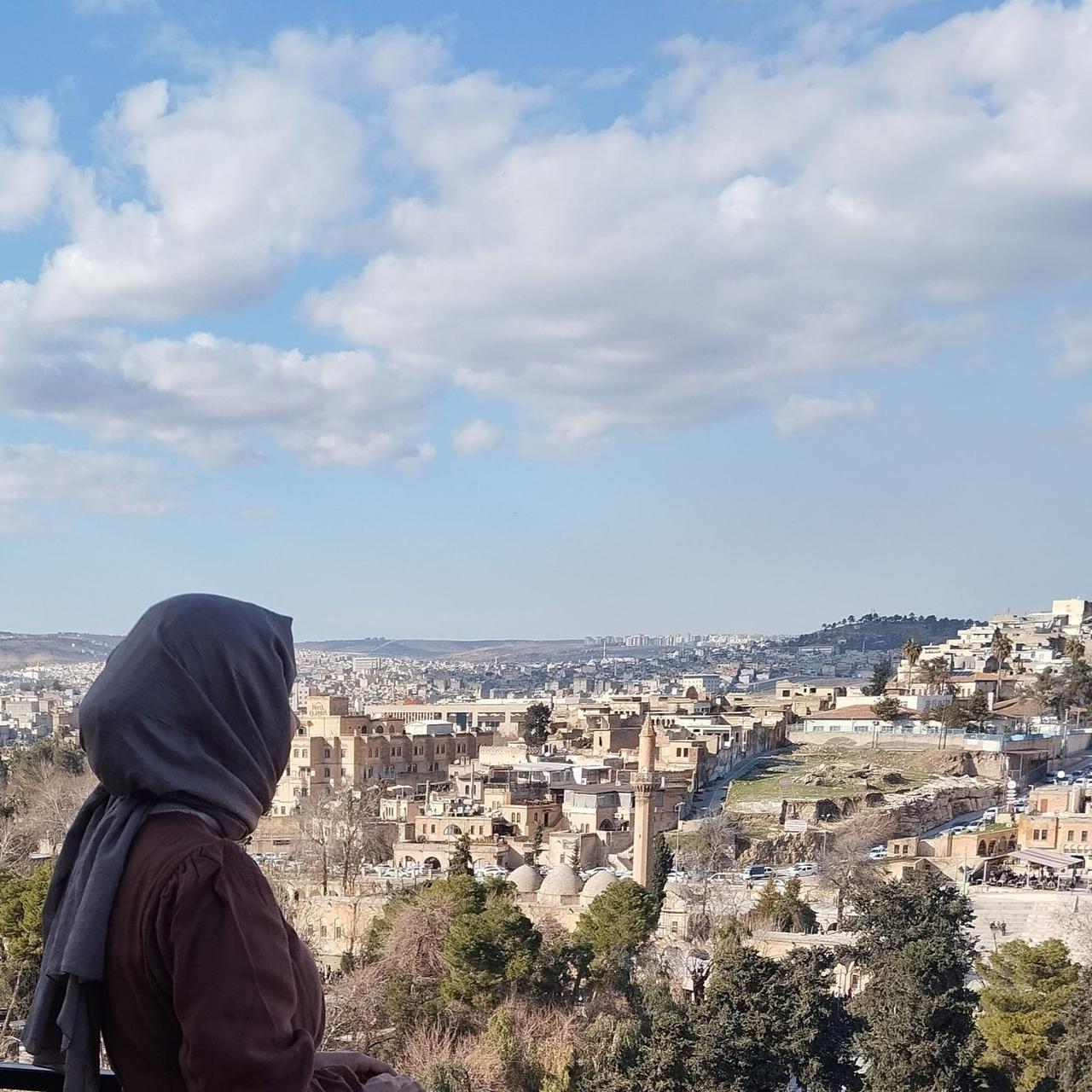
Balıklıgöl is situated in the heart of Şanlıurfa’s urban center, within the core area of the historical settlement. The site lies south of Urfa Castle, and this spatial relationship holds significant importance in the narratives of Prophet Ibrahim. The Balıklıgöl plateau encompasses a broad area including the lakes, mosques, caves regarded as sacred, courtyards, pedestrian pathways, and open spaces.
Halilü’r-Rahman Lake, within the lake complex, measures approximately 150 meters in length and 30 meters in width. With an average depth ranging between 3 and 5 meters, the lake is fed by natural spring waters. Ayn-ı Zeliha Lake, though smaller in scale, is considered an inseparable component of the Balıklıgöl narratives. The water levels of both lakes remain relatively stable throughout the year, indicating a hydrographically stable structure.
The open spaces around Balıklıgöl, together with historically formed pedestrian paths and courtyards, provide a spatial organization that supports public use of the area. This arrangement ensures that Balıklıgöl functions not only as a visited sacred site but also as an open public space integrated into urban life.
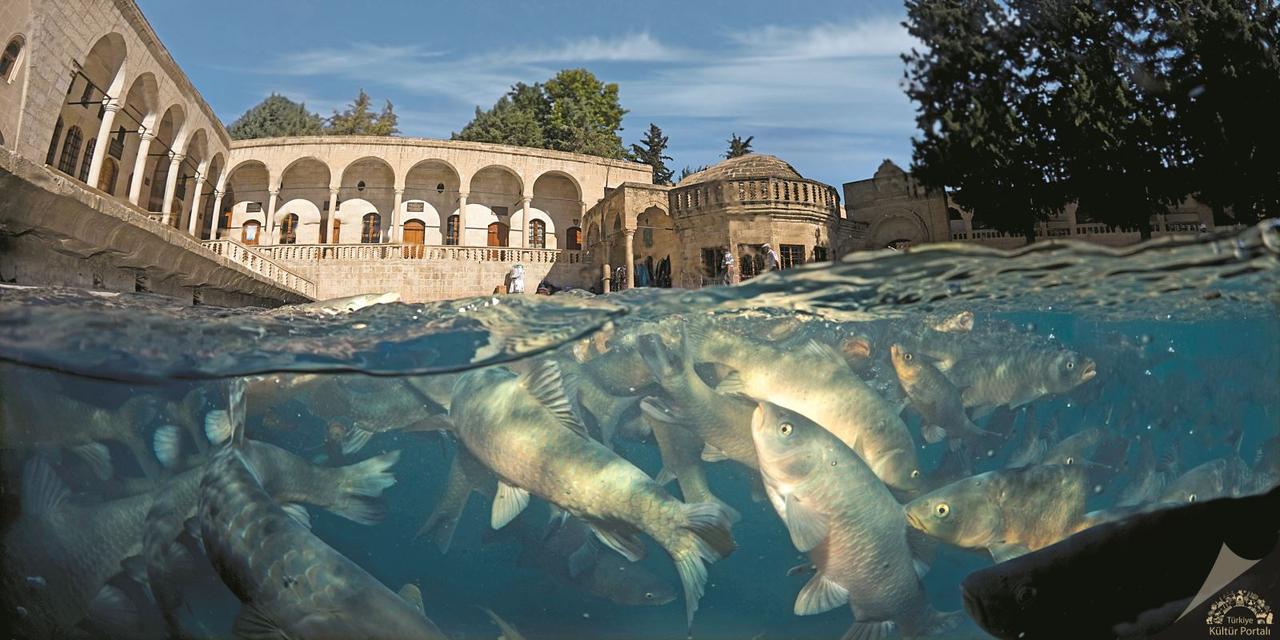
An Image of Fish Inside Balıklıgöl (Culture Portal)
At the heart of Balıklıgöl’s historical and cultural significance lie the beliefs attributed to Prophet Ibrahim. According to tradition, Prophet Ibrahim opposed the polytheistic belief system of the ruler of the time, Nimrod, and championed the belief in one God. This opposition led to his punishment by Nimrod, who ordered him to be thrown into a great fire. Narratives state that at the moment Ibrahim was cast into the fire near Urfa Castle, a divine miracle occurred: the fire turned into water, and the wood and stones used in the fire transformed into fish. The site of this miracle is widely accepted to be Halilü’r-Rahman Lake.
Within the same belief system, it is recounted that Nimrod’s stepdaughter Zeliha, having believed in Prophet Ibrahim and devoted herself to him, threw herself into the fire and was transformed into the waters of Ayn-ı Zeliha Lake upon falling. These narratives have strengthened the perception of Balıklıgöl as sacred and laid the foundation for its continuous use as a site of pilgrimage and worship over centuries.
Another key element of this belief system is the cave on the Balıklıgöl plateau, believed to be the birthplace of Prophet Ibrahim. According to tradition, Ibrahim was secretly born in this cave during the period when Nimrod had ordered the killing of male infants, and he spent his early childhood there. The belief that the water within the cave possesses healing properties has contributed significantly to the site’s enduring appeal as a destination for visitors throughout history.
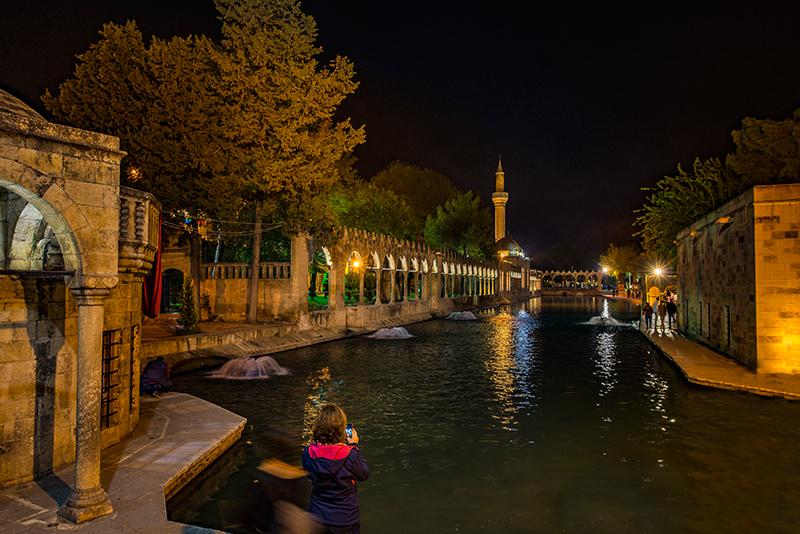
Night View of Balıklıgöl (Şanlıurfa Governorship)
Balıklıgöl is considered a holistic site in conjunction with the historical and religious structures surrounding it. These structures exhibit architectural features from different periods and reflect the historical continuity of the area.
Halilü’r-Rahman Camii is located on the southwest side of Halilü’r-Rahman Lake and was constructed during the Ayyubid period. It is believed to have been built on the site of a previously existing Byzantine church. The mosque’s direct relationship with the lake strengthens the connection between the religious narratives and the physical space.
Rızvaniye Camii is situated north of Balıklıgöl and was built during the Ottoman period. It is known to have been constructed on the site of a Byzantine church. As a key architectural element defining the northern boundary of the Balıklıgöl plateau, Rızvaniye Camii contributes significantly to the spatial integrity of the area.
Şanlıurfa Ulu Camii, which forms a strong link between Balıklıgöl and the historical urban center, was used successively as a synagogue and a church before being converted into a mosque. This structure is one of the most important examples illustrating the transformation and cultural continuity of religious architecture in Şanlıurfa.
Balıklıgöl is regarded as a freshwater system fed by natural spring sources. The formation of the lakes has been influenced by underground water sources, karstic structures, and regional geological features. Through defined inflow and outflow points, the lake waters maintain a consistent circulation, supporting the sustainability of the lake ecosystem.
Physical parameters such as temperature, turbidity, suspended solids, and conductivity of the lake waters have been studied across various periods and are generally found to remain within acceptable limits. However, the lake’s location in the urban center may lead to periodic environmental pressures affecting water quality.
Despite its location in the urban center, Balıklıgöl forms a micro-scale ecosystem comprising aquatic life, fish populations, and surrounding vegetation. The fish in the lakes are predominantly carp species, protected due to religious beliefs. This protection has ensured the long-term continuity of the fish population.
Plane trees and willows surrounding the lake play a vital role in shaping the lake’s microclimate. This vegetation contributes to a cooler and more humid environment around the lake and provides habitat for birds and small animals.
Studies conducted in the Balıklıgöl Basin indicate that water quality generally remains within acceptable limits; however, environmental pressures increase during periods of high visitor density. This underscores the importance of conservation measures for the area.
The Balıklıgöl Urban Plateau presents a holistic urban landscape composed of lakes, sacred sites, historical structures, and open spaces. It is one of the primary areas where Şanlıurfa’s faith-based urban identity is spatially manifested. Throughout history used for worship, pilgrimage, and gathering, the plateau continues to hold significance today through its recreational and public functions.
The Balıklıgöl plateau accommodates both tangible cultural heritage elements and intangible cultural heritage elements such as the narratives of Prophet Ibrahim, popular beliefs, and pilgrimage practices. This unity reinforces Balıklıgöl’s central position within Şanlıurfa’s urban memory.
Dişli, Mehmet, Fatih Akkurt, and Ahmet Alıcılar. “Şanlıurfa Balıklıgöl Suyunun Fiziksel Parametreler Yönüyle Değerlendirilmesi.” Gazi Üniversitesi Mühendislik-Mimarlık Fakültesi Dergisi 18, no. 4 (2003): 81–88.https://dergipark.org.tr/tr/download/article-file/76227.
Ertan, Mehmet Emin. *Hz. İbrahim ve Nemrut*. Şanlıurfa: Şanlıurfa İli Kültür Eğitim Sanat ve Araştırma Vakfı (ŞURKAV) Yayınları, 1999.
Güzel, Abdülkadir. “Tarih Öncesi Bir Yerleşme Olan Şanlıurfa’nın Kuruluşuna Etki Eden Coğrafi Faktörler.” *Marmara Coğrafya Dergisi* 19 (2009): 108–129.https://dergipark.org.tr/en/download/article-file/3185
Karaşah, Banu, and Merve Çelik. "Kent Kimliğini Oluşturan Kent İmgelerinin Kültürel Ekosistem Servisleri Bağlamında Değerlendirilmesi: Balıklıgöl ve Çevresi Örneği." Bartın Orman Fakültesi Dergisi 23, no. 3 (2021): 767–778.
Kürkçüoğlu, A. Cihat, Müslüm Akalın, S. Sabri Kürkçüoğlu, and Selahaddin E. Güler. *Şanlıurfa: Uygarlığın Doğduğu Şehir*. Şanlıurfa: ŞURKAV Yayınları, 2002.https://drive.google.com/file/d/15WhPOmYBGGdr-2yMIfc4IXxc2qywM_g3/view?usp=sharing
Kürkçüoğlu, A. Cihat, and Selahaddin Eyyubi Güler. *Tarih ve Turizm Şehri Şanlıurfa*. Şanlıurfa: ŞURKAV Yayınları, 2010.https://drive.google.com/file/d/1pDS0v1XdLBJmiowlmhZtm_3AjVASJ5DJ/view?usp=sharing
Kürkçüoğlu, A. Cihat. Şanlıurfa Kültür ve Turizm Varlıkları. Şanlıurfa: ŞURKAV Yayınları, 2017.https://drive.google.com/file/d/11yKsl84ePU1E8wiQrymyEhKtYxvTd-RJ/view?usp=sharing
T.C. Ministry of Culture and Tourism. "Balıklıgöl." Kültür Portalı, T.C. Ministry of Culture and Tourism. Accessed Month Day, Year.https://www.kulturportali.gov.tr/turkiye/sanliurfa/gezilecekyer/balikligol
T.C. Ministry of Culture and Tourism. “Şanlıurfa.” Archived web page, October 19, 2021. Accessed via Web Archive:https://web.archive.org/web/20211019072447/https://www.ktb.gov.tr/EN-99290/sanliurfa.html.
T.C. Şanlıurfa Valiliği. "Balıklıgöl." Şanlıurfa Valiliği Resmî Web Sitesi. Accessed January 13, 2026.https://sanliurfa.gov.tr/balikligol2.
Yetiş, Recep, A. Dilek Atasoy, Ayşegül Demir Yetiş, and M. İrfan Yeşilnacar. "Balıklıgöl Havzası Su Kaynaklarının Nitrat ve Nitrit Seviyelerinin Belirlenmesi." Çukurova Üniversitesi Mühendislik Mimarlık Fakültesi Dergisi 33, no. 1 (2018): 47–54.
Öztürk Tel, Hülya, and Elmas Erdoğan. “Şanlıurfa, Balıklıgöl Kent Platosu’nun Ekolojik Tasarım Kapsamında Değerlendirilmesi.” *Mimarlık Bilimleri ve Uygulamaları Dergisi* 6, no. 2 (2021): 564–585.https://dergipark.org.tr/en/download/article-file/1838571.
Şanlıurfa Büyükşehir Municipality. "Balıklıgöl." Şanlıurfa Metropolitan Municipality Official Website. Accessed January 13, 2026.https://www.sanliurfa.bel.tr/icerik/223/30/balikligol
[1]
Mehmet Emin Ertan, Hz. İbrahim ve Nemrut (Şanlıurfa: Şanlıurfa İli Kültür Eğitim Sanat ve Araştırma Vakfı [ŞURKAV] Yayınları, 1999), 1–20. https://www.sanliurfa.bel.tr/files/1/bsb_sonra/surkav_yayinlari/21_HZ_IBRAHIM_VE_NEMRUT.pdf
A. Cihat Kürkçüoğlu, Müslüm Akalın, S. Sabri Kürkçüoğlu ve Selahaddin Eyyubi Güler, Şanlıurfa: Uygarlığın Doğduğu Şehir (Şanlıurfa: ŞURKAV Yayınları, 2002), Hz. İbrahim ve Balıklıgöl bölümü. https://drive.google.com/file/d/15WhPOmYBGGdr-2yMIfc4IXxc2qywM_g3/view
A. Cihat Kürkçüoğlu ve Selahaddin Eyyubi Güler, Tarih ve Turizm Şehri Şanlıurfa (Şanlıurfa: ŞURKAV Yayınları, 2010), Balıklıgöl ve Hz. İbrahim anlatıları bölümü. https://drive.google.com/file/d/1pDS0v1XdLBJmiowlmhZtm_3AjVASJ5DJ/view
A. Cihat Kürkçüoğlu, Şanlıurfa Kültür ve Turizm Varlıkları (Şanlıurfa: ŞURKAV Yayınları, 2017), “Balıklıgöl ve İnanç Merkezleri” başlığı. https://drive.google.com/file/d/11yKsl84ePU1E8wiQrymyEhKtYxvTd-RJ/view
Şanlıurfa Belediyesi, “Balıklıgöl,” Şanlıurfa Büyükşehir Belediyesi Resmî Web Sitesi, erişim 12 Ekim 2017, http://www.sanliurfa.bel.tr/icerik/223/30/balikligol.
Şanlıurfa Balıklıgöl
Location | Şanlıurfa Türkiye | ||||||||
|---|---|---|---|---|---|---|---|---|---|
FormationType | Karstic Spring | ||||||||
SurroundingStructures | Halil-ül Rahman Camii, Rizvaniye Camii, Mevlid-i Halil Mağarası | ||||||||
HistoricalConnections | It is known as the place where Hz. İbrahim was thrown into the fire. | ||||||||
No Discussion Added Yet
Start discussion for "Balıklıgöl, Şanlıurfa" article
Location and Spatial Characteristics
History of Belief and Narratives of Prophet Ibrahim【1】
Historical and Architectural Structures Around Balıklıgöl
Physical Characteristics and Hydrographic Structure
Ecological Structure and Water Quality
Balıklıgöl Urban Plateau and Cultural Landscape