This article was automatically translated from the original Turkish version.
+2 More
Name | Babylift Operation | ||||||||
|---|---|---|---|---|---|---|---|---|---|
Date | April 4, 1975 – May 6, 1975 | ||||||||
Operator | United States President Gerald R. Ford | ||||||||
Participating Countries | United States of America, Australia | ||||||||
Main Aircraft | United States Air Force (USAF): C-5 Galaxy, C-141 Starlifter, C-130 Hercules, C-9 | ||||||||
Related Operations | Operation New Life, Operation Frequent Wind, Operation New Arrivals | ||||||||
Operation Babylift was a humanitarian air evacuation operation launched by the United States government in the final days of the Vietnam War in April 1975, during the advance of communist forces toward South Vietnam and Cambodia. The operation aimed to evacuate thousands of Vietnamese and Cambodian orphaned children from war zones and was carried out with the participation of international humanitarian organizations and other countries, notably Australia. Officially announced by U.S. President Gerald Ford on April 3, 1975, the operation was initiated in response to fears of reprisals and humanitarian crises facing children born to American soldiers and Vietnamese women, as well as vulnerable orphaned children under the impending communist regime.【1】 Operation was also part of a broader evacuation chain that played a role in relocating not only orphans but also civilian refugees and at-risk Vietnamese to safer areas during the final phase of the war.
Documentary on Operation Babylift (Mayday: Air Disaster)
In the early months of 1975, as the North Vietnamese Army advanced southward and captured strategic cities including Da Nang in March, the South Vietnamese government rapidly collapsed, prompting tens of thousands of refugees to flee the country. In this context, orphanages in Saigon were overwhelmed and filled with children in urgent need of medical care; the death rate among orphans rose sharply due to many doctors being deployed to the front lines. Fears that children of American servicemen and Vietnamese women would face retaliation or danger under communist rule generated an urgent call for international action. Through joint efforts by the Agency for International Development (USAID) and private adoption agencies, it was planned that U.S. cargo aircraft returning from delivering aid to Vietnam would evacuate vulnerable children on their return flights.
Operation Babylift was immediately overshadowed by an incident on April 4, 1975. A U.S. Air Force C-5 Galaxy transport aircraft, carrying more than 300 people including at least 230 orphans, volunteers, and personnel from the Defense Attaché Office (DAO), took off from Tan Son Nhut Air Base in Saigon. Shortly after takeoff, the aircraft suffered a catastrophic decompression at an altitude of 23,000 feet due to a failure in the locking mechanism of its rear cargo door. The explosion of the cargo ramp and pressure door caused irreparable damage to the aircraft’s flight control systems in the tail section. Despite efforts by pilot Captain Dennis Traynor to return to the airfield, the plane crashed into rice paddies near the airport. A total of 138 people died, including 78 children. Among the 35 DAO personnel killed were several women employed by the Defense Intelligence Agency (DIA). Although the C-5 crash slowed the operation, it did not halt it, and evacuation efforts continued using other cargo aircraft.【2】
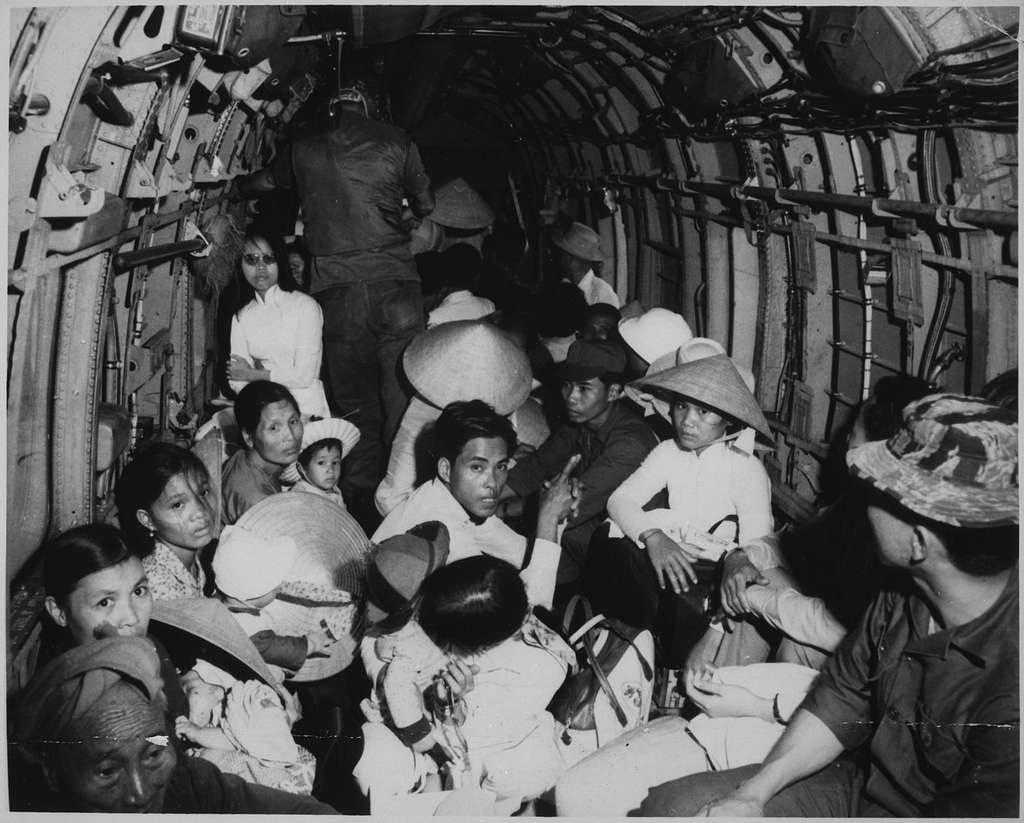
Evacuation of Over 45,000 Vietnamese Refugees from Saigon (PICRYL)
Between April 4 and May 6, the U.S. Air Force (USAF) evacuated more than 2,600 orphans from Vietnam using aircraft such as the C-141 Starlifter and C-130 Hercules. In parallel, Operation New Life, which ran until April 28, evacuated over 45,000 Vietnamese refugees from Saigon. These flights transported evacuees to temporary refugee camps in Clark Air Base in the Philippines, Guam, and Wake Island. As North Vietnamese forces neared Saigon and began rocket and artillery fire on Tan Son Nhut Air Base, the danger to air evacuations increased. The destruction of a grounded C-130 by enemy fire marked the end of fixed-wing evacuation operations. The final air evacuation from Saigon was carried out by Navy, Marine Corps, and Air Force helicopters between April 29 and 30, in Operation Frequent Wind, which transported over 6,000 people to U.S. naval vessels in the South China Sea.【3】 Most of the children rescued by Babylift were transferred after processing in Guam and Wake Island to U.S. military bases in Hawaii, Washington, and California, and then to reception centers such as Fort Chaffee, Camp Pendleton, and Eglin Air Force Base, where they were reunited with new families in the United States.
Operation Babylift had an international dimension, with the Royal Australian Air Force (RAAF) participating in evacuation and humanitarian missions using its fleet of C-130 Hercules aircraft, designated S Squadron. The RAAF initially focused on distributing Red Cross supplies and other humanitarian aid but quickly assumed responsibility for evacuating orphans and relocating civilians from frontline areas. Australian social worker Rosemary Taylor, who had worked for many years in Vietnam through the organization Friends For All Children (FFAC), prepared the lists of children to be evacuated, laying the foundation for the operation.【4】 The RAAF conducted its first Babylift flight simultaneously with the U.S. evacuation on April 4, transporting 107 infants and children via Bangkok to Australia. Additionally, S Squadron evacuated over a thousand civilians by bus from Phan Rang to Can Tho, carrying out civil rescue operations within this scope.
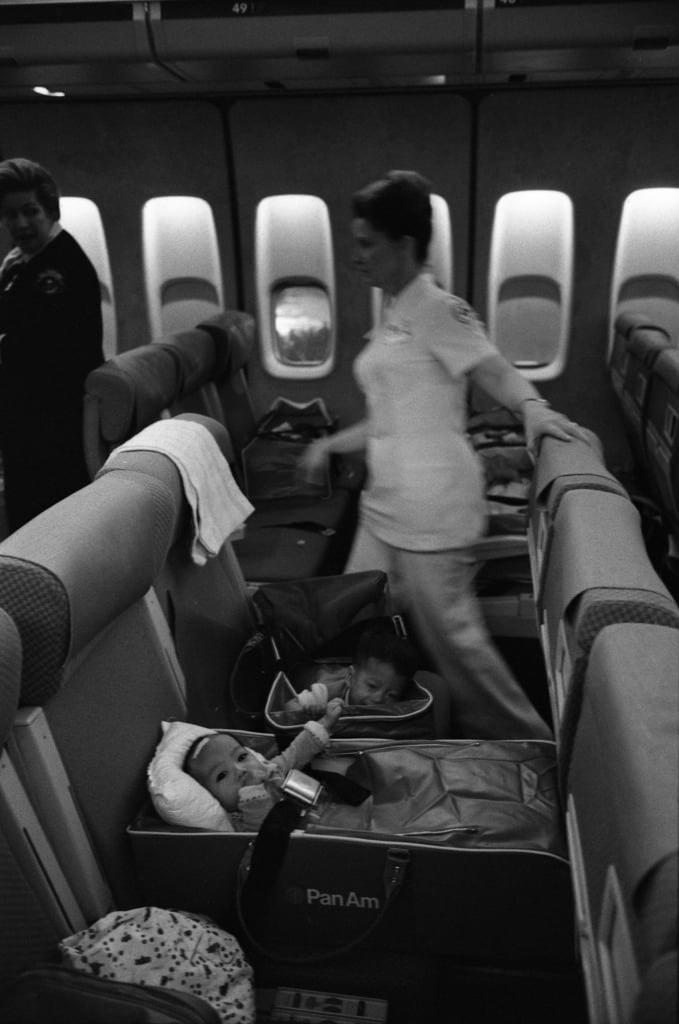
Under Babylift, the U.S. Air Force transported approximately 1,800 orphans using its own aircraft, while private operators carried 884 children on contracted flights.【5】 C-141 Starlifters were used for long-range flights, while C-130s enabled nighttime evacuations of children and civilians from Saigon. On Australian flights, infants were placed in cardboard boxes and secured with seat belts; undernourished, ill, or premature babies were transported under the supervision of RAAF nurses. The second Babylift flight occurred on April 17; led by Chief Nurse Vivian Bullwinkel, the team categorized children by age and health condition, and some were transferred to Qantas aircraft for the long journey home.【6】
Operation New Life, nearly concurrent with Babylift, was a large-scale evacuation plan to remove hundreds of thousands of civilians from Saigon. C-141s flew continuous daytime missions and C-130s operated at night, transporting more than 50,000 people to the Philippines, Wake Island, and Guam. When Philippine President Ferdinand Marcos imposed limits on the number of refugees his country would accept, evacuation routes were redirected to prioritize Guam. RAAF cargo officers attempted to control crowds by closing all aircraft entrances except one, enforcing controlled boarding.
With runways no longer usable, Operation Frequent Wind, launched on April 29–30, became the largest helicopter evacuation in U.S. history. U.S. Marine Corps and Air Force CH-46, CH-53, and HH-53 helicopters transported over 6,000 people from Saigon to U.S. naval vessels in the South China Sea over two days. The 56th Special Operations Squadron’s H-53 helicopters delivered 1,831 people alone to the USS Midway; when the carrier became overcrowded, refugees were transferred to other ships.【8】
Refugees initially directed to temporary camps in Guam, the Philippines, and Wake Island were later transported to reception centers within the United States. C-141, C-130, and C-5 aircraft conducted long-range flights to centers such as Eglin Air Force Base, Fort Chaffee, Camp Pendleton, and Fort Indiantown Gap. In an unprecedented pace for aviation history, more than 24,000 refugees were offloaded at Fort Smith alone within 15 days. During this period, the number of Vietnamese refugees relocated to the United States exceeded 130,000; approximately half were transported by air.【9】
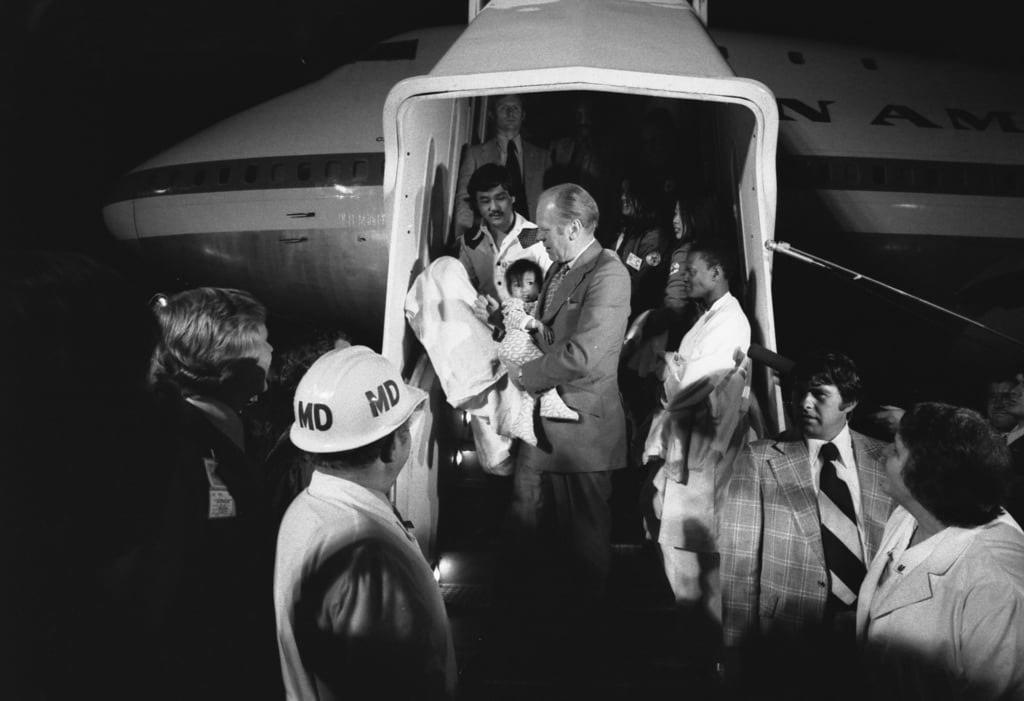
Infants Evacuated Under Operation Babylift with President Gerald R. Ford (NARA)
Operation Babylift was only one part of a massive wave of migration in which over 130,000 people moved from temporary camps in the Pacific islands to the United States and Australia. The operation enabled the evacuation and liberation of tens of thousands. One of the rescued orphans’ stories is that of Dominic Golding-Nguyen, a newborn found deaf and with cerebral palsy outside a bombed building in Saigon’s Chinatown. Believed to have little chance of survival, Dom was placed aboard an RAAF C-130. Two infants died on that flight, but Dominic survived. After receiving treatment at a Melbourne hospital, he was adopted by an Australian family.【10】
Air Force Historical Support Division. “1975 – Operation Babylift and Frequent Wind.” U.S. Air Force, Accessed November 15, 2025.https://www.afhistory.af.mil/FAQs/Fact-Sheets/Article/458955/1975-operation-babylift-and-frequent-wind/
Air Mobility Command Museum. “Operation Babylift & New Life.” Accessed November 15, 2025.https://www.amcmuseum.org/history/operation-babylift-and-new-life/
Australian Broadcasting Corporation. “Inside Operation Babylift, Which Brought Vietnamese Orphans to Australia at the Fall of Saigon.” ABC News. Accessed November 15, 2025.https://www.abc.net.au/news/2025-07-24/operation-babylift-vietnam-war-50-years-on/105541998
Australian War Memorial. "Operation Babylift." *Australian War Memorial, Wartime Magazine Issue 105*. Accessed November 15, 2025.https://www.awm.gov.au/wartime/105/operation-babylift
Defense Intelligence Agency History Office. “Remembering the First Operation Babylift Flight.” DIA. Accessed November 15, 2025.https://www.dia.mil/News-Features/Articles/Article-View/Article/566960/remembering-the-first-operation-babylift-flight/
Department of Veterans’ Affairs. “50th Anniversary of Operation Babylift.” DVA – Latest Stories. Accessed November 15, 2025.https://www.dva.gov.au/news/latest-stories/50th-anniversary-operation-babylift
Gerald R. Ford Presidential Library & Museum. “Operation Babylift.” Gerald R. Ford Presidential Library & Museum, Digital Research Room. Accessed November 15, 2025.https://www.fordlibrarymuseum.gov/digital-research-room/topic-guides/operation-babylift
Martin, Rachel. “Remembering the Doomed First Flight of Operation Babylift.” NPR. Accessed November 15, 2025.https://www.npr.org/2015/04/26/402208267/remembering-the-doomed-first-flight-of-operation-babylift
Mayday: Air Disaster. "Operation Babylift Tragedy: The Untold Story of Vietnam War Orphans | Mayday: Air Disaster." YouTube. Accessed November 15, 2025.https://www.youtube.com/watch?v=ucBz_E_F5Yk
National Archives (NARA). "Photograph of President Gerald R. Ford Carrying a Vietnamese Baby from Clipper." NARA. Accessed November 15, 2025.https://nara.getarchive.net/media/photograph-of-president-gerald-r-ford-carrying-a-vietnamese-baby-from-clipper-f32599
National Archives (NARA). “Nurses and Vietnamese Refugee Children on an Operation Babylift Flight Upon Its Arrival at San Francisco International Airport.” NARA. Accessed November 15, 2025.https://nara.getarchive.net/media/nurses-and-vietnamese-refugee-children-on-an-operation-babylift-flight-upon-52f032
National Archives of Australia. “Operation Babylift.” National Archives of Australia, Migrant Stories – Vietnam. Accessed November 15, 2025.https://www.naa.gov.au/explore-collection/immigration-and-citizenship/migrant-stories/vietnam/operation-babylift
PICRYL. "Stunned by the viciousness of a Viet Cong attack on their village, Vietnam War." Accessed November 15, 2025.https://picryl.com/media/stunned-by-the-viciousness-of-a-viet-cong-attack-on-their-village-vietnam-war-cf6adf
[1]
Air Force Historical Support Division, “1975 – Operation Babylift and Frequent Wind,” U.S. Air Force, erişim 15 Kasım 2025, https://www.afhistory.af.mil/FAQs/Fact-Sheets/Article/458955/1975-operation-babylift-and-frequent-wind/
[2]
Defense Intelligence Agency History Office, “Remembering the First Operation Babylift Flight.” DIA, erişim 15 Kasım 2025, https://www.dia.mil/News-Features/Articles/Article-View/Article/566960/remembering-the-first-operation-babylift-flight/
[3]
Air Force Historical Support Division, “1975 – Operation Babylift and Frequent Wind,” U.S. Air Force, erişim 15 Kasım 2025, https://www.afhistory.af.mil/FAQs/Fact-Sheets/Article/458955/1975-operation-babylift-and-frequent-wind/
[4]
Australian War Memorial, “Operation Babylift,” Australian War Memorial, Wartime Magazine Issue 105, erişim 15 Kasım 2025, https://www.awm.gov.au/wartime/105/operation-babylift
[5]
Air Mobility Command Museum, “Operation Babylift & New Life,” Air Mobility Command Museum, erişim 15 Kasım 2025. https://www.amcmuseum.org/history/operation-babylift-and-new-life/
[6]
Australian War Memorial, “Operation Babylift,” Australian War Memorial, Wartime Magazine Issue 105, erişim 15 Kasım 2025, https://www.awm.gov.au/wartime/105/operation-babylift
[8]
Air Mobility Command Museum, “Operation Babylift & New Life,” Air Mobility Command Museum, erişim 15 Kasım 2025. https://www.amcmuseum.org/history/operation-babylift-and-new-life/
[9]
Air Mobility Command Museum, “Operation Babylift & New Life,” Air Mobility Command Museum, erişim 15 Kasım 2025. https://www.amcmuseum.org/history/operation-babylift-and-new-life/
[10]
Australian War Memorial, “Operation Babylift,” Australian War Memorial, Wartime Magazine Issue 105, erişim 15 Kasım 2025, https://www.awm.gov.au/wartime/105/operation-babylift

Name | Babylift Operation | ||||||||
|---|---|---|---|---|---|---|---|---|---|
Date | April 4, 1975 – May 6, 1975 | ||||||||
Operator | United States President Gerald R. Ford | ||||||||
Participating Countries | United States of America, Australia | ||||||||
Main Aircraft | United States Air Force (USAF): C-5 Galaxy, C-141 Starlifter, C-130 Hercules, C-9 | ||||||||
Related Operations | Operation New Life, Operation Frequent Wind, Operation New Arrivals | ||||||||
No Discussion Added Yet
Start discussion for "Baby Lift Operation" article
Historical Background and Planning of the Operation
Logistical Efforts and Humanitarian Organization
Course of the Operation
Babylift Flights (April 4 – May 6, 1975)
Operation New Life (April 4–28, 1975)
Operation Frequent Wind (April 29–30, 1975)
Operation New Arrivals (April 29 – September 16, 1975)
Legacy and Human Stories