


This article was automatically translated from the original Turkish version.
Auxiliary Power Unit (APU) is a small gas turbine engine commonly used in aircraft, military and commercial vehicles, locomotives, and some large maritime vehicles. The primary function of the APU is to provide electrical, hydraulic, and pneumatic power before the main engines are started or when they are shut down.
The importance of the APU in the aviation sector is significant because it performs critical functions such as maintaining cabin systems while the aircraft is on the ground, starting the engines, and providing emergency power. In commercial aircraft, it is typically located in the tail section and operates on jet fuel.
APUs are not limited to aircraft. They are also used in military vehicles, diesel locomotives, and some large trucks and trailers. For example, in military tanks, the APU is used to start the main engine and generate power with low fuel consumption during prolonged operations.

Auxiliary Power Unit (Credit: http://www.blackrockapu.com)
The Auxiliary Power Unit (APU) performs important roles especially in aircraft, military vehicles, locomotives, and some large commercial land vehicles.
Aircraft engines require high-pressure air before they can be started. The APU generates pneumatic air (compressed air) to meet this requirement and enables engine start-up.
When the aircraft is on the ground, the main engines are turned off. However, cabin systems such as lighting, air conditioning, and avionics systems still require power. The APU generates electricity as an alternative to the aircraft’s main generators.
This feature reduces dependence on ground power units (GPU) at airports and saves fuel.
The pressurized cabins and air conditioning systems of aircraft are supported by the APU, especially when the aircraft is on the ground.
If a failure occurs in the main engines or an electrical outage happens, the APU activates as a backup power source.
For example, in commercial aircraft such as the Airbus A320 and Boeing 737, the APU plays a critical backup role by generating electricity independently from the engines during flight.
The APU is used not only in aircraft but also in military tanks, armored vehicles, locomotives, and large commercial trucks.
By supporting systems without unnecessarily running the main engines of aircraft and vehicles, the APU reduces fuel consumption and carbon emissions.
Especially newer generation APUs are designed to be more efficient and have lower emissions.
The Auxiliary Power Unit (APU) is a system that generates electrical, pneumatic, and hydraulic energy using a small gas turbine or internal combustion engine. The operating principle of the APU used in aircraft and some land and maritime vehicles can be examined in three main phases: Start-up, Operation, and Shutdown.
1- The starter motor engages.
2- Fuel injection begins.
3- The turbine begins to operate.
4- The APU reaches steady state.
Once the APU is operational, it provides power for two main systems:
1- Electrical Generation:
2- Pneumatic Power Generation:
While operating, the APU continuously monitors temperature, pressure, and fuel consumption. If any anomaly is detected, safety systems activate and shut down the APU.
1- The APU load is reduced.
2- Fuel flow is cut off.
3- The cooling process begins.
4- The APU shuts down completely.
The operating principle of the APU varies according to its intended use:
1- Normal Mode:
2- Emergency Mode:
3- Fuel Saving Mode:
4- Cold Weather Mode:
The APU operates on the basis of a small gas turbine engine and consists of the following components:
1- Air Intake System
2- Fuel System
3- Starter System
4- Combustion Chamber
5- Turbine and Generator
6- Exhaust System
7- Control and Protection Systems
The Auxiliary Power Unit (APU) is strategically positioned in aircraft to ensure safe and efficient operation. Depending on the aircraft design, the APU is typically located in the tail section or, in some specialized designs, beneath the wings or within the fuselage.
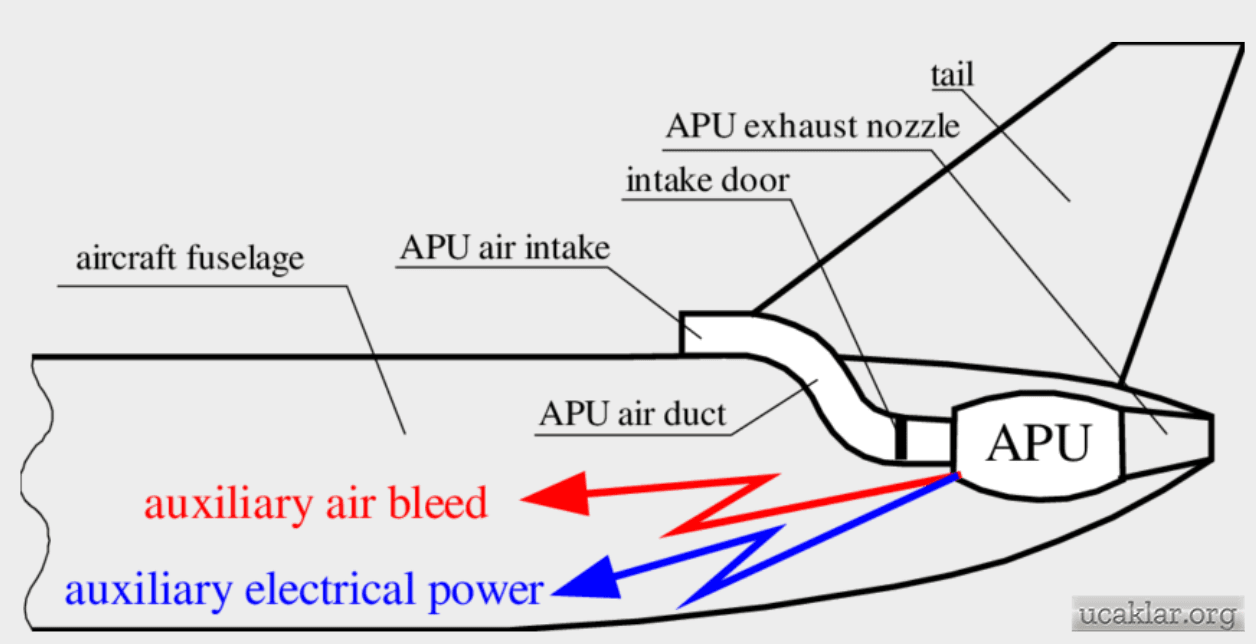
Location of the APU in aircraft (Credit: ucaklar.org)
In most commercial and military aircraft, the APU is located as follows:
1- In the Aircraft’s Tail Section (Tail Cone / Rear Fuselage)
2- Beneath the Fuselage or Within the Wings
3- Inside the Fuselage or at the Wing Root in Helicopters
When determining the location of the APU in an aircraft, the following engineering criteria are considered:
1- Exhaust Gas Direction
2- Aerodynamic Balance
3- Maintenance and Accessibility
4- Fuel and Pneumatic Connections


Click here to watch a simulation explaining how the Auxiliary Power Unit works.
Fernandes, M. D., Andrade, S. D. P., Bistritzki, V. N., Fonseca, R. M., Zacarias, L. G., Gonçalves, H. N. C., ... & Matencio, T. "SOFC-APU systems for aircraft: A review." *International Journal of Hydrogen Energy* 43, no. 33, 2018: 16311-16333.Accessed Adresi.
Gereffi, Gary, Dubay, Kristen, and Lowe Marcy. "Auxiliary Power Units." *Manufacturing Climate Solutions*, 2008: 37.Accessed Adresi.
K.A. Friedrich and R. Henne. "Auxiliary Power Unit (APU) Application"Accessed Adresi.
Lomas, Chris. "What is the Auxiliary Power Unit (APU)?" 2024.Accessed Adresi.
Samarathunga, Wasantha, Wang, Guagwei, and Wang, Shiqin. "Auxiliary power unit evaluation for tethered UAV." International Journal of New Technology and Research 2, no. 7, 2016: 72-75.Accessed Adresi.

No Discussion Added Yet
Start discussion for "Auxiliary Power Unit (APU)" article
Primary Functions of the APU
1. Starting the Aircraft’s Main Engines
2. Providing Electrical Power While the Aircraft is on the Ground
3. Enabling Air Conditioning Operation
4. Providing Emergency Power
5. Supporting Military and Commercial Vehicles
6. Improving Fuel Efficiency and Environmental Benefits
Operating Principle of the APU
A) Start-up (Starting Phase)
B) Operation (Running Phase)
C) Shutdown (Shutdown Phase)
Different Operating Modes of the APU
Components of the APU
Location of the APU in Aircraft
Typical APU Location
Factors Influencing APU Location in Aircraft
APU Location by Aircraft Model
Location and Importance of the APU Exhaust Outlet
Advantages of the APU