


This article was automatically translated from the original Turkish version.
Locus of control is a psychological concept that expresses an individual’s perception of their ability to control events in their life. First introduced by American psychologist Julian B. Rotter in 1954, this concept explains how individuals tend to attribute their successes, failures, and other life events to internal or external factors attributions. Individuals with an internal locus of control believe that their lives are shaped by their own efforts and decisions, while those with an external locus of control believe that events are determined by chance, fate, or external forces.
In psychology, this concept is closely related to personality theories, learned helplessness, and motivation research, and has also found broad application in disciplines such as education, workplace dynamics, and health psychology like. Developed within Rotter’s social learning theory, locus of control has been supported by various studies and is recognized as an important psychological variable for understanding individual differences.
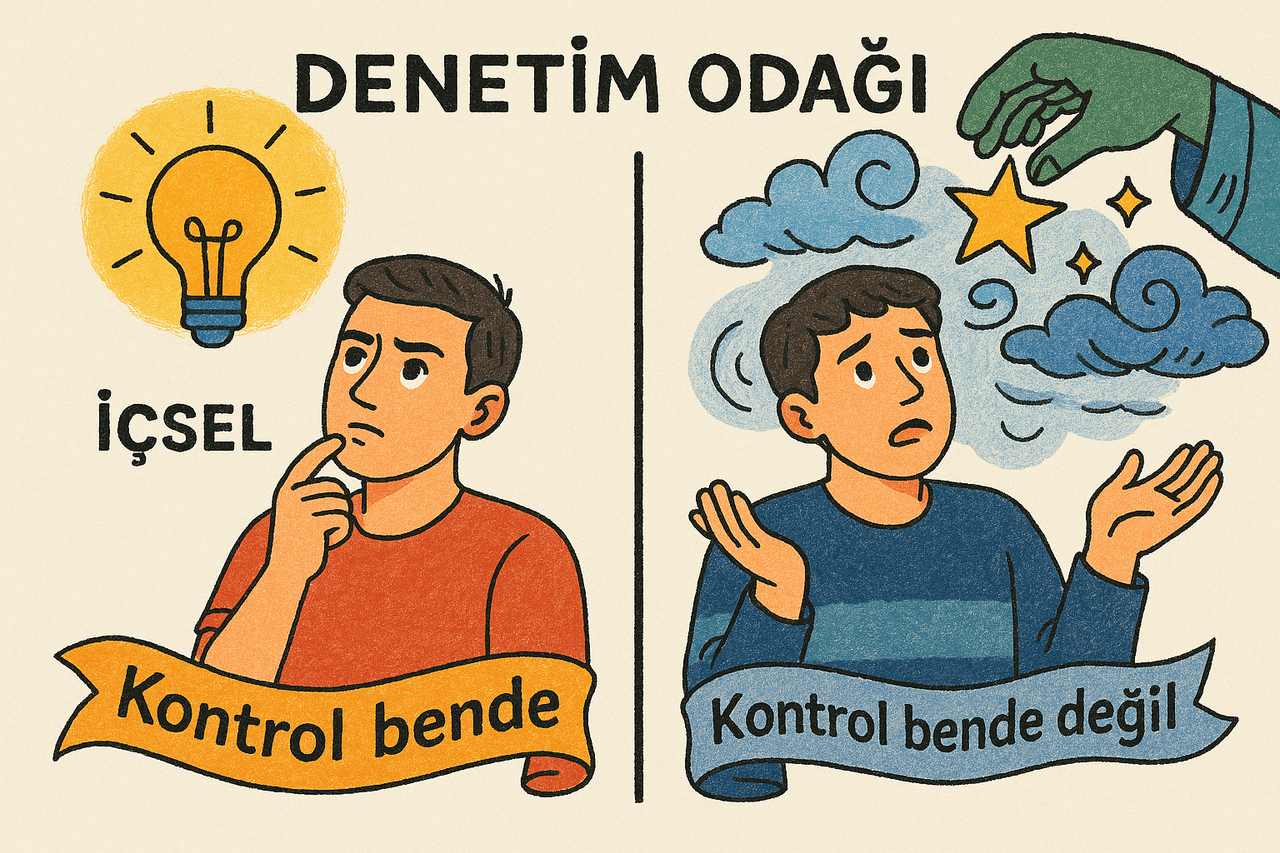
Generated by Artificial Intelligence.
The concept of locus of control was introduced in 1954 by American psychologist Julian B. Rotter within the framework of his Social Learning Theory. Rotter sought to explain how individuals shape their behaviors through interactions with their environment and the role of learning in this process. According to him, individuals develop different behavioral patterns depending on how they perceive the causes of rewards and punishments. Locus of control refers to an individual’s belief system regarding the source of power that controls events in their life.
Rotter developed the Locus of Control Scale to measure how individuals attribute responsibility for events. This scale contains questions designed to determine whether a person has an internal or external locus of control. Rotter’s work established a foundational framework for explaining how personality traits interact with environmental factors and generated significant repercussions in psychology.
Locus of control is divided into two main categories: internal locus of control and external locus of control.
Whether an individual’s locus of control is internal or external can be influenced by many factors, including upbringing style, environmental conditions, socioeconomic status, cultural structure, and personality traits.
Locus of control is an important psychological variable that shapes individuals’ thought processes and behaviors. Its key characteristics can be outlined as follows:
Locus of control has a broad range of effects, from individual personality traits to social positioning. Internal and external locus of control shape individuals’ behaviors, learning processes, professional success, and social relationships. Additionally, cultural and socioeconomic factors play a significant role in the development of locus of control.
Locus of control is a major factor influencing personality structure and behavioral patterns. Individuals with an internal locus of control exhibit a confident, independent, and responsible attitude because they believe they have greater control over their lives. These individuals are typically highly motivated and willing to exert effort to achieve their goals. They also tend to have well-developed problem-solving skills and perceive challenges as controllable. In contrast, individuals with an external locus of control may display a passive, dependent, and fatalistic attitude, believing that control lies outside themselves. They may avoid taking responsibility and attribute failures to external factors, thereby refraining from efforts toward change. This tendency is associated with psychological states such as learned helplessness and low self-efficacy.
Locus of control plays a major role in an individual’s educational experience. Students with an internal locus of control are more motivated to study because they view academic success as a result of their own efforts. They analyze their achievements and failures, identify weaknesses, and develop new strategies for improvement. These individuals demonstrate a more active and responsible approach to learning. In contrast, students with an external locus of control tend to attribute academic success to luck, teacher attitudes, or the examination system. Their motivation to study may be low, and in cases of failure, they may prefer to make excuses rather than show effort. This pattern can lead to long-term academic failure and a low perception of self-efficacy. Educators should encourage students to solve problems, provide feedback linking success to personal effort, and support the development of independent thinking skills.
Locus of control directly influences individuals’ performance and career development in the workplace. Individuals with an internal locus of control tend to be more proactive, responsible, and productive in work environments. They exert effort to overcome challenges, apply problem-solving skills effectively, and take initiative to improve their work. As a result, they are more likely to rise to leadership positions. Additionally, they generally experience higher job satisfaction because they attribute their success to their own efforts and thus feel fulfilled in their roles.
Individuals with an external locus of control, however, may adopt a more passive attitude in the workplace. They are likely to attribute their career advancement not to their own abilities or efforts but to external factors such as luck, decisions by senior management, or economic conditions. This can hinder initiative-taking and lead to job dissatisfaction and lack of motivation. They may also struggle to cope with stressful situations and resist change in the workplace.
Employers can encourage employees to develop an internal locus of control by promoting more proactive and productive behavior. Strengthening feedback mechanisms, recognizing individual achievements, and granting employees greater autonomy are strategies that support the development of an internal locus of control.
Locus of control, while an individual characteristic, is significantly influenced by social structure and cultural factors. Cross-cultural studies show that locus of control develops differently across societies.
Individualistic Cultures: In Western societies (e.g., USA, Canada, and Western Europe countries), where individualism is emphasized, the proportion of individuals with an internal locus of control is higher. In these societies, individuals are encouraged to attribute success to their own efforts and to develop independent decision-making skills. Educational systems and the workplace are structured to emphasize personal responsibility.
Collectivist Cultures: In Eastern societies (e.g., Asia, the Middle East, and Latin American countries), external locus of control is more common. In these societies, family, social norms, and authority figures play a larger role in an individual’s life. Successes are linked more to community support and social structure than to individual effort. In cultures where external locus of control dominates, values such as fatalism and obedience to authority may be prominent.
In addition, socioeconomic status is also an influential factor in locus of control. Economically disadvantaged groups may develop an external locus of control, believing that the system oppresses them and that their success is limited by external factors. In contrast, individuals with access to economic and social resources may feel they have greater control over their lives and thus develop an internal locus of control.
Locus of control is a significant variable directly affecting an individual’s psychological health. Whether an individual has an internal or external locus of control can determine how they cope with stress, perceive self-efficacy, experience levels of anxiety and depression, and respond to therapeutic interventions.
Locus of control affects how individuals perceive stressful events and how they respond to them. Individuals with an internal locus of control tend to view problems as controllable and therefore cope with stress more effectively. They are more likely to interpret stressful situations as learning opportunities and develop problem-solving strategies. Because these individuals are inclined to seek solutions in the face of difficulties, their psychological resilience increases over time. In contrast, individuals with an external locus of control perceive stressful situations as uncontrollable. By attributing negative experiences to luck, fate, or external forces, they are at risk of developing learned helplessness. This leads them to refrain from efforts to reduce stressors in their lives and adopt a passive attitude. Individuals with an external locus of control are at higher risk for anxiety disorders and depression because the belief that they lack control over events increases feelings of helplessness. Research shows that individuals with an external locus of control use less effective coping strategies and are more prone to psychological distress. Therefore, it can be said that locus of control has a direct impact on psychological health.
Locus of control is directly related to an individual’s sense of self-efficacy. Self-efficacy refers to an individual’s belief in their ability to succeed in a specific situation. Individuals with an internal locus of control believe they are capable of achieving their goals and exert greater effort to overcome obstacles. These individuals develop problem-focused coping strategies to deal with challenges.
Individuals with an external locus of control, who believe events are beyond their control, often have low self-efficacy. Lacking confidence in themselves, they may avoid failure and use avoidance or emotion-focused coping strategies when faced with difficulties. For example, when encountering failure, they may be more inclined to accept the situation or ignore the problem rather than analyze its source or generate solutions.
Locus of control also significantly affects psychological resilience. Individuals with an internal locus of control are more resilient because they believe they maintain control over their lives. By developing effective stress-coping strategies, they tend to preserve their psychological well-being. In individuals with an external locus of control, feelings of uncertainty and lack of control may lead to psychological vulnerability.
Locus of control is an important focus in psychotherapy. Various therapeutic approaches aim to modify locus of control in the treatment of psychological disorders.
Warning: The content in this section is provided solely for general encyclopedic information purposes. The information here should not be used for diagnosis, treatment, or medical referral. Before making any decisions regarding health, you must consult a physician or qualified healthcare professional. The author of this article and KÜRE Encyclopedia assume no responsibility for any consequences arising from the use of this information for diagnosis or treatment purposes.
Aubé, Caroline, Vincent Rousseau, and Estelle Morin. "Perceived Organizational Support and Organizational Commitment: The Moderating Effect of Locus of Control and Work Autonomy." Journal of Managerial Psychology 22 (2007): 479-495.
Cadinu, Maria, Ana Maass, Maria Lombardo, and Simona Frigerio. “Stereotype Threat: The Moderating Role of Locus of Control Beliefs.” *European Journal of Social Psychology* 36 (2006): 183-197.https://doi.org/10.1002/ejsp.303.
Galvin, Benjamin M., Amy E. Randel, Brian J. Collins, and Russell E. Johnson. “Changing the Focus of Locus (of Control): A Targeted Review of the Locus of Control Literature and Agenda for Future Research.” *Journal of Organizational Behavior* 39 (2018): 820-833.https://doi.org/10.1002/job.2275.
Lefcourt, H. M., and K. Davidson-Katz. "Locus of Control and Health." Handbook of Social and Clinical Psychology: The Health Perspective, 246-266. 1991.
Ng, Thomas W. H., Karen L. Sorensen, and Lillian T. Eby. “Locus of Control at Work: A Meta-Analysis.” *Journal of Organizational Behavior* 27 (2006): 1057-1087.https://doi.org/10.1002/job.416.
VanderZee, K.I., Buunk, B.P., and Sanderman, R. (1997), Social Support, Locus of Control, and Psychological Well-Being. Journal of Applied Social Psychology, 27: 1842-1859.https://doi.org/10.1111/j.1559-1816.1997.tb01628.x

Locus of Control Theory
Julian B. Rotter and the Locus of Control Theory
Internal and External Locus of Control Concepts
Key Characteristics of Locus of Control
Individual and Societal Effects of Locus of Control
Effects on Personality and Behavior
Relationship with Education and Learning Processes
Role of Locus of Control in the Workplace
Evaluation in the Context of Social Structure and Cultural Differences
Locus of Control and Psychological Health
Relationship with Stress, Anxiety, and Depression
Connection with Self-Efficacy and Coping Strategies
Therapeutic Approaches and Interventions