


This article was automatically translated from the original Turkish version.
Asymmetric war is a concept used to describe conflicts characterized by significant imbalances between the parties in terms of military capacity, organizational structure, and strategic capabilities. This imbalance profoundly affects the nature of the conflict. One side is typically a powerful state, while the other often consists of non-state actors, irregular forces, or structures with limited resources. This difference distinguishes such conflicts from classical wars. The stronger party conducts direct and organized combat, while the weaker party seeks to achieve its objectives through indirect means. In this context, asymmetric war is not merely about opposing groups having different capacities; it is also an phenomenon that transforms the physical boundaries of war, the objectives of the parties, and the methods employed. The weaker actor turns to tactics outside the rules of classical warfare in order to counter the superior opponent.
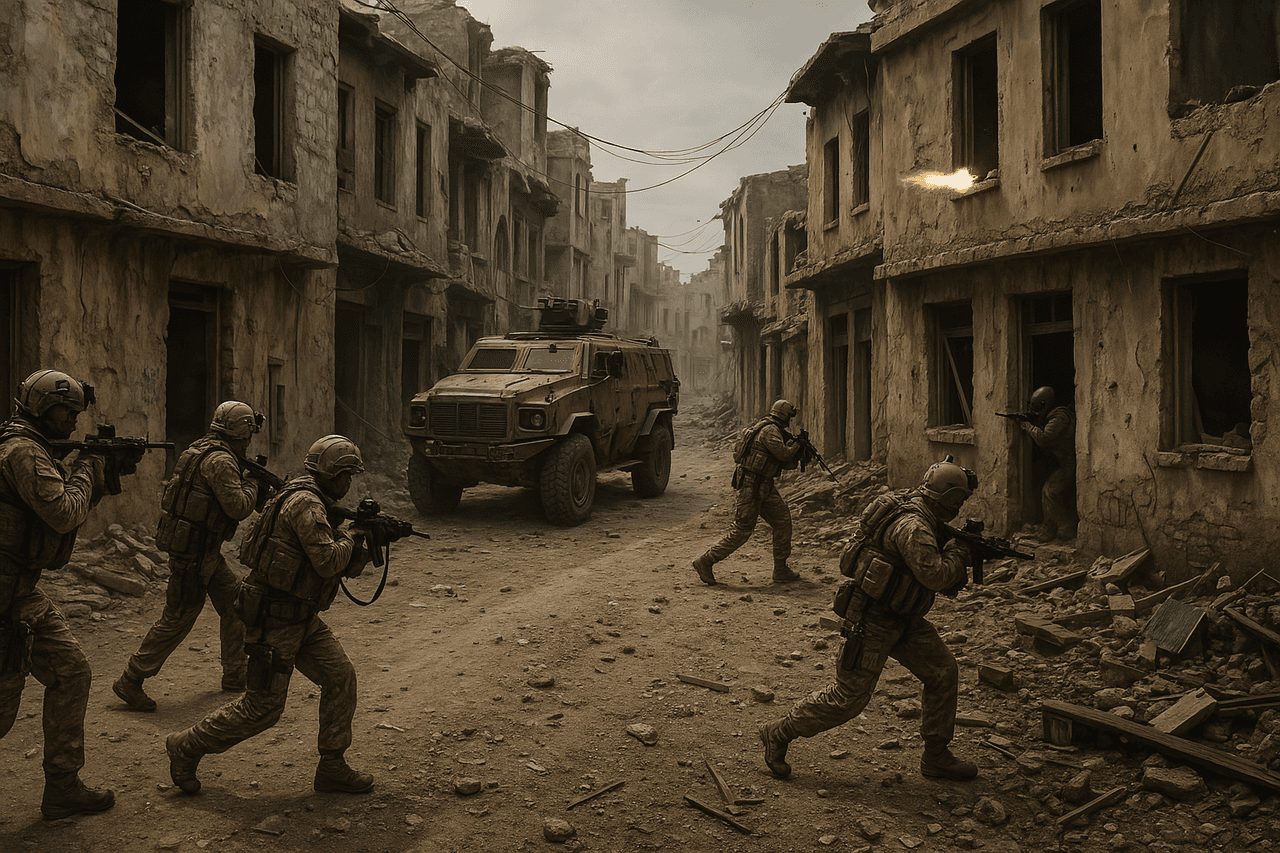
(Image generated by artificial intelligence)
At the core of asymmetric warfare lies the avoidance of certain defeat that direct confrontation would bring. For this reason, the weaker party often resorts to hit-and-run tactics, guerrilla warfare, psychological operations, cyberattacks, and propaganda campaigns. These tools aim to neutralize the superior military strength of the stronger party. In particular, information warfare and the management of public perception have become integral components of such conflicts in recent years.
The goal of the weaker actor is not only physical victory but also political and psychological advantage. Shaping public opinion, challenging state authority, and generating fear and insecurity within society are central to these strategies. Consequently, the war is not confined to the battlefield alone; it also unfolds in the media, digital platforms, and the everyday life of society.
Asymmetric warfare raises questions about the applicability of international humanitarian law. The foundational principles of classical war law—distinction, proportionality, and military necessity—become blurred in such conflicts. Non-state actors often fail to distinguish between combatants and civilians or deliberately turn densely populated areas into battlefields, undermining these principles. Moreover, the stronger party’s use of disproportionate force based on technological superiority may constitute a violation of the laws of war. This situation complicates the ethical dimensions of the conflict. In asymmetric warfare, both sides may be inclined to stretch legal and moral boundaries, thereby increasing the destructive impact on civilians.
Following the Cold War, non-state actors have gained greater visibility on the international stage. Particularly in regions such as the Middle East, Africa, and South Asia, where state authority is weak, these actors have become increasingly active. Some of these groups are driven by ideological, others by ethnic, and still others by economic interests. However, their common feature is the adoption of a mode of warfare distinct from conventional state structures. The rise of non-state actors has also triggered profound changes in the perception of security. Threats are no longer limited to regular armies crossing borders; even a small organized structure within a country can pose a major security risk.
Asymmetric warfare renders classical security paradigms obsolete. A country’s high military expenditures or modern weapon systems may not always be effective against asymmetric threats, because such threats aim not to engage in direct combat but to target vulnerabilities. Conventional state armies often find themselves unprepared when confronted with asymmetric threats.
This situation necessitates a reassessment of security strategies. Today, the concept of security is no longer confined to military capacity alone; it requires a multidimensional approach supported by intelligence, social structures, the media, and diplomatic tools. In this context, conflicts emerge as comprehensive processes that unfold not only on conventional battlefields but also across various levels and domains of society.
Geiß, Robin. "Asymmetric Conflict Structures." International Review of the Red Cross 92, no. 879 (2010): 475–501.Accessed Adresi.
Szpyra, Jan. "Deterring Hybrid Threats: Lessons from NATO and the EU." Security and Defence Quarterly 31, no. 4 (2020): 103–116.Accessed Adresi.
Yalçın, Hasan Basri. Asimetrik Savaş: Fırat Kalkanı, Zeytin Dalı, Barış Pınarı. İstanbul: SETA Yayınları, 2020. Accessed April 2, 2025.Accessed Adresi.

Methods and Strategic Objectives
Legal and Ethical Boundaries in Asymmetric Warfare
The Rise of Non-State Actors
Transformation of Classical Security Approaches