

+2 More

Astigmatism is a common refractive error that occurs when the cornea (the transparent layer at the front of the eye) or the lens (the focusing structure inside the eye) has an irregular curvature, preventing light from focusing on a single point on the retina. Normally, the eye has a round shape, like a basketball, but in astigmatism, it takes on an oval shape, resembling a rugby or American football. This irregularity causes light to refract unevenly across different meridians (horizontal, vertical, or oblique axes), resulting in blurred or distorted vision at both near and far distances. Astigmatism is often congenital and may coexist with other refractive errors such as myopia (nearsightedness) or hyperopia (farsightedness).
Astigmatism is classified based on its anatomical origin and refractive properties:
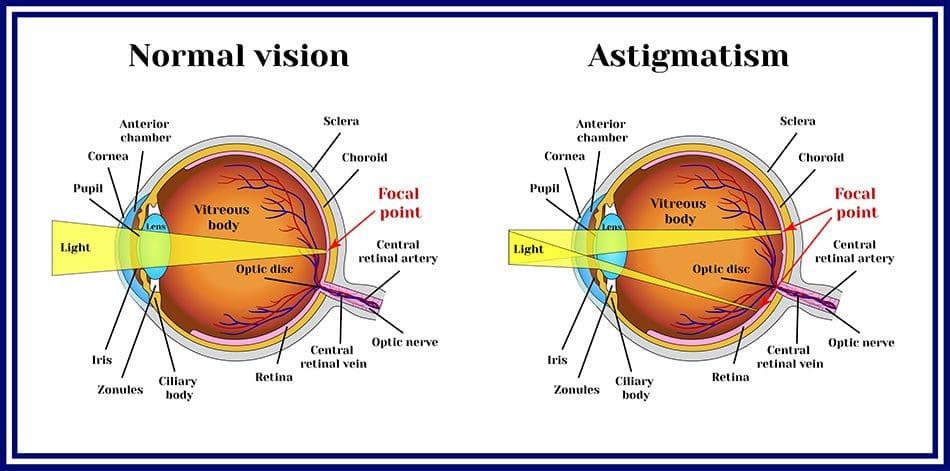
Common symptoms of astigmatism include:
Children may not notice these symptoms, making regular eye screenings crucial. If untreated, astigmatism in children can lead to amblyopia (lazy eye) or learning difficulties.
The exact cause of astigmatism is not fully understood, but genetics play a significant role. It is often present from birth and inherited from parents. Other possible causes include:
Astigmatism can change over time; for instance, high astigmatism in infancy often decreases around the age of one as the eye develops.
Astigmatism affects approximately one in three people worldwide and varies with age and ethnicity:
Astigmatism is diagnosed through a comprehensive eye examination, which may include:
Treatment for astigmatism depends on its severity and the patient's visual needs:
Since astigmatism is primarily genetic or structural, it cannot be prevented. However, early diagnosis through routine eye exams ensures timely treatment. Vision screenings are particularly crucial in preschool and school-age children.
If treated early, astigmatism generally has a good prognosis. Vision can be corrected with glasses, contact lenses, or surgery. However, untreated astigmatism may lead to complications such as amblyopia (lazy eye), strabismus (eye misalignment), or permanent vision impairment. Progressive conditions like keratoconus require regular monitoring.
Astigmatism is a widespread refractive error affecting both children and adults. Influenced by genetic and environmental factors, it can be effectively managed with modern diagnostic and treatment methods. Regular eye check-ups, early intervention, and personalized treatment strategies significantly enhance the quality of life for individuals with astigmatism.
"Astigmatism."Boston Children's Hospital. Erişim tarihi 13 Mart 2025. https://www.childrenshospital.org/conditions/astigmatism.
"Astigmatism."American Optometric Association. Erişim tarihi 13 Mart 2025. https://www.aoa.org/healthy-eyes/eye-and-vision-conditions/astigmatism?sso=y.
"Astigmatism."National Health Service (NHS). Erişim tarihi 13 Mart 2025. https://www.nhs.uk/conditions/astigmatism/.
"Astigmatism."National Eye Institute (NEI). Erişim tarihi 13 Mart 2025. https://www.nei.nih.gov/learn-about-eye-health/eye-conditions-and-diseases/astigmatism.
"Astigmatism."Cleveland Clinic. Erişim tarihi 13 Mart 2025. https://my.clevelandclinic.org/health/diseases/8576-astigmatism.
"Astigmatism."American Academy of Ophthalmology. Erişim tarihi 13 Mart 2025. https://www.aao.org/eye-health/astigmatism.
"Astigmatism."Mayo Clinic. Erişim tarihi 13 Mart 2025. https://www.mayoclinic.org/diseases-conditions/astigmatism/symptoms-causes/syc-20353835.

Types of Astigmatism
Symptoms of Astigmatism
Causes and Risk Factors
Epidemiology
Diagnosis
Treatment Options
Prevention and Early Detection
Prognosis and Complications
This article was created with the support of artificial intelligence.