


This article was automatically translated from the original Turkish version.
The esel mobil system refers to an automatic adjustment mechanism implemented through tax components to prevent international oil prices and exchange rate fluctuations from being fully and directly reflected in consumer prices.【1】.
The system is based on covering a portion of price increases through the Special Consumption Tax (SCT), functioning as a fiscal policy tool aimed at limiting the rise in pump prices.
The concept is linked in economic literature to the term “eselmobil,” which denotes a flexible scale, and refers to a payment or pricing arrangement adjusted in response to changes in prices or costs.【2】.
The esel mobil concept describes a mechanism whereby certain economic variables are automatically adjusted in response to changes in production costs or price levels. This approach is based on the use of a variable scale rather than fixed prices or wages, creating a structure that adapts to changing cost conditions.
In the fuel market, the esel mobil system is defined as a specific adaptation of this general concept, implemented through tax mechanisms.
The esel mobil system operates on the principle of reducing Special Consumption Tax (SCT) rates to limit the direct pass-through of increases in international oil prices and exchange rates to pump prices. When price increases occur, a portion of the rise is offset by SCT reductions, leading to a corresponding indirect decrease in Value Added Tax (VAT) amounts.【3】.
This mechanism functions as a tax adjustment system designed to moderate the extent of price increases faced by consumers.
The system is designed to operate not only during price increases but also during price decreases. When oil prices or the exchange rate fall, the SCT can be increased by an amount corresponding to a portion of the price decline, thereby restoring fiscal balance. This two-way mechanism creates a structure that softens the transmission of price movements to pump prices.
Karar Resmi Gazete'de yayımlandı - Resmi Gazete
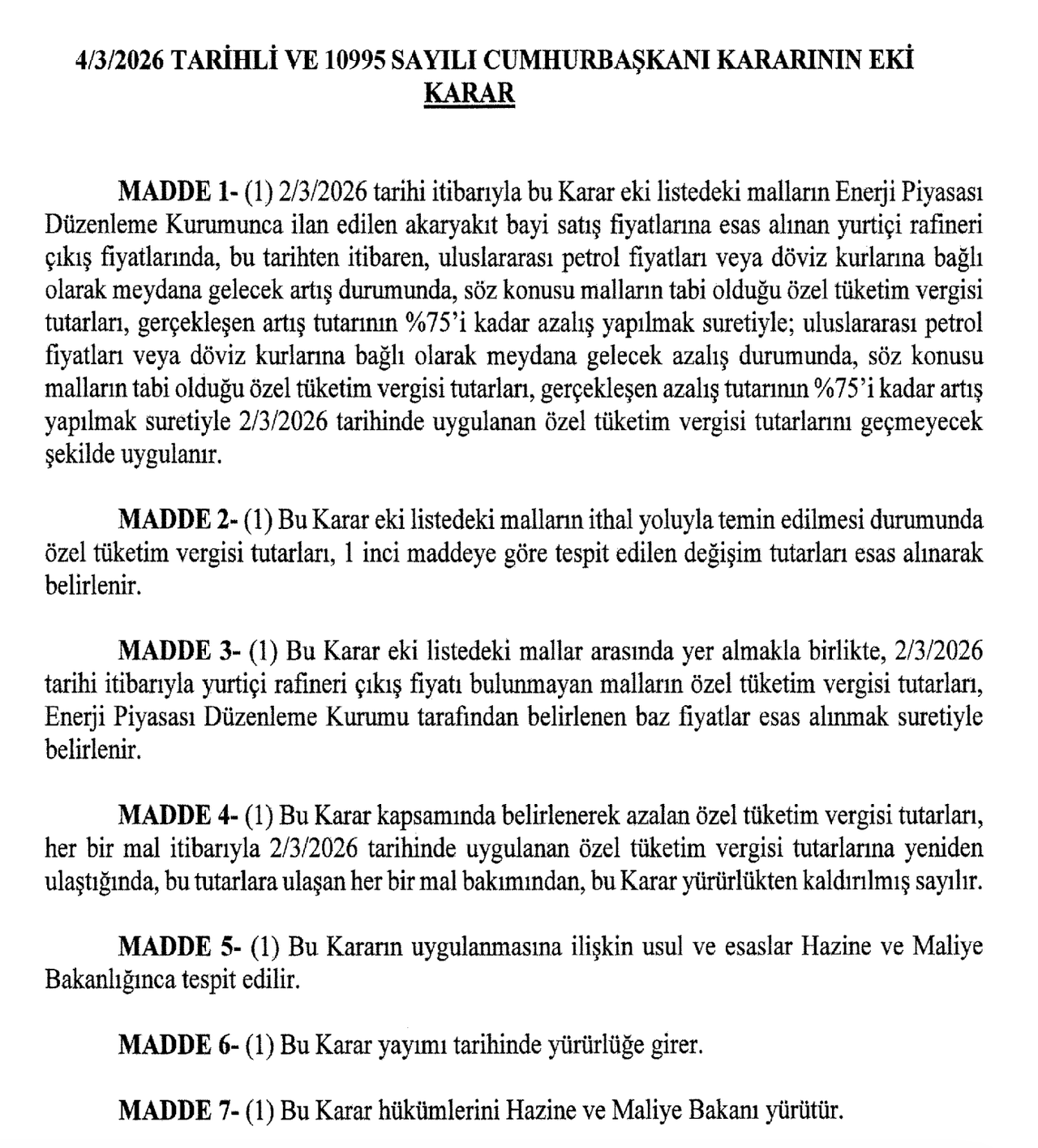
As of 5 March 2026, the esel mobil system was temporarily reinstated to limit the impact of fuel price increases on inflation.【4】.
A calculation system based on 2 March 2026 prices was established, under which up to 75 percent of fuel price increases could be offset through SCT reductions.【5】. This model reflects a balancing approach in which not the full extent of price increases is passed on to consumers, but rather a portion is absorbed through tax adjustments.
Under the application, SCT reductions of up to 14.8277 TL per liter for gasoline, 13.9006 TL per liter for diesel, and 11.3830 TL per kilogram for LPG are permitted. In the event of price declines, the SCT may be increased by up to 75 percent of the price reduction, provided that the new SCT level does not exceed the initial rate.
This structure establishes a mechanism that does not eliminate price increases entirely, but rather offsets a portion of them through tax adjustments.
Following the reintroduction of the system, new adjustments were made to fuel prices, resulting in increases of 92 kuruş per liter for gasoline and 3.11 TL per liter for diesel as of 5 March.
As a result, the price of gasoline rose from 58.42 TL to 59.33 TL, and diesel prices increased from 60.42 TL to 63.52 TL. This price movement demonstrates that the esel mobil system is not a mechanism that eliminates price increases entirely, but rather one that partially offsets them through tax adjustments.【6】.
The esel mobil system is recognized as a price-balancing mechanism introduced in Türkiye’s fuel market in 2018. During this period, increases in fuel prices were partially offset by SCT reductions, aiming to limit the rise in pump prices. The system was used as a fiscal policy tool to mitigate the inflationary impact of fuel price increases.【7】.
By the end of 2021, the system was deemed unsustainable due to rapid exchange rate appreciation and rising oil prices, leading to its discontinuation. The mechanism was terminated for diesel and LPG on 25 December 2021, and for gasoline on 1 March 2022.
This period demonstrates that the esel mobil system has been used in Türkiye as a price-balancing policy instrument that can be activated or suspended depending on economic conditions.
Accessed November 26, 2025. https://www.aa.com.tr/tr/kultur/ahlatta-acilan-kurslarla-geleneksel-tas-isciligi-yasatiliyor/3116279.
Accessed November 26, 2025. https://www.aa.com.tr/tr/kultur/ahlatta-acilan-kurslarla-geleneksel-tas-isciligi-yasatiliyor/3116279.
Accessed November 26, 2025. https://www.aa.com.tr/tr/kultur/ahlatta-acilan-kurslarla-geleneksel-tas-isciligi-yasatiliyor/3116279.
Accessed November 26, 2025. https://www.aa.com.tr/tr/kultur/ahlatta-acilan-kurslarla-geleneksel-tas-isciligi-yasatiliyor/3116279.
Anadolu Ajansı. "Akaryakıt Fiyatlarında Geçici Olarak Eşel Mobil Sistemi Devreye Alındı." Anadolu Ajansı, 2026. Accessed March 5, 2026.
BBC Türkçe. "Eşel Mobil Sistemi Nedir?" Accessed March 5, 2026. https://www.bbc.com/turkce/articles/c75eevgwn2do
Bloomberg HT. "Eşel Mobil Sonrası Akaryakıta İlk Zam." Bloomberg HT, 2026. Accessed March 5, 2026.
Dünya Gazetesi. "Eşel Mobil Sistemi Nedir? Eşel Mobil Nasıl Uygulanacak?" Dünya, 2026. Accessed March 5, 2026.
Ekonomi Gazetesi. "4 Yıl Aradan Sonra Yeniden Eşel Mobil mi Geliyor?" Ekonomi Gazetesi, 2026. Accessed March 5, 2026.
Gazete Oksijen. "Akaryakıttaki Savaş Fiyatlaması: Eşel Mobil Sistemi Geri mi Dönüyor?" Gazete Oksijen, 2026. Accessed March 5, 2026.
NTV. "Akaryakıt Fiyatlarındaki Artışta Yükü Devlet Üstlenecek: Eşel Mobil Sistemi Devreye Girdi." NTV, 2026. Accessed March 5, 2026.
Resmî Gazete. "Cumhurbaşkanı Kararı." Resmî Gazete, no. 20260305-1, March 5, 2026. Accessed March 5, 2026.
Türk Dil Kurumu. "Eşel Mobil." Türk Dil Kurumu Sözlükleri. Accessed March 5, 2026.
https://gazeteoksijen.com/ekonomi/akaryakitta-savas-fiyatlamasi-esel-mobil-sistemi-geri-mi-donuyor-267484
https://www.aa.com.tr/tr/ekonomi/akaryakit-fiyatlarinda-gecici-olarak-esel-mobil-sistemi-devreye-alindi/3850525
https://www.dunya.com/ekonomi/esel-mobil-sistemi-nedir-esel-mobil-nasil-uygulanacak-haberi-817169
https://www.resmigazete.gov.tr/eskiler/2026/03/20260305-1.pdf
[1]
Dünya Gazetesi. “Eşel Mobil Sistemi Nedir? Eşel Mobil Nasıl Uygulanacak?” Dünya, 2026. Erişim tarihi: 5 Mart 2026.
https://www.dunya.com/ekonomi/esel-mobil-sistemi-nedir-esel-mobil-nasil-uygulanacak-haberi-817169
[2]
Türk Dil Kurumu. “Eşel Mobil.” Türk Dil Kurumu Sözlükleri. Erişim tarihi: 5 Mart 2026.
[3]
Anadolu Ajansı. “Akaryakıt Fiyatlarında Geçici Olarak Eşel Mobil Sistemi Devreye Alındı.” Anadolu Ajansı, 2026. Erişim tarihi: 5 Mart 2026.
[4]
Resmî Gazete. “Cumhurbaşkanı Kararı.” Resmî Gazete, Sayı: 20260305-1, 5 Mart 2026. Erişim tarihi: 5 Mart 2026.
https://www.resmigazete.gov.tr/eskiler/2026/03/20260305-1.pdf
[5]
Anadolu Ajansı. “Akaryakıt Fiyatlarında Geçici Olarak Eşel Mobil Sistemi Devreye Alındı.” Anadolu Ajansı, 2026. Erişim tarihi: 5 Mart 2026.
[6]
Bloomberg HT. “Eşel Mobil Sonrası Akaryakıta İlk Zam.” Bloomberg HT, 2026. Erişim tarihi: 5 Mart 2026.
https://www.bloomberght.com/esel-mobil-sonrasi-akaryakita-ilk-zam-3771019
[7]
Ekonomi Gazetesi. “4 Yıl Aradan Sonra Yeniden Eşel Mobil mi Geliyor?” Ekonomi Gazetesi, 2026. Erişim tarihi: 5 Mart 2026.
https://www.ekonomigazetesi.com/kose-yazisi/4-yil-aradan-sonra-yeniden-esel-mobil-mi-geliyor-74081


No Discussion Added Yet
Start discussion for "Assel Mobile System" article
Economic Meaning of the Concept
Mechanism of Operation in Fuel Pricing
Temporary Application and Technical Parameters in 2026
Example of Price Movement After Implementation of Esel Mobil
Previous Application Period in Türkiye