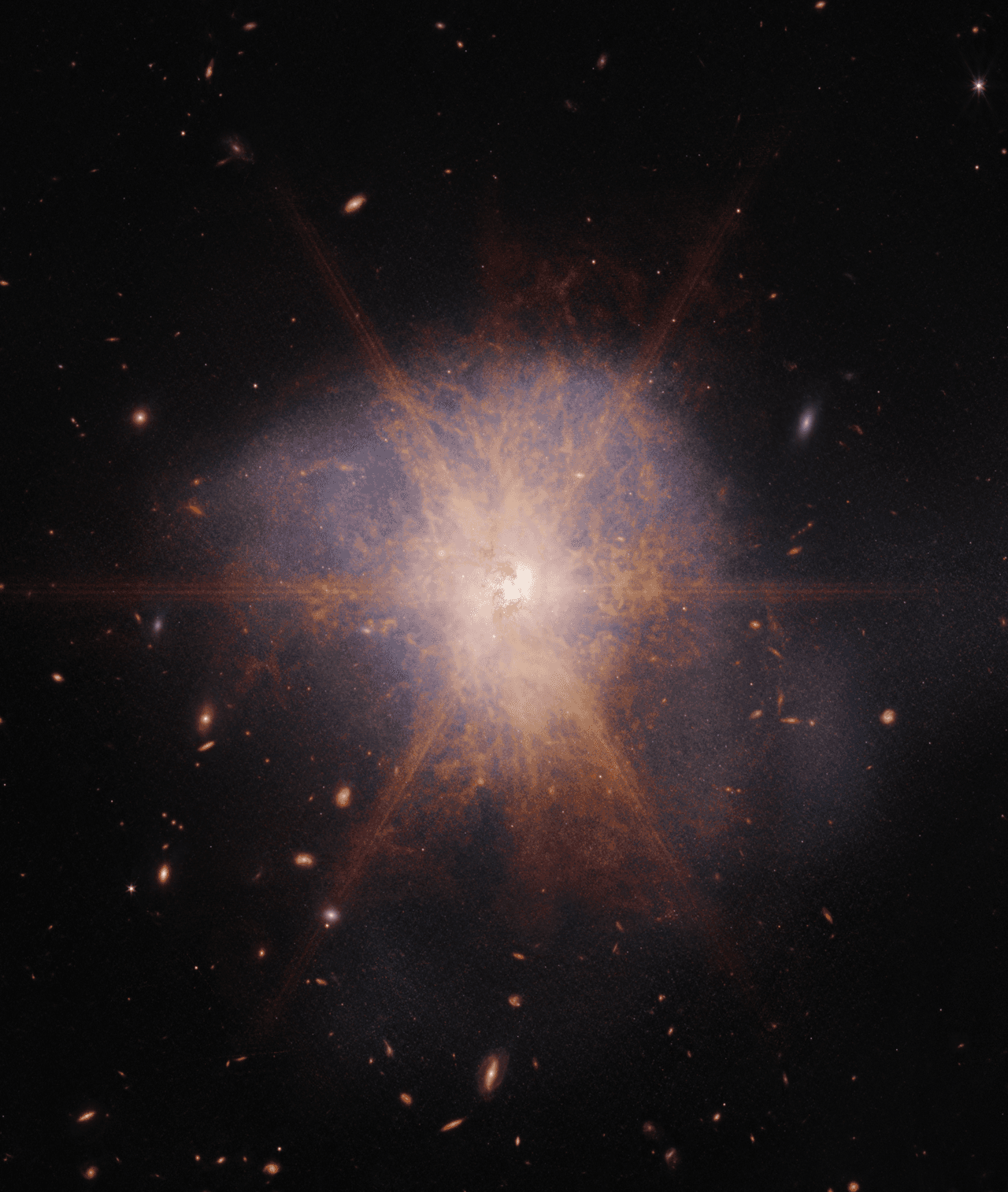
Catalogue Names | IRAS 15327+2340 (Infrared Astronomical Satellite) UGC 09913 (Uppsala General Catalogue) IC 4553 / IC 4554 (Index Catalogue) ARP 220 (Arp Atlas) | ||||||||
|---|---|---|---|---|---|---|---|---|---|
Galaxy Type | ULIRG – Ultra-Luminous Infrared Galaxy | ||||||||
Morphology | Two Merging Spiral Galaxies in an Advanced Stage | ||||||||
Constellation | Ophiuchus | ||||||||
Distance(s) | ~250 Million Light-Years | ||||||||
ARP 220 is one of the objects included in the Atlas of Peculiar Galaxies (1966), compiled by Halton Arp, and is classified under the category of "peculiar galaxies." According to the NASA/IPAC Extragalactic Database, ARP 220 is classified as an Ultra-Luminous Infrared Galaxy (ULIRG) and is believed to have formed from the merger of the galaxies IC 4553 and IC 4554. This galaxy pair is in the late stages of merging and contains a dense star-forming region and a heavily dust-obscured environment.
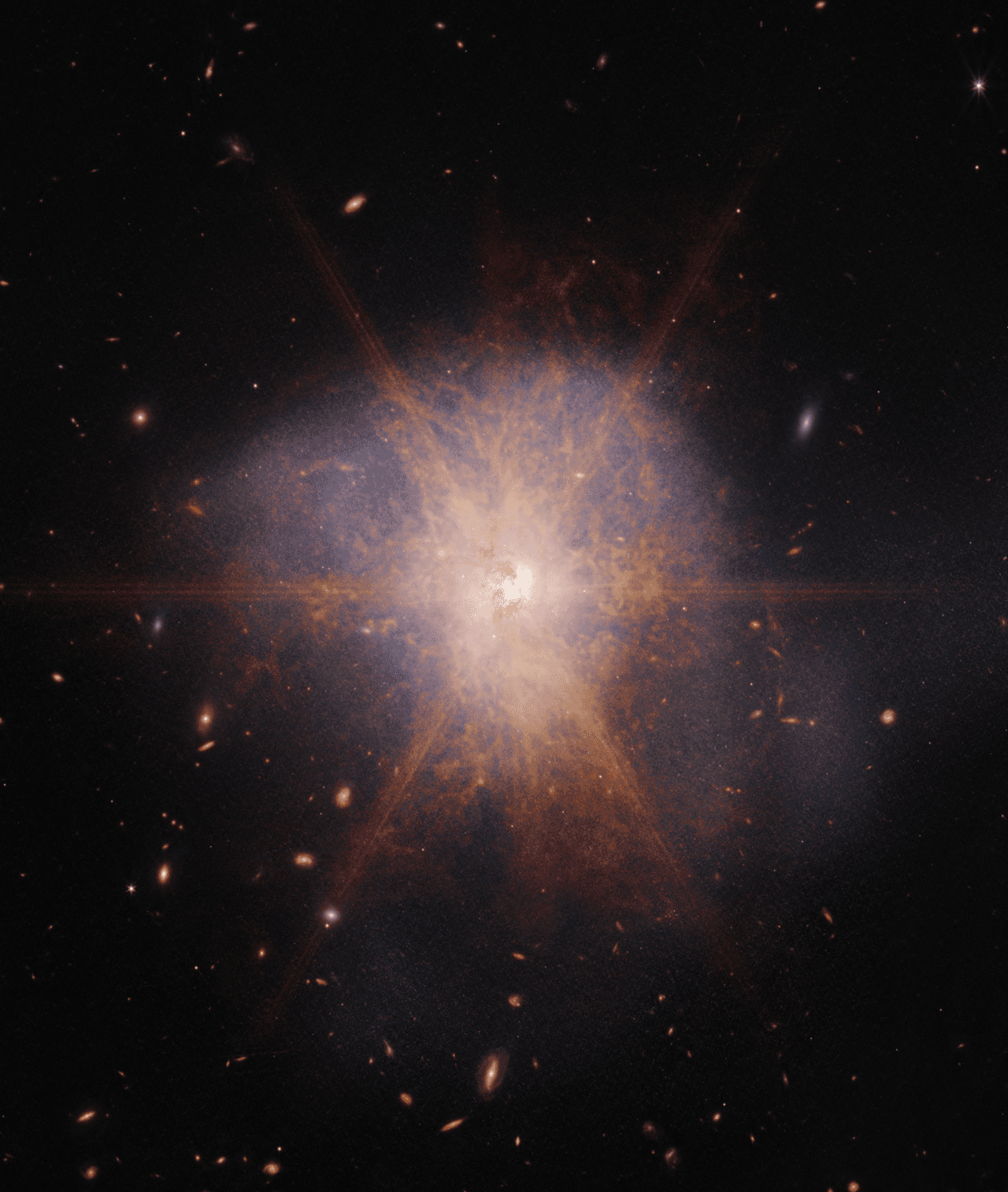
ARP 220 (NASA)
ARP 220 lies in the final stages of the merger of two spiral galaxies. As a result of this merger, a large amount of gas and dust has been compressed in the galaxy system, triggering intense star formation processes.
High-resolution infrared and radio observations of ARP 220 reveal that it contains two distinct nuclei at its center. These nuclei are separated by approximately 350 parsecs and each likely hosts its own supermassive black hole. This structure represents a late stage in the galactic merger process, where the cores have not yet fully coalesced.
ARP 220 contains a dense dust environment, making it difficult to observe in visible wavelengths. However, observations using infrared telescopes like Spitzer and Herschel have played a crucial role in revealing the internal structure of the system. Emission lines from CO (carbon monoxide) and HCN (hydrogen cyanide) molecules indicate the presence of a large concentration of molecular gas in the galaxy's core.
ARP 220 is one of the galaxies with the highest known star formation rates. The star formation rate is approximately 100 solar masses per year (M☉/year), which is about 50 times higher than that of the Milky Way Galaxy.
This extraordinary star formation is the primary source of the galaxy’s observed high infrared luminosity. The newly formed stars are embedded in dust, which absorbs their ultraviolet radiation; this energy is then re-emitted at infrared wavelengths.
There is ongoing debate about whether active galactic nuclei (AGN) exist in the central regions of ARP 220. X-ray observations have revealed faint but distinct X-ray sources in each of the two nuclei. However, it remains unclear whether these sources are due to starbursts or the accretion of matter onto black holes.
Observations by telescopes such as the Chandra X-ray Observatory and NuSTAR have detected weak but hard X-ray components in some of the nuclei. These findings suggest the presence of embedded, low-luminosity AGNs within ARP 220.
ARP 220 hosts numerous radio supernovae and supernova remnants. These remnants indicate the intensity of star formation and suggest that a large number of massive stars have recently exploded as supernovae. Observations using Very Long Baseline Interferometry (VLBI) techniques have revealed dozens of compact radio sources in the galaxy’s core, most of which are believed to be supernova remnants.
ARP 220 is significant because it simultaneously exhibits processes such as galaxy mergers, starburst activity, and potential AGN activity. This makes it similar to the massive galaxy mergers believed to have occurred in the early universe. Thus, it is studied as a local analog of high-redshift (z > 2) ULIRGs and systems evolving into quasars.
ARP 220 is considered a model system in studies of galaxy evolution, used to understand the morphological, kinematic, and chemical impacts of the merger process.
Studies of ARP 220 involve a wide range of telescopes and observational tools:
These observation data reveal the multi-component structure of the system and demonstrate how various physical processes interact with one another.
ARP 220 is a complex celestial object characterized by galaxy merging, intense star formation, infrared emission, and potential active cores. Structurally and dynamically, it is considered to be in an advanced stage of evolution and offers an opportunity to observe the outcomes of galaxy mergers in the nearby universe. Multiwavelength campaigns conducted by international observatories have provided detailed insights into this galaxy's internal structure and physical processes, contributing to our understanding of galaxy evolution and star formation.
NASA. "Webb Captures the Spectacular Galactic Merger Arp 220." NASA, 17 May 2024. https://www.nasa.gov/universe/webb-captures-the-spectacular-galactic-merger-arp-220/. Accessed 7 July 2025.
ESA/Hubble. "Interacting Galaxy Arp 220." ESA/Hubble Image Archive. https://esahubble.org/images/heic0810bf/. Accessed 7 July 2025.
NASA. "Hubble Interacting Galaxy Arp 220." NASA Science – Hubble Space Telescope. https://science.nasa.gov/asset/hubble/hubble-interacting-galaxy-arp-220/. Accessed 7 July 2025.
Harvard-Smithsonian Center for Astrophysics. "Extreme Nucleus in Galaxy Arp 220." Harvard CfA News. https://pweb.cfa.harvard.edu/news/extreme-nucleus-galaxy-arp220. Accessed 7 July 2025.

Catalogue Names | IRAS 15327+2340 (Infrared Astronomical Satellite) UGC 09913 (Uppsala General Catalogue) IC 4553 / IC 4554 (Index Catalogue) ARP 220 (Arp Atlas) | ||||||||
|---|---|---|---|---|---|---|---|---|---|
Galaxy Type | ULIRG – Ultra-Luminous Infrared Galaxy | ||||||||
Morphology | Two Merging Spiral Galaxies in an Advanced Stage | ||||||||
Constellation | Ophiuchus | ||||||||
Distance(s) | ~250 Million Light-Years | ||||||||
Location and Basic Characteristics
Morphology and Internal Structure
Dust and Gas Distribution
Star Formation and Energy Output
AGN (Active Galactic Nucleus) Presence Debates
Radio Observations and Supernova Remnants
Evolutionary Significance
Multiwavelength Observations and Instruments
This article was created with the support of artificial intelligence.