


This article was automatically translated from the original Turkish version.
Arduino is an open-source microcontroller platform that enables the development of systems capable of sensing and controlling events in the physical world. This system integrates electronic hardware and a software development environment, and due to its user-friendly design, it is widely used in hobby projects as well as in education, art, engineering, and industry.
Arduino is a low-cost and flexible solution that enables individuals with varying levels of technical knowledge to bring their own projects to life. The system can be easily integrated with various sensors, motors, and modules.
The Arduino project emerged in 2005 at the Interaction Design Institute Ivrea in Italy, under the leadership of Massimo Banzi and David Cuartielles. It was developed to create a more affordable and easier-to-program microcontroller platform for students.
The project's name was inspired by a bar in Ivrea called "Bar di Re Arduino." "Arduino" is also the name of a historical king of Italy, Arduin of Ivrea.
Initially developed for educational purposes, the system quickly built a global user community and, thanks to its open-source philosophy, rapidly grew to become one of the fundamental tools for electronic prototyping.
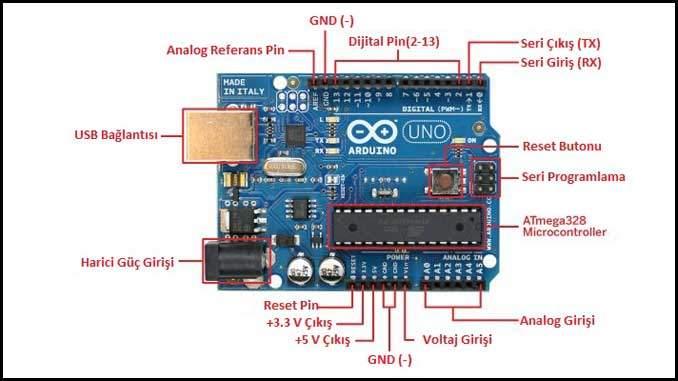
The core hardware of Arduino consists of microcontroller boards with different specifications. These boards include:
The software side of the Arduino platform is represented by the Arduino IDE (Integrated Development Environment). This development environment supports a simple C/C++-based programming language. Users upload their code to Arduino boards via USB. Additionally, online alternatives such as the Arduino Web Editor are available.
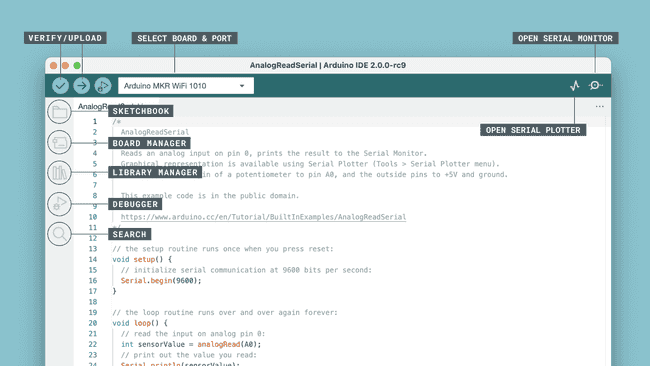
Arduino IDE Interface -
Arduino’s extensive range of add-on support makes it a versatile platform. Some commonly used modules and components include:
Arduino’s flexible and open-source nature enables applications across numerous fields:
Arduino has built a strong global community based on open-source principles. Users share their projects through forums, GitHub pages, blogs, and video platforms. This structure facilitates learning for beginners while offering innovative solutions for advanced users.
Thanks to extensive library support and a comprehensive documentation network, users at all levels can develop their own projects.
Robocombo. "Arduino Nedir? Arduino ile Neler Yapılır?" Robocombo, October 25, 2021.https://www.robocombo.com/blog/icerik/arduino-nedir-arduino-ile-neler-yapilir
Robotistan Maker. "Arduino Nedir, Ne İşe Yarar?" Maker | Robotistan, February 18, 2021.https://maker.robotistan.com/arduino-nedir-ne-ise-yarar/
TÜBİTAK Bilim Genç. “Arduino Kartı Tanıyalım.” *Bilim Genç*, April 2, 2021.https://bilimgenc.tubitak.gov.tr/makale/arduino-karti-taniyalim-0

History
Structure and Components
Hardware
Software
Popular Arduino Boards
Sensors and Modules
Input Devices
Output Devices
Communication Modules
Applications
Community and Open-Source Culture