This article was automatically translated from the original Turkish version.
+2 More
Original Name | Aokigahara Forest (青木ヶ原樹海) | ||||||||
|---|---|---|---|---|---|---|---|---|---|
Other Name | Suicide Forest Jukai (Sea of Trees) | ||||||||
Location | Minamitsuru District Japan Yamanashi Prefecture | ||||||||
Protection Area | Fuji-Hakone-Izu National Park | ||||||||
Geological Structure | Forest cover developed on young basalt lava flows | ||||||||
Tourist Areas | Wind Cave Bat Cave Ice Cave | ||||||||
Vegetation Cover | Shallow root development near the ground surface Coniferous trees Thick layer of dead organic matter | ||||||||
Climatic Characteristics | High humidity Low wind Absorption of light and sound | ||||||||
Awareness | Individual and mass suicide cases | ||||||||
Measures | Help request points Warning signs Return markers such as ropes or ribbons | ||||||||
Aokigahara Forest (青木ヶ原樹海) is a geographical area located at the base of Mount Fuji that has gained widespread media attention due to reports of suicides. Due to its dense forest structure, it is also known as “Jukai” (Sea of Trees) and has become the center of narratives in Japan surrounding themes of death, disappearance, and silence. Through literature, cinema, journalism, and online content, it has transformed into a powerful image associated with the narrative of the “suicide forest,” both within Japan and internationally.
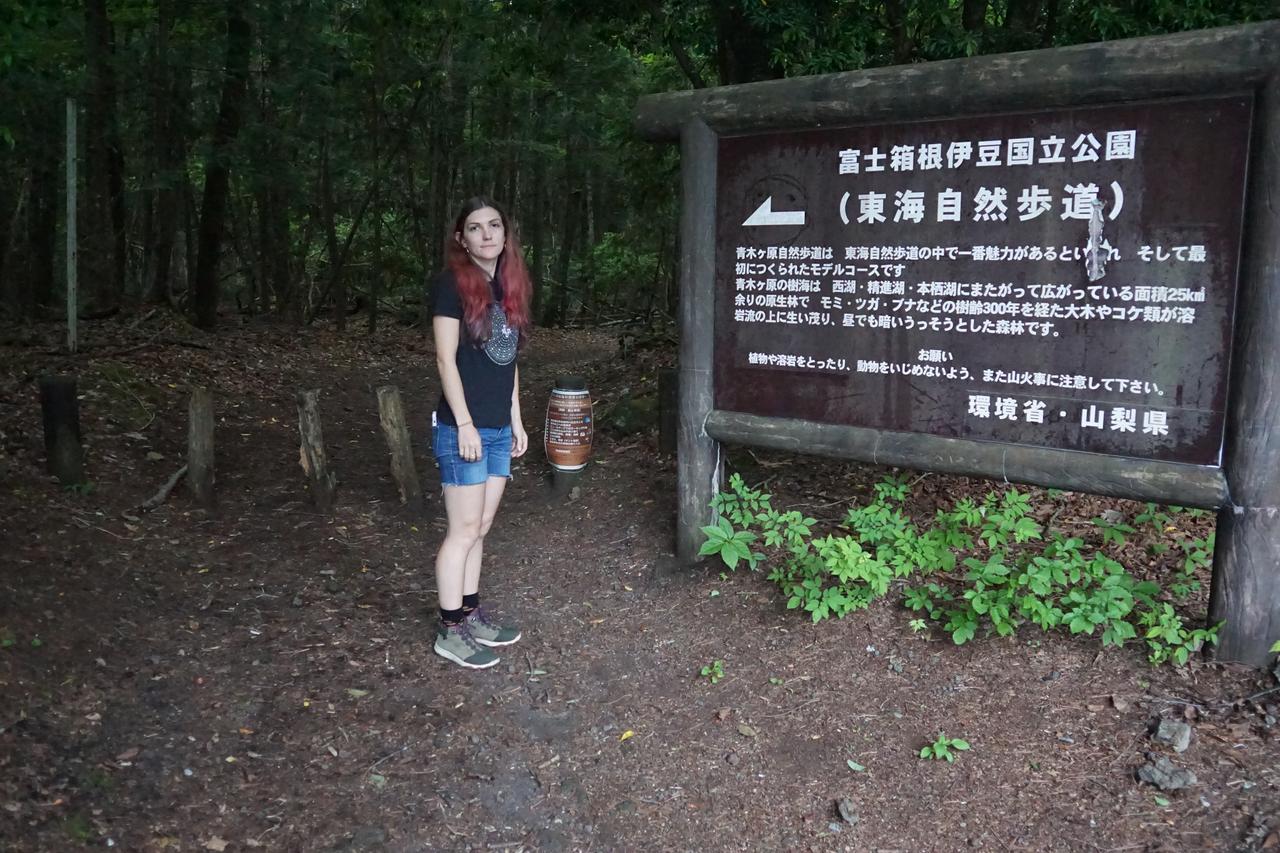
A Warning Sign in Aokigahara Forest (Flickr)
This image has also created a controversial cultural space, intersecting with modern discourses that reference an “invisible and uninterfered-with death,” loneliness, or silence. Academic literature on Aokigahara seeks to understand both the historical and media origins of this image and the dynamics behind why this place is chosen, as well as the forest’s “closed” or “absorbing” spatial character.
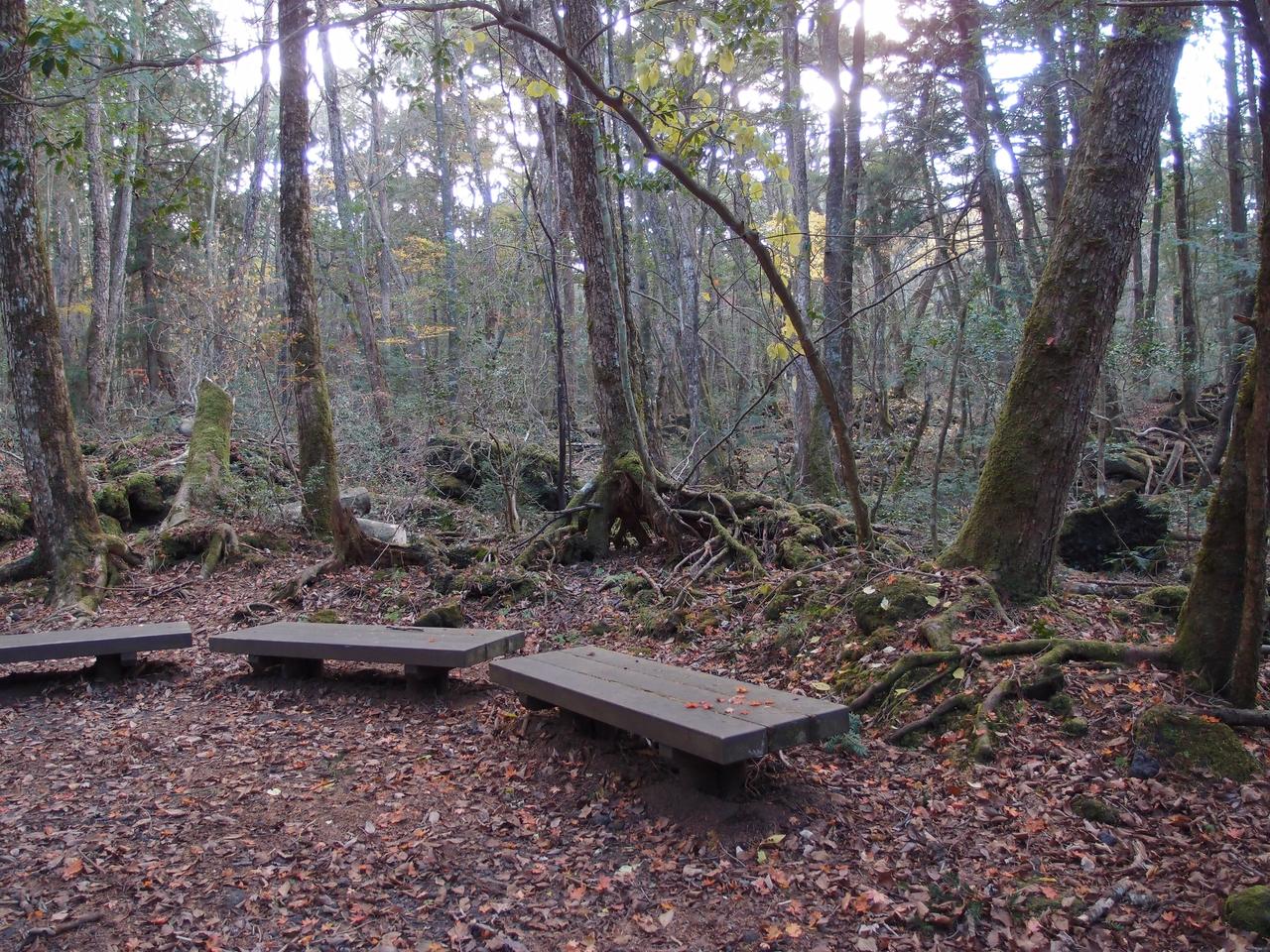
Aokigahara is a forest that has developed on a geologically young volcanic terrain composed of basaltic lava flows. Irregular lava flows, depressions, and voids on the ground, along with lava tubes—structures indicating the presence of wind and ice caves in the region—define the forest’s microtopography. This rough and impermeable terrain causes roots to grow close to the surface, encourages trees to cluster densely, and leads to the accumulation of a thick layer of dead organic matter. This condition creates a visually and acoustically “absorbing” vegetation texture that makes navigation difficult outside marked trails; the term “Jukai” is the linguistic expression of this sensory unity.
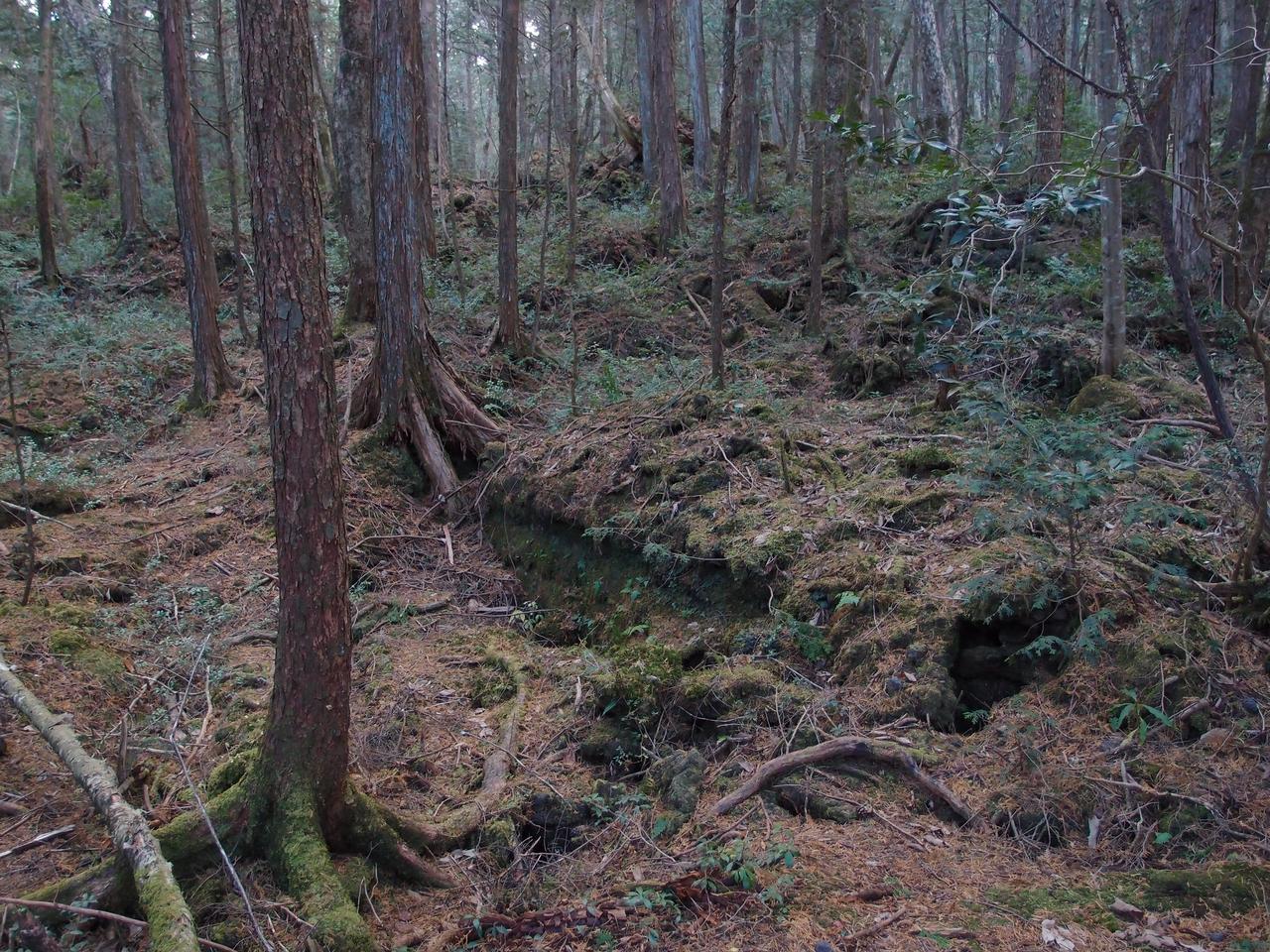
A View from Aokigahara Forest (Flickr)
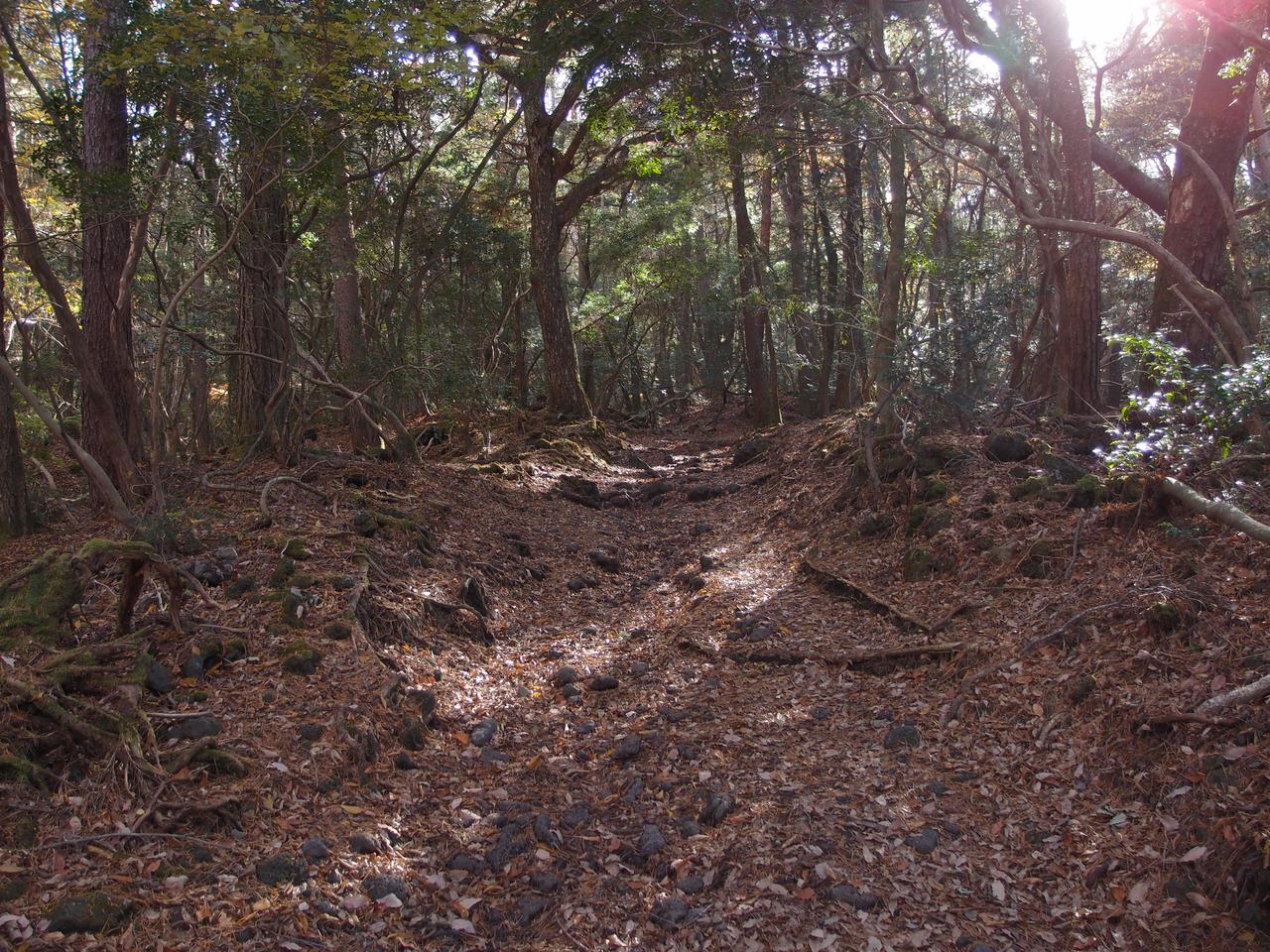
In areas dominated by coniferous trees, shading and the accumulation of humus in the understory create a low-light, cool, and humid microclimate. This microclimate perpetuates the sensation of a misty and silent forest while limiting the perception of seasonal temperature variations near the ground. The porous structure of the lava bed and the shallow spread of tree roots allow small openings created by storms or snow loads to form, over time, a self-renewing mosaic. This mosaic highlights transitions between younger growth patches and older tree clusters, causing the forest to fragment into microhabitats with rapidly changing levels of light, moisture, and species composition across short horizontal distances.
A Scene from Aokigahara Forest (Flickr)
The spatial experience of Aokigahara is described in literature as “labyrinthine.” Misty air, dense trunks and branch networks, low ground-level winds, and sound absorption reduce visual and auditory distances. These characteristics have facilitated its association in popular culture with themes of “disappearance” and “irreversibility.” Indeed, the frequent practice of tying ropes or ribbons along trails in narratives serves both to indicate the need for navigation and to demonstrate the forest’s visual and acoustic absorption. This sensory environment, shaped by the interaction of geomorphology and ecology, provides the foundation for Aokigahara to be perceived not merely as a “forest” but as an experienced “threshold space”【1】.
The name “Jukai” (Sea of Trees) for Aokigahara originates from local terminology based on its dense vegetation and the difficulty it poses for navigation. In the modern era, the forest has acquired additional layers of meaning through literary and media narratives. From the 1950s onward, representations of the forest in popular culture increased; particularly influential were narratives surrounding Seichō Matsumoto’s novel Nami no Tō.
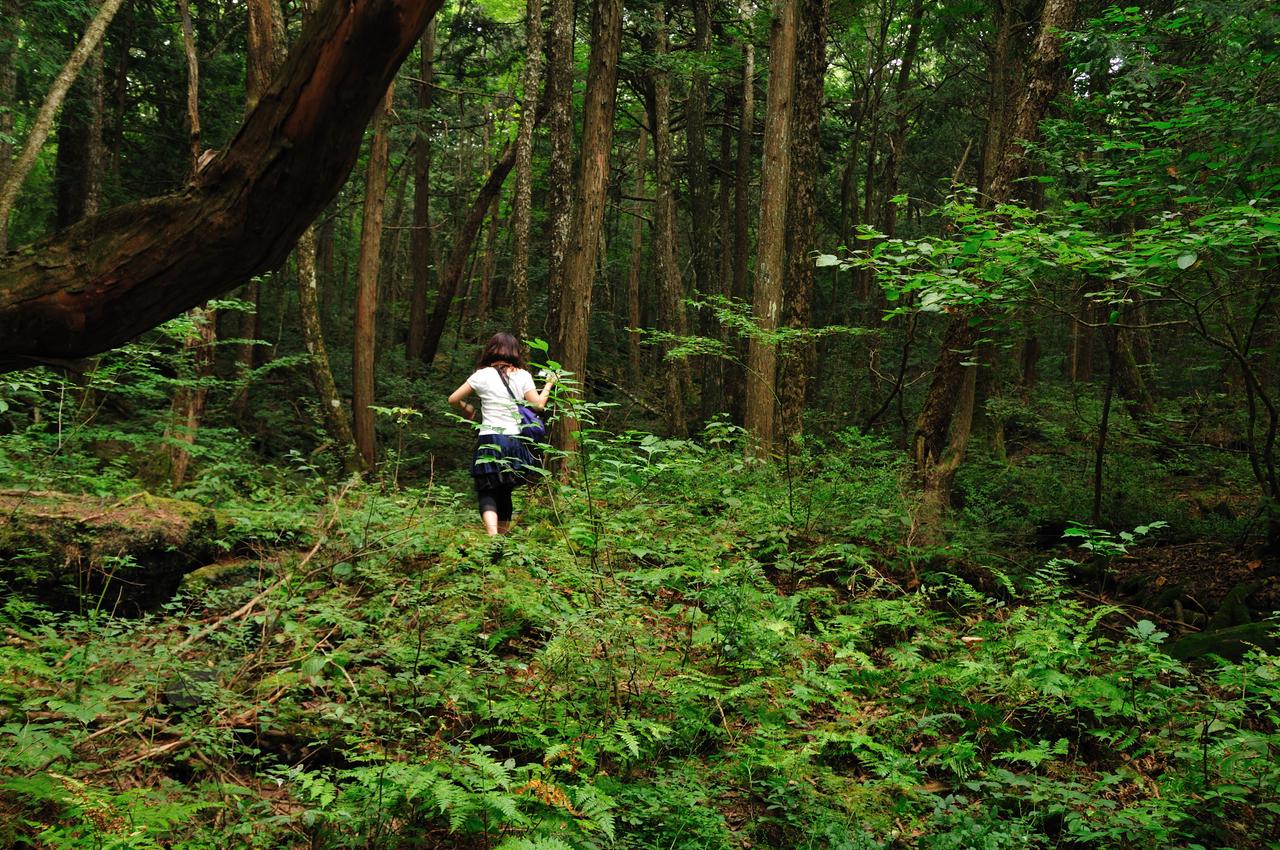
A Visitor Advancing into the Forest’s Depths (Flickr)
In 1974, near Ashiwadamura village in Minamitsuru district, within the boundaries of Yamanashi Prefecture, the skeletal remains of a young woman, approximately 23–24 years old, were discovered about 400 meters inside the forest along the route of the Fugaku Fuketsu (Wind Cave). A copy of Matsumoto’s novel was found beside her body, strengthening public perception of a link between the text and the place. However, records indicating the region’s association with suicide predate this incident; the designation “suicide forest” is an image that solidified over time and cannot be reduced to a single text or event.
Over time, numerous misattributions have arisen regarding the novel’s plot and the events in Aokigahara. The common summary that Nami no Tō describes the joint suicide of two lovers within the forest does not match the actual narrative; the novel’s conclusion, and indeed any direct depiction of entering the forest, is never explicitly portrayed. Another frequent confusion involves mixing up Nami no Tō with another work by the same author titled Kuroi Jukai, which includes “Jukai” in its title. This confusion has contributed to the spread of secondary English renderings such as “Black Sea of Trees,” reinforcing the image’s persistence.
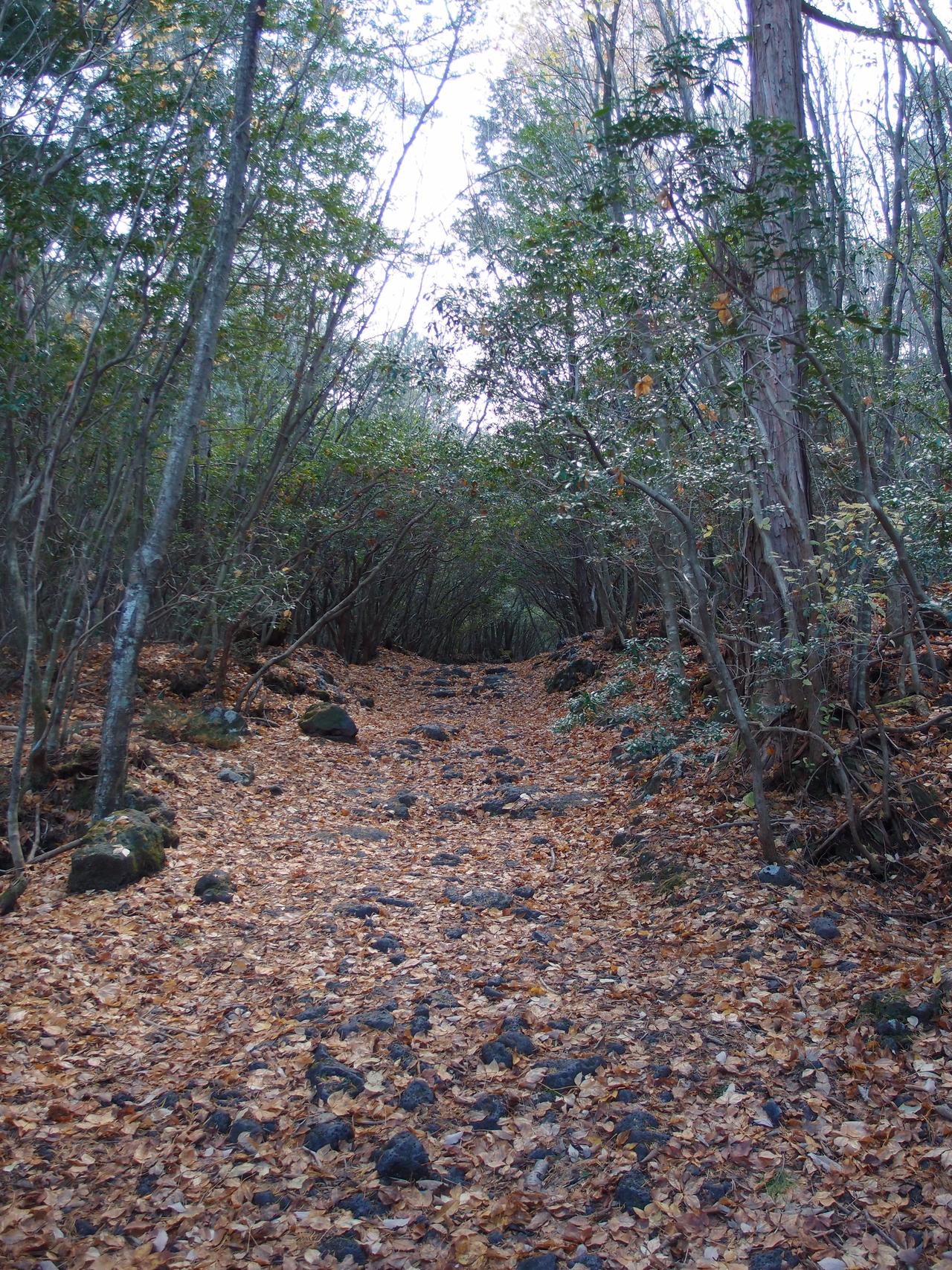
A Natural Trail in Aokigahara Forest (Flickr)
Newspaper reports and popular publications have at times provided detailed descriptions of locations within the forest; concrete details regarding position and access have circulated widely. Over time, television programs, documentaries, online videos, and personal blogs have linked Aokigahara with narratives of “silent and invisible death,” propelling the image into global circulation. Within this circulation, local practices such as suicide prevention hotlines and informational signs have been implemented in the forest, and periods of intervention by civil and institutional actors have been documented.
The historical image of Aokigahara emerged through a layered process beginning with local naming and geographical characteristics, then accumulating through popular literature, journalistic language, and audiovisual content. The term “suicide forest” is the result of this layering; it has become a lasting cultural image shaped by the cumulative impact of literary narratives, isolated incidents, media repetition, and online content.
It is notable that newspaper reports and popular publications often provide detailed descriptions of locations within the forest. Information on position, direction, and access has at times been conveyed through precise coordinates and landscape features; this representation has simultaneously revealed the forest’s enclosed texture as “Jukai” and its tangible elements (trails, lava tubes, cave entrances). In the 2000s, the forest became the subject of television programs, documentaries, and online videos, and was carried into global circulation through personal blogs and vlogs.
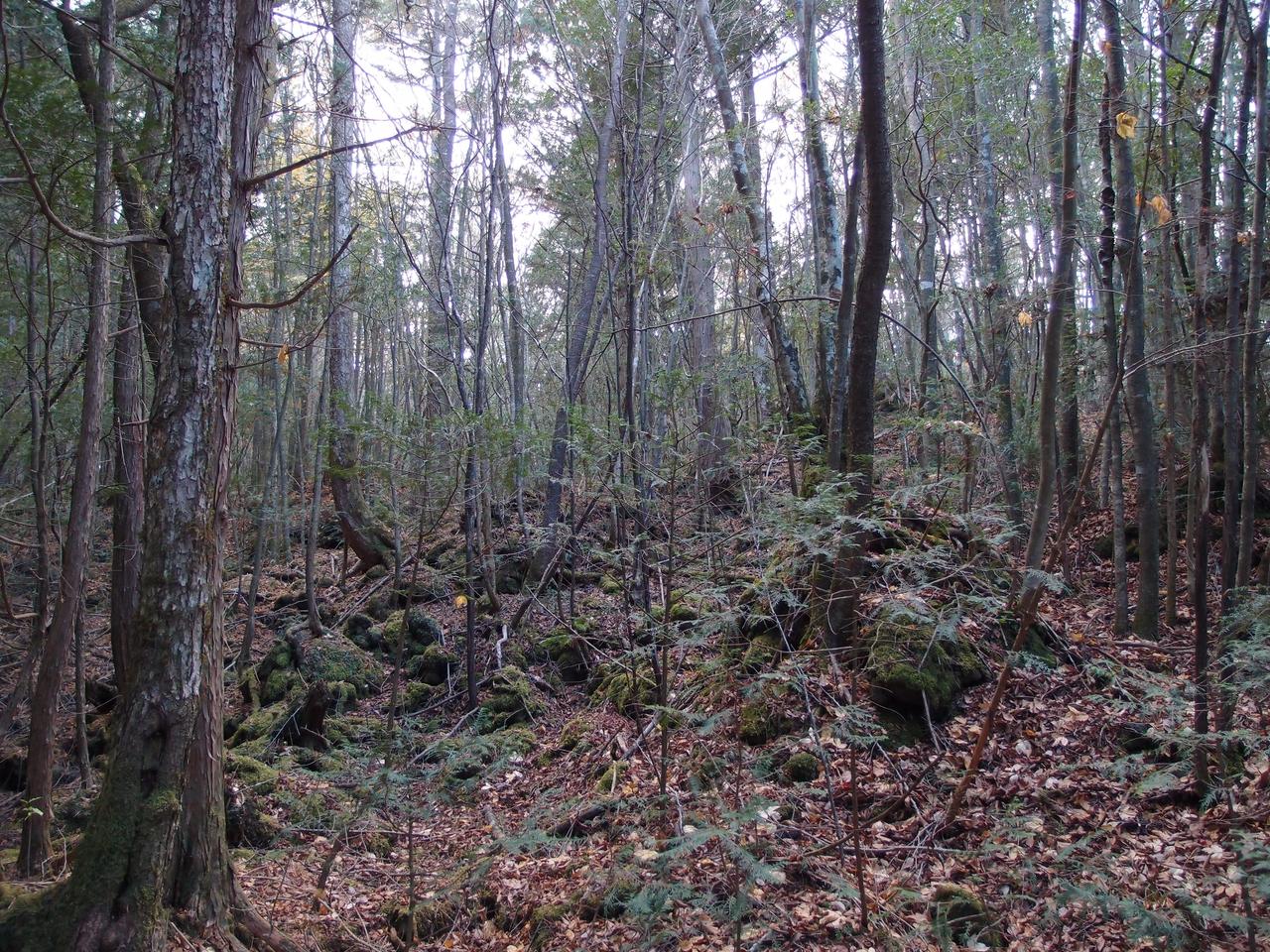
A Scene from Aokigahara Forest (Flickr)
In 2001, eleven suicide prevention call boxes were installed within the forest, containing informational notes emphasizing the physical and temporal reality of death in this environment. Local authorities and volunteers have noted that bodies found in the forest decompose rapidly due to decay and animal activity, and have called for periodic monitoring of the area.
One prominent work that increased Aokigahara’s visibility in popular culture is the film The Sea of Trees, directed by Gus Van Sant. The film received negative critical reception; its visual choices and thematic focus on disappearance were frequently discussed in reviews and exhibition contexts. In the film, Aokigahara is depicted as a setting where tools such as cell phones and compasses become useless, ropes and ribbons are used as trail markers, and internal caves and lava tubes serve as spatial elements of tension. This portrayal exemplifies popular narratives reinforcing the forest’s labyrinthine character.
Among records of field experiences, the observations of Hayano Azusa stand out; she spent years patrolling the forest and speaking with individuals contemplating suicide. Hayano’s patrol practices have been featured in documentaries, and her fictional writings, composed for various reasons, have left an imprint on the literary dimension of the forest’s image. In this context, online content creators’ recordings of the forest have also sparked debate in different periods; in January 2018, a video posting showing a corpse triggered a widespread public reaction concerning platform policies and content standards.
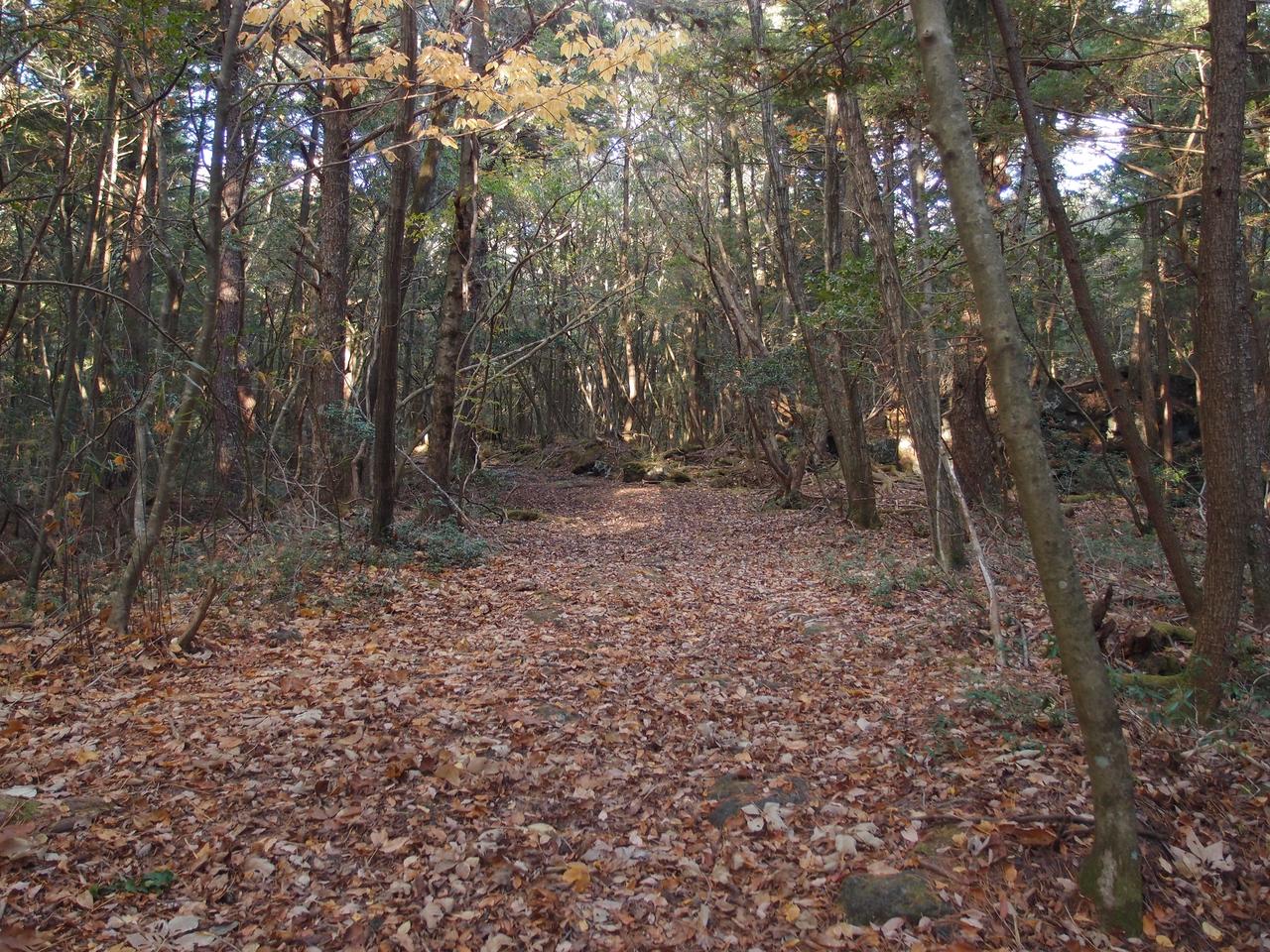
A Trail in Aokigahara Forest (Flickr)
Another dimension of Aokigahara’s cultural circulation can be traced through contemporary practices and analogies focused on the “visibility of suicide.” Physical deterrent systems and public communication examples developed in suicide hotspots outside Japan have been used as comparative material in reporting and commentary on Aokigahara. Meanwhile, site-specific warning signs, suicide prevention hotlines, and clearly marked trails in Aokigahara have been documented as local practices. Thus, Aokigahara has come to be recognized as an image set built around recurring motifs—silence, disappearance, return markers, cave entrances, dense tree cover—that span from literature to journalism, cinema to online production.
In the modern era, Aokigahara has been described as a focal point for narratives surrounding suicide in Japan, associated with images of “silent,” “invisible,” and “unintervened” death. Recorded suicide cases in the forest include hanging, carbon monoxide poisoning, drug overdose, and fatal substance abuse; the predominance of male victims mirrors national trends in Japan.
Within the forest, themes of “disappearance” and “vanishing,” combined with the possibility of the body remaining undiscovered, have been presented as compelling reasons for choosing the site. Layers of meaning such as “not being a burden,” “quiet withdrawal,” and “becoming invisible” appear in local narratives. Case accounts also record instances of psychogenic amnesia, mutual suicide agreements, and individuals entering the forest to confirm their decision, sometimes with the intention of surviving.
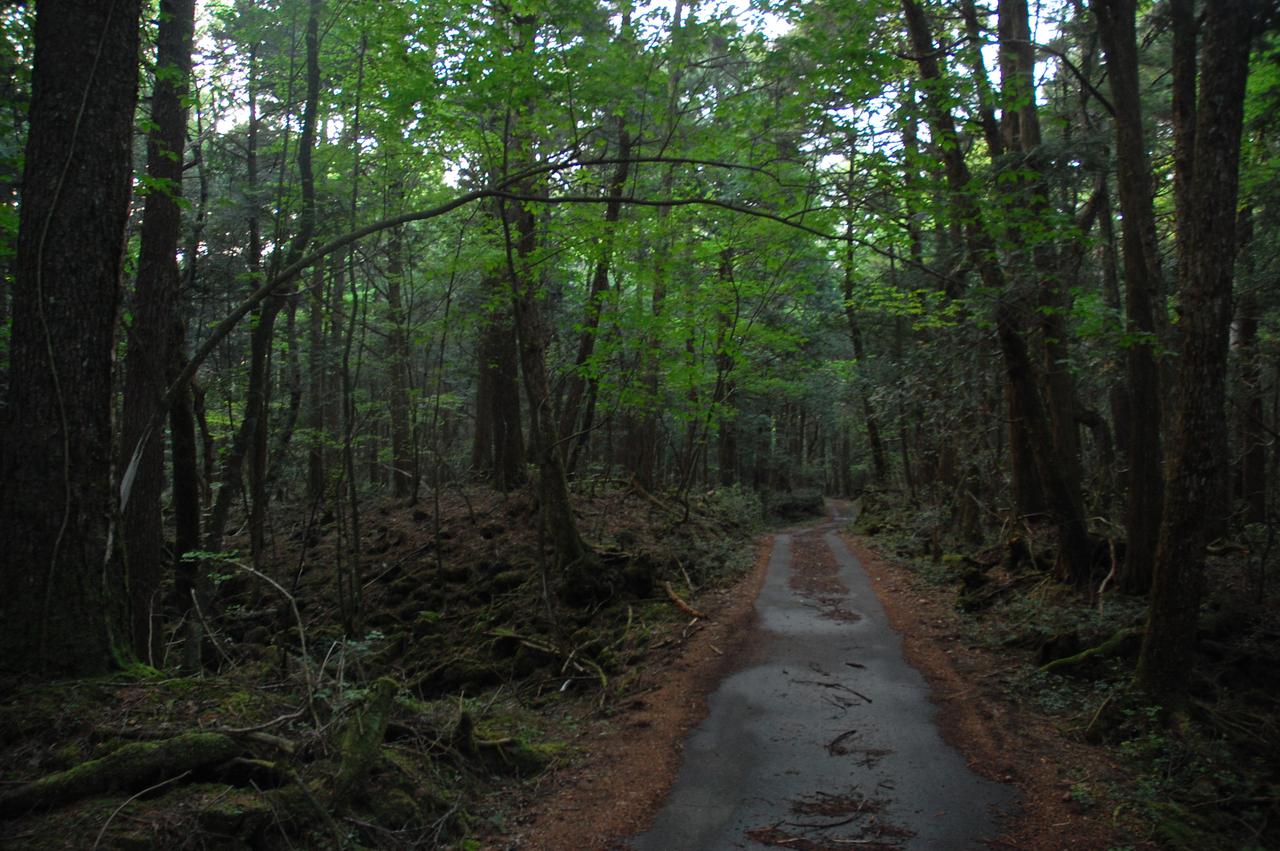
A Trail in Aokigahara Forest (Flickr)
A prominent element in Aokigahara’s image is the notion of the “chosen place,” reinforced by media and literary texts. Novels, television adaptations, newspaper reports, and online content have produced detailed descriptions of specific entrances, trails, and landscape features; these details have become recurring elements that reinforce the durability of the image.
In the context of World Health Organization guidelines on reporting suicide, the visibility of location details and the language of event reporting have become topics of discussion within Japanese journalistic practice. Mapping practices are also part of this visibility. In Japan, marking locations associated with suicide on maps in various publications has facilitated the recognition of “suicide sites” within literary and cultural memory.
In the 2000s, practices encountered in the forest included warning signs and call boxes linked to suicide prevention hotlines. These are visible along forest entrances and heavily used trails. Testimonies from volunteers and local officials who have patrolled the area for extended periods note that bodies decompose rapidly, are often disturbed by wildlife, and are not always collected regularly; suicide prevention calls and informational notices are accessible near trails. These observations have contributed to narratives in the social perception of Aokigahara that, alongside the image of “silent and invisible death,” also underscore the harsh reality of how and when bodies are found. These narratives aim to reduce suicide incidents.
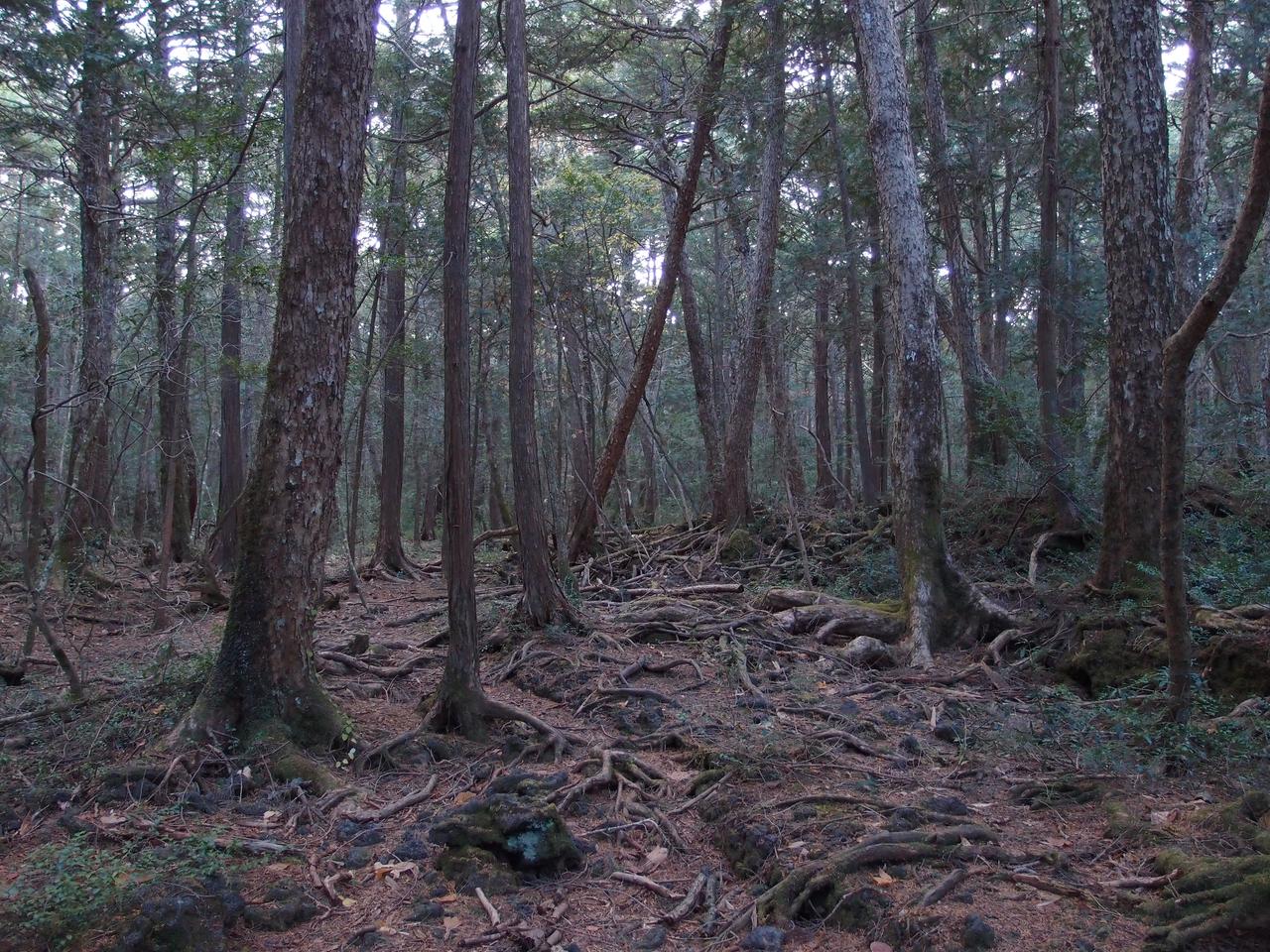
A Scene from Within Aokigahara Forest (Flickr)
Studies in Japan that evaluate suicide in relation to environmental variables provide an indirect background for understanding Aokigahara. Research conducted between 1999 and 2010, analyzing monthly suicide rates nationwide, incorporated geomagnetic activity indices (K-index) alongside factors such as sunspot cycles, unemployment rates, temperature, humidity, and day length. Statistical correlations between geomagnetic disturbances and suicide rates, particularly among men, were reported. While these findings are not specific to Aokigahara, they offer a framework for contextualizing Japanese suicide data in relation to seasonal natural and environmental variations.
Aokigahara is promoted alongside walking trails that develop around caves and lava tubes within Fuji-Hakone-Izu National Park. Sites such as Fugaku Fuketsu (Wind Cave), Narusawa Ice Cave, and Saiko Bat Cave serve as tangible waypoints in the forest experience; marked trails connected to these points help visitors avoid getting lost.
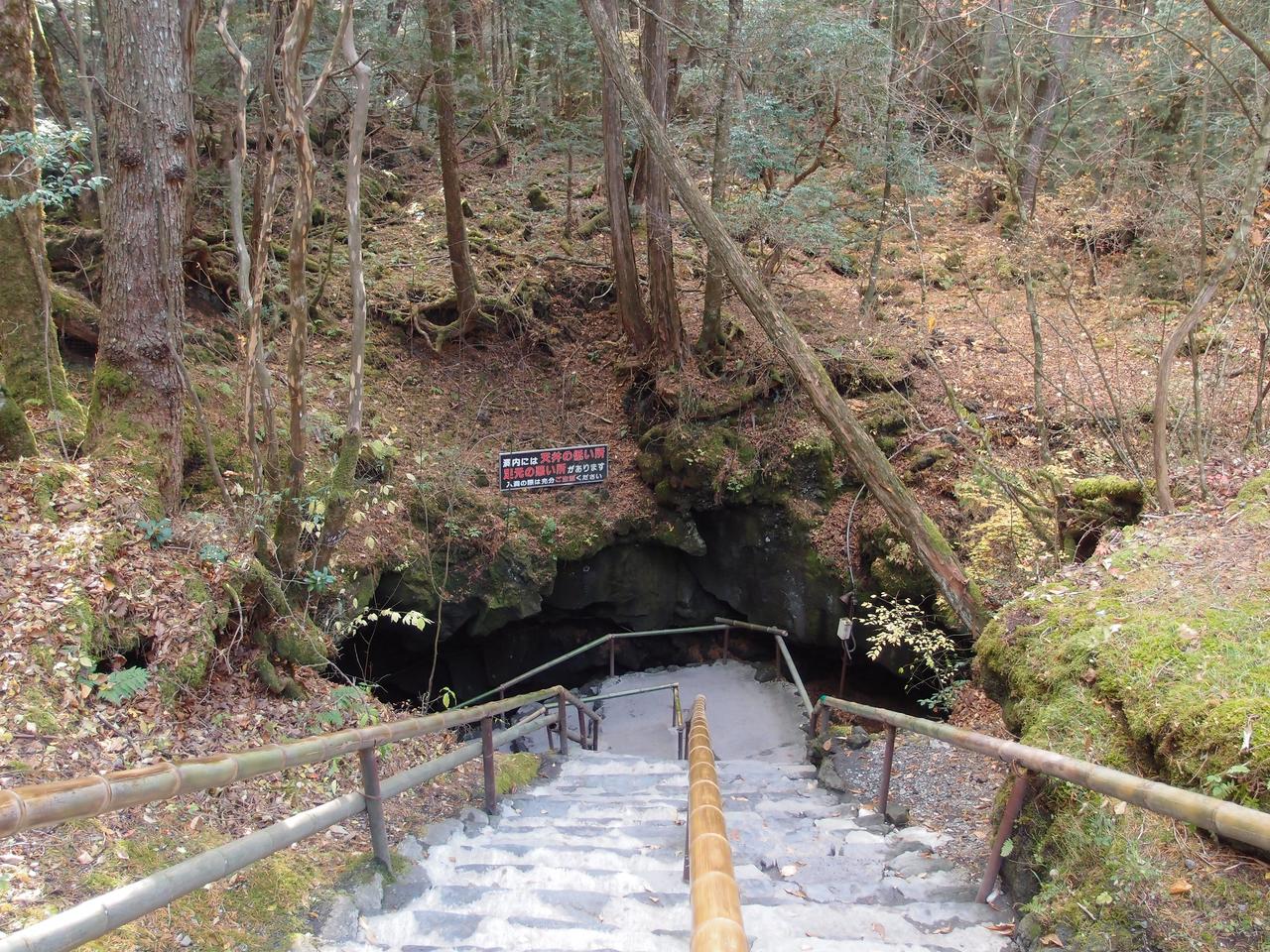
Wind Cave (Flickr)
Official promotional materials include information on geological formations, microclimate characteristics, and visit duration alongside walking routes and access descriptions. The forest’s trail system, due to intense shading and the rugged topography of the lava field, presents rapidly changing ground and lighting conditions over short distances; cave entrances are the primary points where this variability becomes visible.
The call boxes installed in 2001 are positioned along entrances and heavily used trails, containing informational notes that emphasize the physical and temporal reality of death in the forest. Due to the forest’s enclosed texture and difficulty of access, the patrol practices of local officials and volunteers appear in press reports and documentaries; these accounts describe how bodies decompose rapidly and how wildlife activity alters the landscape. Warning signs for visitors, emergency call messages, and clearly marked trails are recurring visual elements on-site.
The global circulation of Aokigahara’s image as the “suicide forest” is often framed in tourism literature as “dark tourism.” Popular programs, documentaries, and online videos repeatedly feature motifs such as cave entrances, ropes and ribbons, trail junctions, and dense tree canopies to depict the forest’s “labyrinthine” character. This visibility coexists alongside official promotions that emphasize the forest’s natural and geological features and safe pathways. In visitor narratives, wind and ice caves within the forest, entrances near Saiko Lake, and access points along the Minamitsuru route are frequently cited geographical locations.
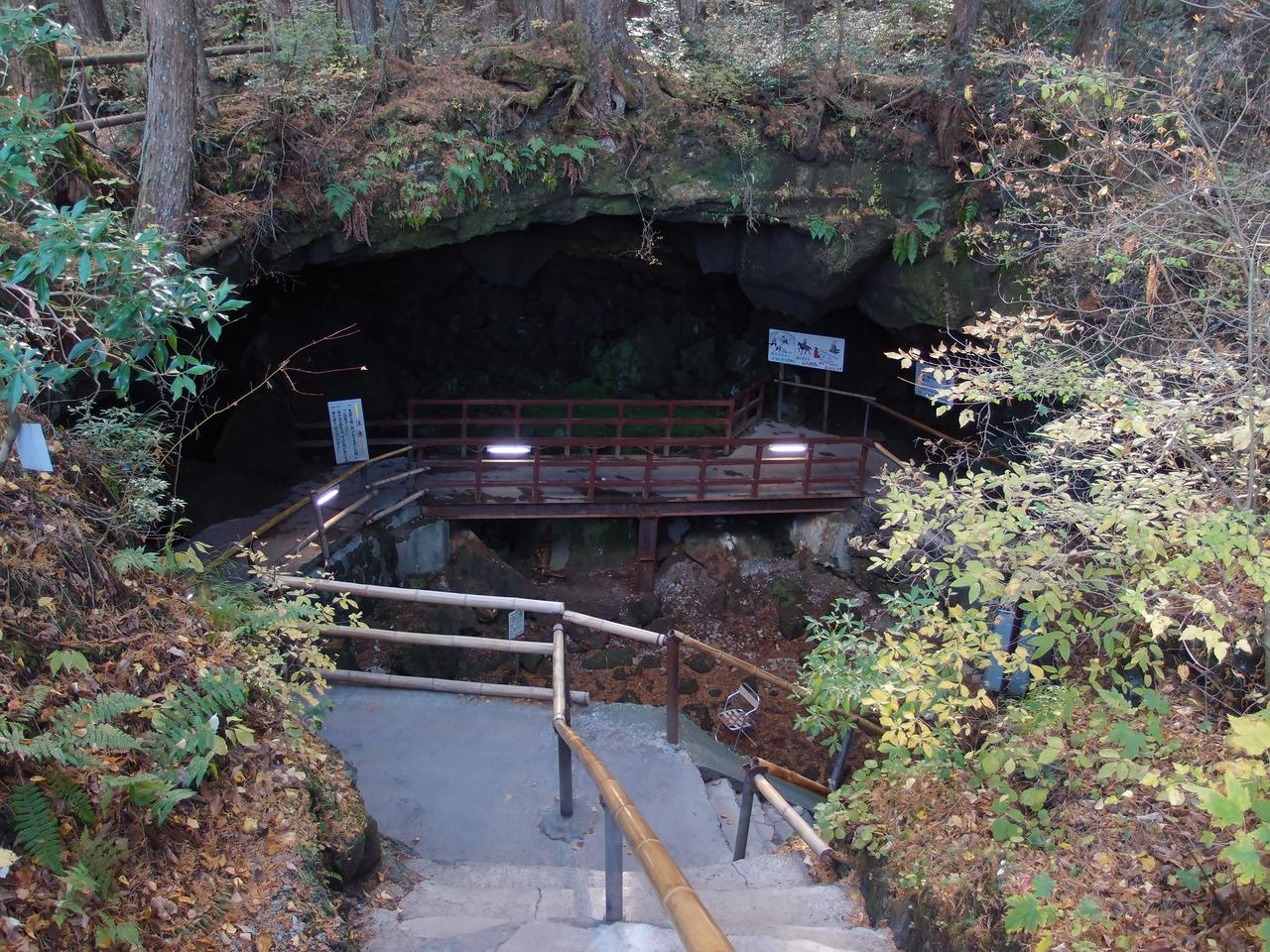
Ice Cave (Flickr)
In public communication and land management, how location and method details are conveyed in news language has periodically been a subject of debate. Local practices, including trail integrity, informational signs placed along entrances, and suicide prevention hotlines, reflect how the forest is simultaneously recognized as a natural area and as a space defined by a specific cultural image. Within this framework, Aokigahara maintains its identity as a visitation site where narratives of caves and geology converge with the dense-texture experience that sustains the name “Jukai.”
Ajari. “Aokigahara Forest.” Flickr, 13 November 2013. Accessed October 6, 2025.https://www.flickr.com/photos/25766289@N00/2875483296/
Bloomfield, Emma Frances. “Thanaviewing, the Aokigahara Forest, and Orientalism: Rhetorical Separations Between the Self and the Other in *The Forest*.” In *Virtual Dark Tourism*, April 2018. Accessed October 6, 2025.https://www.researchgate.net/publication/324708895_Thanaviewing_the_Aokigahara_Forest_and_Orientalism_Rhetorical_Separations_Between_the_Self_and_the_Other_in_The_Forest.
Cather, Kirsten. *Scripting Suicide in Japan.* Oakland: University of California Press, 2024. (New Interventions in Japanese Studies; 5). Accessed October 6, 2025.https://webfiles.ucpress.edu/oa/9780520400276_WEB.pdf.
Chang, Kathryn Yalan. “‘A Perfect Place to Die’: Thinking the EcoGothic, Darkness, and the Dark Sweet in Gus Van Sant’s *The Sea of Trees*.” *Southeast Asian Review of English* 59, no. 1 (July 2022): 88–109. Accessed October 6, 2025.https://www.researchgate.net/publication/362770085_A_Perfect_Place_to_Die_Thinking_the_EcoGothic_Darkness_and_the_Dark_Sweet_in_Gus_Van_Sant%27s_The_Sea_of_Trees.
Desmarais, Simon. “La Aokigahara Jukai (Mer des Arbres).” Flickr, 22 Mayıs 2010. Accessed October 6, 2025.https://www.flickr.com/photos/simonippon/4628501899/.
Devlin, Tara A. Aokigahara: The Truth Behind Japan’s Suicide Forest. First Edition. September 2019.
Gilhooly, Rob. “Inside Aokigahara, Japan’s ‘Suicide Forest’.” *The Japan Times*, June 26, 2011. Accessed October 6, 2025.https://www.japantimes.co.jp/life/2011/06/26/general/inside-japans-suicide-forest/
Hernández-Santaolalla, Víctor, and Paloma Sanz Marcos. “Following Death: Suicide as Tourist Attraction through Popular Culture.” *The Journal of Popular Culture* 52, no. 6 (December 2019): 1290–1311. Accessed October 6, 2025.https://rodin.uca.es/bitstream/handle/10498/30118/DEFINITIVO.pdf.
Liz Mc. "Aokigahara (suicide forest)." Flickr, May 27, 2018. Accessed October 6, 2025.https://www.flickr.com/photos/11638547@N00/42885146671/
Mionel, Viorel, and Oana Mionel. “Definitely Gets the Adrenaline Pumping! Fright and Dark Tourism in a Haunted Forest.” *Tourism Planning & Development* 22, no. 5 (2025): 755–777. Accessed October 6, 2025.https://www.tandfonline.com/doi/pdf/10.1080/21568316.2025.2476577
O’Kane, Megan Rose. *Geographies of Suicide and the Representation of Self-Sacrifice in Japanese Popular Culture and Media.* April 27, 2016. Accessed October 6, 2025.https://scgrg.co.uk/wp-content/uploads/2016/09/OKane-Belfast.pdf.
Research Works
Salazar, Gilberto Mejía. “Macabre Tourism in Japan: Case Study Aokigahara Forest and Nagoro Village.” *Journal of Global Tourism Research* 7, no. 2 (November 2022): 151–156. Accessed October 6, 2025.https://www.researchgate.net/publication/365032961_Macabre_tourism_in_Japan_Case_study_Aokigahara_Forest_and_Nagoro_Village
Tada, Harue, Tsutomu Nishimura, Eiji Nakatani, Kazuki Matsuda, Satoshi Teramukai, and Masanori Fukushima. “Association of Geomagnetic Disturbances and Suicides in Japan, 1999–2010.” *Environmental Health and Preventive Medicine* 19, no. 1 (January 2014): 64–71. Accessed October 6, 2025.https://pmc.ncbi.nlm.nih.gov/articles/PMC3890079/.
Takahashi, Yukio. “Aokigahara-Jukai: Suicide and Amnesia in Mt. Fuji’s Black Forest.” *Suicide and Life-Threatening Behavior* 18, no. 2 (Summer 1988): 164–175. Accessed October 6, 2025.https://pubmed.ncbi.nlm.nih.gov/3420643/
Vellut, Guilhem. “Aokigahara Forest.” Flickr, 13 November 2013. Accessed October 6, 2025.https://www.flickr.com/photos/o_0/10863114695/
Vellut, Guilhem. “Aokigahara Forest.” Flickr, 13 November 2013. Accessed October 6, 2025.https://www.flickr.com/photos/o_0/10863122085/
Vellut, Guilhem. “Aokigahara Forest.” Flickr, 13 November 2013. Accessed October 6, 2025.https://www.flickr.com/photos/o_0/10863125735/
Vellut, Guilhem. “Aokigahara Forest.” Flickr, 13 November 2013. Accessed October 6, 2025.https://www.flickr.com/photos/o_0/10863169686/
Vellut, Guilhem. “Aokigahara Forest.” Flickr, 13 November 2013. Accessed October 6, 2025.https://www.flickr.com/photos/o_0/10863170736/
Vellut, Guilhem. “Aokigahara Forest.” Flickr, 13 November 2013. Accessed October 6, 2025.https://www.flickr.com/photos/o_0/10863201036/
Vellut, Guilhem. “Aokigahara Forest.” Flickr, 13 November 2013. Accessed October 6, 2025.https://www.flickr.com/photos/o_0/10863202696/
Vellut, Guilhem. “Aokigahara Forest.” Flickr, 13 November 2013. Accessed October 6, 2025.https://www.flickr.com/photos/o_0/10863468883/
Vellut, Guilhem. “Entrance Ice Cave Aokigahara Forest.” Flickr, 13 November 2013. Accessed October 6, 2025.https://www.flickr.com/photos/o_0/10863265844/
Vellut, Guilhem. “Entrance Wind Cave Aokigahara Forest Aokigahara Forest.” Flickr, 13 November 2013. Accessed October 6, 2025.https://www.flickr.com/photos/o_0/10863287014/
Visual Sources
Waagner Mucha, Daniela. “An Analysis of Tourist Perception Before Visiting Dark Destination, a Case of ‘Suicide’ Forest, Japan.” *International Hospitality and Tourism Student Journal* 15, no. 4 (2023). Accessed October 6, 2025.https://www.sturesearch.ch/wp-content/uploads/Daniela-Waagner-Mucha.pdf
[1]
Eşik mekan, geçiş bölgelerini ifade eder. Örneğin, bir anayoldan bir ormana girildiğinde çok sesli ve görsel uyaranın bol olduğu bir alandan bir anda sessiz ve görsel uyaranların sınırlı olduğu bir bölgeye geçilmiş olur. Çevre bölgelerden Aokigahara ormanına giriş bu tip bir deneyime sebep olur.

Original Name | Aokigahara Forest (青木ヶ原樹海) | ||||||||
|---|---|---|---|---|---|---|---|---|---|
Other Name | Suicide Forest Jukai (Sea of Trees) | ||||||||
Location | Minamitsuru District Japan Yamanashi Prefecture | ||||||||
Protection Area | Fuji-Hakone-Izu National Park | ||||||||
Geological Structure | Forest cover developed on young basalt lava flows | ||||||||
Tourist Areas | Wind Cave Bat Cave Ice Cave | ||||||||
Vegetation Cover | Shallow root development near the ground surface Coniferous trees Thick layer of dead organic matter | ||||||||
Climatic Characteristics | High humidity Low wind Absorption of light and sound | ||||||||
Awareness | Individual and mass suicide cases | ||||||||
Measures | Help request points Warning signs Return markers such as ropes or ribbons | ||||||||
Geography and Ecology
Historical Background and Naming
Aokigahara in Literature, Media, and Popular Culture
Suicide and Social Perception
Visitation, Conservation, and Tourism