Registration Number | 433 | ||||||||
|---|---|---|---|---|---|---|---|---|---|
Registration Date | June 18, 2019 | ||||||||
Applicant/Registrant(s) | Gaziantep Commodity Exchange | ||||||||
Province(s) | Gaziantep | ||||||||
Product / Product Group(s) | Bakery and Pastry Products Sweets Dough-Based Foods | ||||||||
Type of Geographical Indication | Geographical Indication | ||||||||
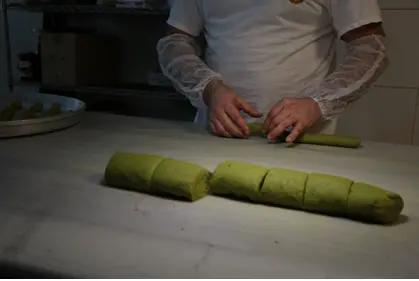
Antep Kurabiyesi is a traditional bakery product from Gaziantep cuisine, made with semolina and clarified butter (sadeyağ), available in plain or pistachio varieties. Registered as a Geographical Indication on June 18, 2019, under Law No. 6769 on Industrial Property by the Gaziantep Commodity Exchange, it is a hallmark of Gaziantep’s cultural identity, particularly associated with Bayram (holiday) celebrations. The plain variety is locally known as “Bayram Kurabiyesi” (holiday cookie).
The kurabiye is distinguished by its use of geographically indicated Şanlıurfa sadeyağ and early-harvest “boziç” Antep pistachios, alongside locally sourced semolina and flour. The plain variety is shaped into crescents, while the pistachio version is formed into short, straight pieces. It maintains freshness for up to one month in cool, dry conditions.
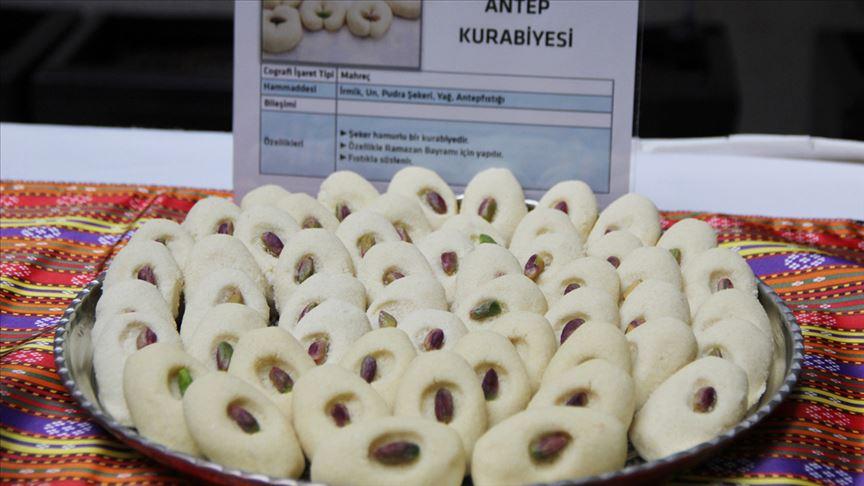
Antep Kurabiyesi (AA)
Traditional stone ovens are commonly used for baking. Due to their fragile texture, kurabiyes are packaged side by side after cooling.
Antep Kurabiyesi’s production is tied to Gaziantep due to its use of local ingredients and traditional methods, requiring all stages to occur within the province. Inspections, coordinated by the Gaziantep Commodity Exchange, are conducted at least annually, verifying production location, ingredient ratios, and compliance with geographical indication standards. Reports are submitted to the Turkish Patent and Trademark Office.
Anadolu Ajansı. "Antep Kurabiyesi Coğrafi İşaret Olarak Tescillendi." Anadolu Ajansı. Accessed October 21, 2025. https://www.aa.com.tr/tr/turkiye/antep-kurabiyesi-cografi-isaret-olarak-tescillendi-/1518439.
Türk Patent ve Marka Kurumu. "Antep Kurabiyesi." Türk Patent ve Marka Kurumu. Accessed October 21, 2025. https://ci.turkpatent.gov.tr/cografi-isaretler/detay/38510.
Türk Patent ve Marka Kurumu. Antep Kurabiyesi. Türk Patent ve Marka Kurumu. Accessed October 21, 2025. https://ci.turkpatent.gov.tr/Files/GeographicalSigns/8ba51fcc-4f8e-473a-ab02-8a4988c8770f.pdf.

Registration Number | 433 | ||||||||
|---|---|---|---|---|---|---|---|---|---|
Registration Date | June 18, 2019 | ||||||||
Applicant/Registrant(s) | Gaziantep Commodity Exchange | ||||||||
Province(s) | Gaziantep | ||||||||
Product / Product Group(s) | Bakery and Pastry Products Sweets Dough-Based Foods | ||||||||
Type of Geographical Indication | Geographical Indication | ||||||||
Ingredient Characteristics
Composition
Preparation Process
Geographical Boundary and Inspection
This article was created with the support of artificial intelligence.