Registration Number | 1067 | ||||||||
|---|---|---|---|---|---|---|---|---|---|
Registration Date | 07.04.2022 | ||||||||
Applicant/Registrant(s) | Gaziantep Commodity Exchange | ||||||||
Province(s) | Gaziantep | ||||||||
Type of Geographical Indication | Geographical Indication | ||||||||
Product / Product Group(s) | Processed and Unprocessed Fruits and Vegetables and Mushrooms | ||||||||
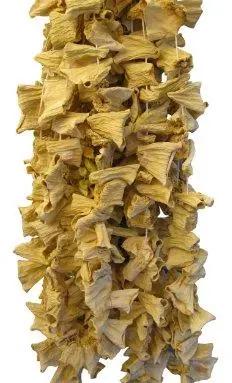
Antep Haylan Kabağı Kurusu is a traditional dried vegetable product unique to Gaziantep, made from the haylan gourd (Lagenaria siceraria L.). Registered as a Geographical Indication on April 7, 2022, under Law No. 6769 on Industrial Property by the Gaziantep Commodity Exchange, it is a staple of Gaziantep’s winter food preservation culture.
The dried product is hard, crisp, and brittle, with a light green-yellowish outer surface free of spots, cracks, or sunburn. The interior is lighter in color, with seeds and inner flesh fully removed, and uniformly dried. It has an elliptical, curved, and twisted shape, measuring 6–7 cm in length, 1–2 mm in thickness, and 4–5 cm in width. The dry matter content is approximately 5–6%.
Haylan gourd is grown in Gaziantep’s loamy soils, rich in organic matter with high water retention and permeability. Seedlings are planted with 60–80 cm row spacing and 50–60 cm within rows. Harvesting occurs from August to mid-September, during morning and evening hours, with fruits cut from their stems.
The gourds are washed, stemmed, peeled, and sliced lengthwise into two or three pieces, with the inner flesh hollowed out. Each piece is threaded onto cotton strings in groups of 50, with the open side facing down. These strings are hung on tripod-shaped wooden racks positioned to maximize sunlight exposure. Drying takes place in August and September at 30–35°C with wind speeds of 19–28 km/h, continuing until the moisture content reaches 5%. The process lasts 4–7 days, depending on weather conditions.
Dried strings are tied at the ends and stored in cool, dry environments with 50–55% relative humidity and temperatures of 15–18°C, where they can be preserved for up to one year.
Production is restricted to Gaziantep province, reflecting the product’s deep ties to the region’s culinary heritage. This cultural connection underpins its Geographical Indication designation.
Compliance with geographical indication standards is overseen by a committee coordinated by the Gaziantep Commodity Exchange, including representatives from the Gaziantep Gastronomy and Tourism Association and the Gastronomy and Culinary Arts Department of Gaziantep University’s Faculty of Fine Arts. Inspections occur at least annually, with additional checks as needed or in response to complaints.
Criteria include verification of production location records, adherence to product characteristics, compliance with the production method, and proper use of the Geographical Indication.
Türk Patent ve Marka Kurumu. "Antep Haylan Kabağı Kurusu / Gaziantep Haylan Kabağı Kurusu Coğrafi İşaret Sicil Belgesi." Coğrafi İşaretler Portalı. Accessed October 21, 2025. https://ci.turkpatent.gov.tr/Files/GeographicalSigns/7d46a3c3-a16f-4b0b-b5a4-8c53e4885791.pdf.
Türk Patent ve Marka Kurumu. "Antep Haylan Kabağı Kurusu / Gaziantep Haylan Kabağı Kurusu." Coğrafi İşaretler Portalı. Accessed October 21, 2025. https://ci.turkpatent.gov.tr/cografi-isaretler/detay/38444.

Registration Number | 1067 | ||||||||
|---|---|---|---|---|---|---|---|---|---|
Registration Date | 07.04.2022 | ||||||||
Applicant/Registrant(s) | Gaziantep Commodity Exchange | ||||||||
Province(s) | Gaziantep | ||||||||
Type of Geographical Indication | Geographical Indication | ||||||||
Product / Product Group(s) | Processed and Unprocessed Fruits and Vegetables and Mushrooms | ||||||||
No Discussion Added Yet
Start discussion for "Antep Haylan Kabağı Kurusu / Gaziantep Haylan Kabağı Kurusu" article
Production Method
Geographical Boundary and Cultural Connection
Inspection Process
This article was created with the support of artificial intelligence.