


This article was automatically translated from the original Turkish version.

Anomaly Detection
Basic Type | Point Anomaly Collective Anomaly Contextual Anomaly | ||||||||
|---|---|---|---|---|---|---|---|---|---|
Application Area(s) | Finance Health Cyber Security Defense Industry Technologies Energy Systems Production Systems | ||||||||
Related Field | Cyber Security Artificial Intelligence Data Mining Machine Learning Embedded Systems | ||||||||
Anomaly Detection (Eng. Anomaly Detection), often used synonymously with outlier detection, is an analytical approach used to identify unusual behaviors in complex systems across various disciplines. This technique is based on detecting observations that deviate significantly from the general behavioral patterns in a dataset. Although such anomalies are rarely observed, they have the potential to cause serious consequences in critical areas such as system security, operational continuity, and healthcare.
In today’s technological infrastructures, the continuous growth in data volume and system complexity has made anomaly detection a strategic necessity. In many fields—including defense technologies, cybersecurity, finance, healthcare, energy systems, industrial automation, and smart city applications—it is essential to monitor system behavior and detect abnormal conditions in real time.
Anomalies observed in data are typically exceptional cases that deviate from the system’s normal behavioral patterns. Such deviations can indicate a variety of causes, including hardware failures, security breaches, or uncontrolled environmental influences. Anomalies are generally classified into three main categories:
A point-based anomaly occurs when a single observation in a dataset is clearly distinct from all other observations. For example, a temperature sensor recording an unusually high value of 100°C at a specific moment falls into this category. Such anomalies often arise from erroneous data input, hardware malfunction, or sudden environmental changes.
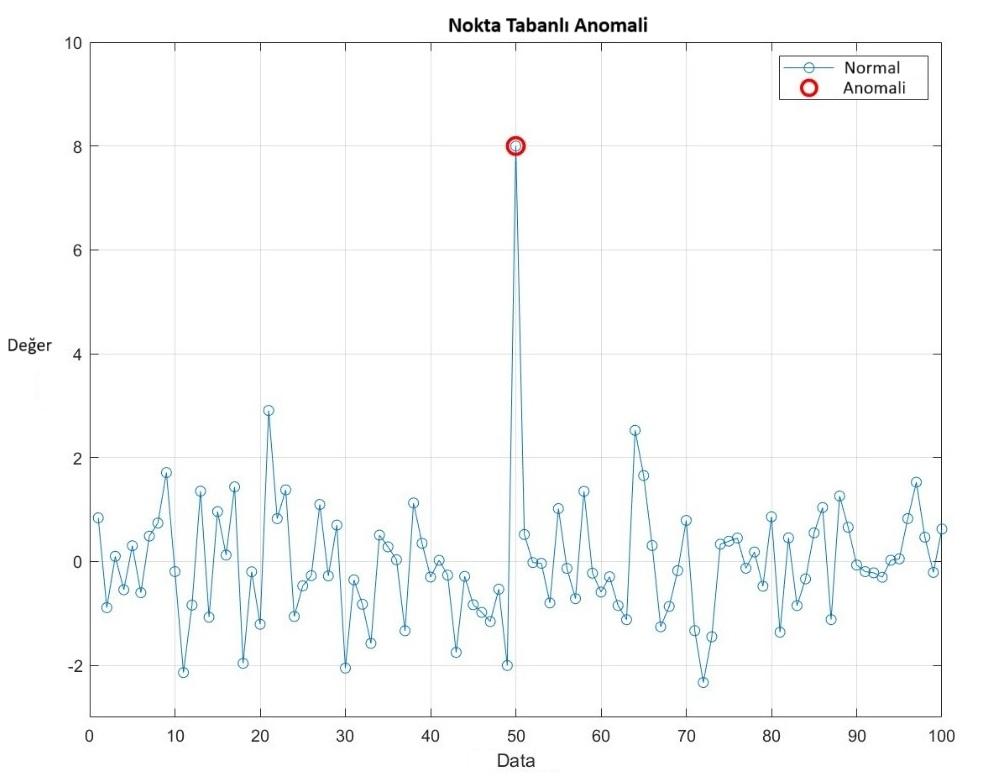
Nokta Tabanlı Anomali Örneği - Grafiksel Temsil (Mehmet Alperen Bakıcı)
A collective anomaly is identified when a group of data points, when analyzed together, form an unexpected pattern. These anomalies involve datasets that individually appear normal but collectively exhibit abnormal behavior. For instance, a large number of low-volume data transfers occurring simultaneously on a network may seem innocuous but could be part of a DDoS attack.
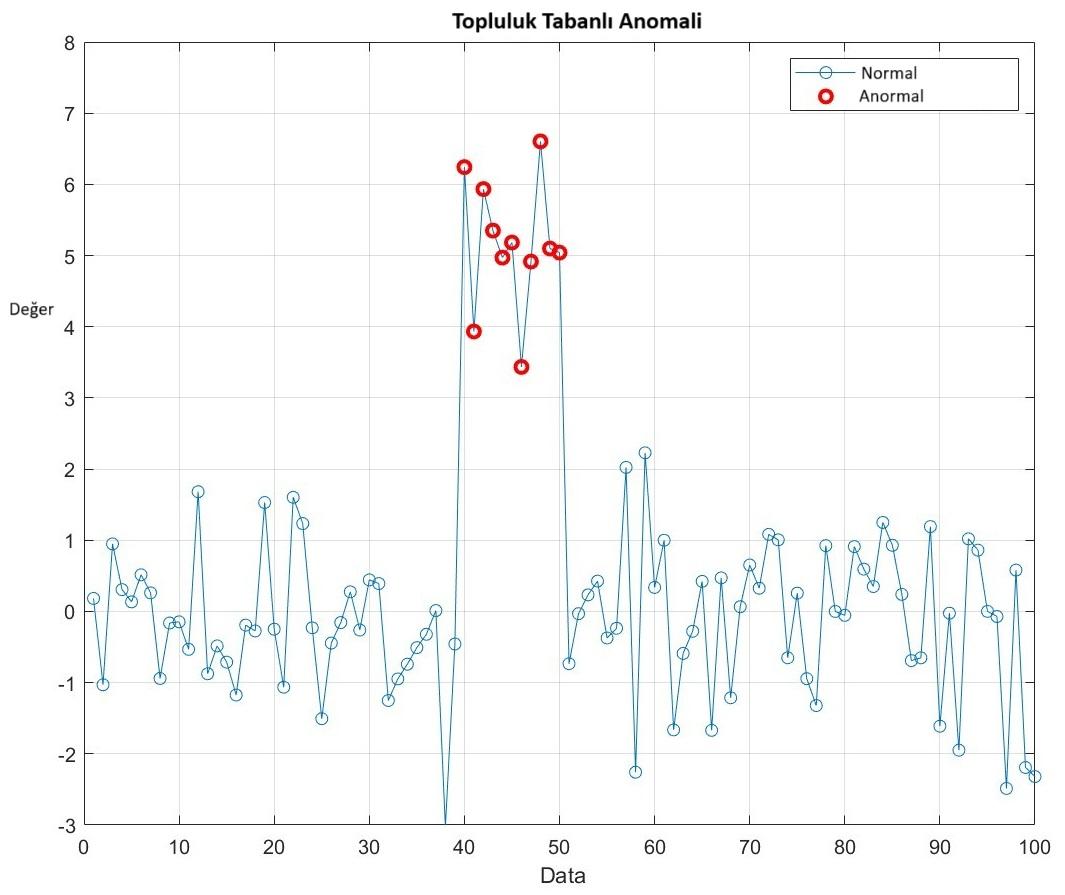
Topluluk Tabanlı Anomali Örneği - Grafiksel Temsil (Mehmet Alperen Bakıcı)
An observation that may be considered normal in isolation can be deemed abnormal under specific contextual conditions. These anomalies vary depending on contextual factors such as time, geography, or user type. For example, high electricity consumption during daytime hours in a factory is considered normal, but the same level of consumption during the night shift would be considered abnormal.
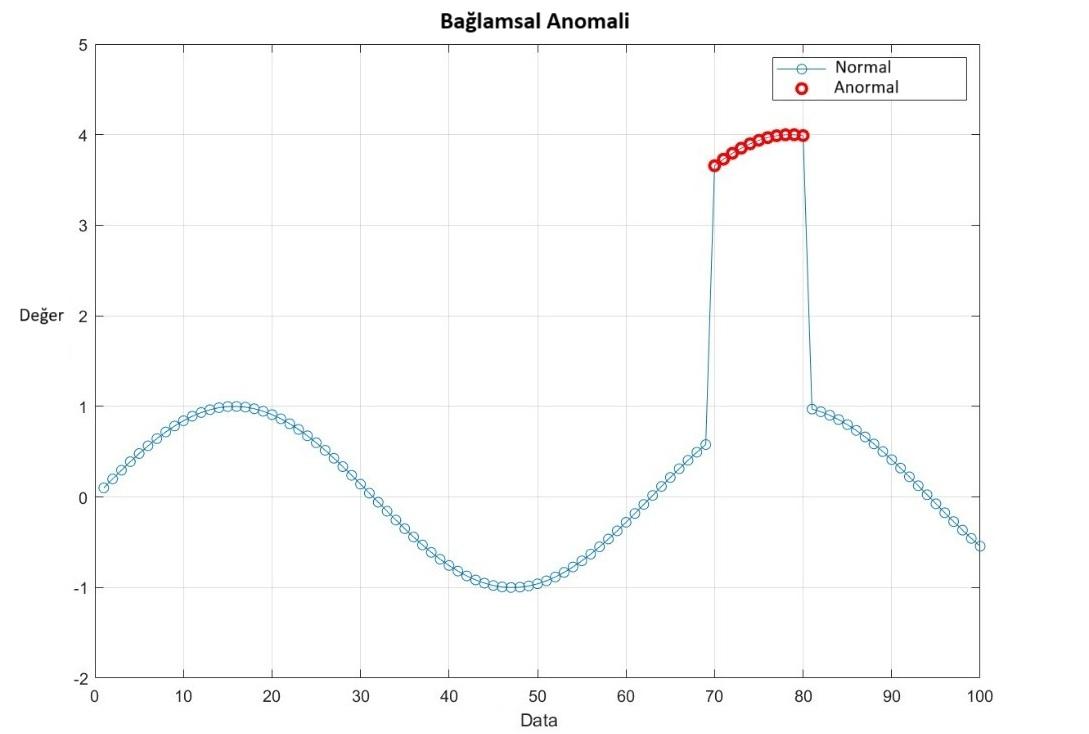
Bağlamsal Anomali Örneği - Grafiksel Temsil (Mehmet Alperen Bakıcı)
Anomaly detection is no longer limited to analyzing deviations in historical data; it now plays a decisive role in real-time monitoring, predictive maintenance, and autonomous system optimization. It has become a critical component across diverse sectors for security, operational efficiency, and decision support systems.
Cyberattacks often begin with abnormal behaviors hidden within normal traffic patterns. Anomaly detection systems:
Credit card fraud, fake transactions, or money laundering rely on identifying anomalous financial behaviors. Financial fraud typically begins with exceptional transaction patterns. Anomaly detection:
In patient monitoring systems, anomalies such as irregular heart rhythms, breathing irregularities, or sensor malfunctions can be identified through anomaly detection. Wearable technologies and IoT medical devices generate continuous streams of data.
Anomaly detection systems:
In modern production lines, thousands of sensors continuously provide data streams. Anomaly detection:
Used to detect sudden changes in electricity consumption, frequency imbalances, or grid faults. In electricity, natural gas, and renewable energy networks, anomaly detection:
Events such as sudden increases in traffic congestion, unusual route usage, or sensor failures can be identified. In traffic, public transportation, and logistics networks, anomaly detection:
Chandola, Varun, Arindam Banerjee, and Vipin Kumar. “Anomaly Detection: A Survey.” *ACM Computing Surveys (CSUR)* 41, no. 3 (2009): 1–58.https://dl.acm.org/doi/abs/10.1145/1541880.1541882
DataCamp. “Introduction to Anomaly Detection.” DataCamp Tutorials. Accessed May 15, 2025.https://www.datacamp.com/tutorial/introduction-to-anomaly-detection
Ghamry, F. M., G. M. El-Banby, A. S. El-Fishawy, F. E. A. El-Samie, and M. I. Dessouky. “A Survey of Anomaly Detection Techniques.” *Journal of Optics* (2024): 1–19.https://link.springer.com/article/10.1007/s12596-023-01147-4
IBM. "Anomaly Detection." IBM Think Blog. Accessed May 15, 2025.https://www.ibm.com/think/topics/anomaly-detection.

Anomaly Detection
Basic Type | Point Anomaly Collective Anomaly Contextual Anomaly | ||||||||
|---|---|---|---|---|---|---|---|---|---|
Application Area(s) | Finance Health Cyber Security Defense Industry Technologies Energy Systems Production Systems | ||||||||
Related Field | Cyber Security Artificial Intelligence Data Mining Machine Learning Embedded Systems | ||||||||
Types of Anomalies
Point-based Anomaly
Collective Anomaly
Contextual Anomaly
Application Areas
Cybersecurity
Finance and Digital Payment Systems
Healthcare
Industry 4.0 and Production Automation
Energy Systems
Transportation and Smart City Systems